
与皮肤和软组织感染(SSTI)疾病组相关的金黄色葡萄球菌的抗生素敏感性和基因组变异
Antibiotic susceptibility and genomic variations in Staphylococcus aureus associated with Skin and Soft Tissue Infection (SSTI) disease groups.
作者信息
Changchien Chih-Hsuan, Chen Shu-Wun, Chen Ying-Ying, Chu Chishih
机构信息
Department of Plastic and Reconstructive Surgery, Chiayi Christian Hospital, 539 Jhongsiao Rd., Chiayi City, 60002, Taiwan, Republic of China.
Department of Microbiology, Immunology, and Biopharmaceuticals, National Chiayi University, No 300, University Road, Chiayi, 60004, Taiwan, Republic of China.
出版信息
BMC Infect Dis. 2016 Jun 10;16:276. doi: 10.1186/s12879-016-1630-z.
BACKGROUND
Staphylococcus aureus is associated with human skin and soft tissue infections (SSTIs); however, the involvement of virulence factors in different clinical presentations is unclear.
METHODS
We analyzed methicillin-resistant S. aureus (MRSA) and methicillin-sensitive S. aureus (MSSA) strains from Taiwan to determine correlations among the clinical characteristics of SSTIs, antimicrobial susceptibility and virulence factors of S. aureus with specific genetic backgrounds.
RESULTS
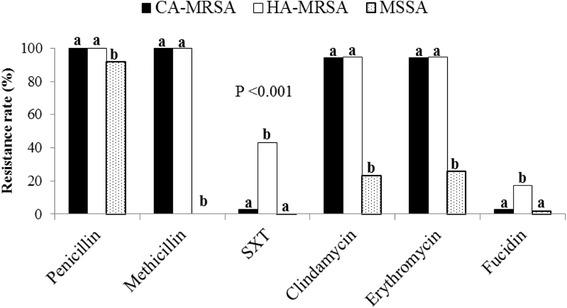
We identified 177 MRSA isolates and 130 MSSA isolates among the 307 SSTI-associated S. aureus isolates. Hospital-acquired (HA)- and community-acquired (CA)-MRSA isolates accounted for 61.6 % and 38.4 % of the isolates, respectively. Clinical presentations in SSTI patients differed significantly for the disease groups. Deep-seated MRSA infections presented with higher amputation rate than MSSA infections. MRSA isolates were all susceptible to linezolid, teicoplanin, and vancomycin, and >94 % of isolates were erythromycin- and clindamycin-resistant. Staphylococcal cassette chromosome (SCCmec) types IV, V, and VII were the most frequent in the CA-MRSA group (n = 68); types III, IV and V were the most frequent in the HA-MRSA group (n = 109). Panton-Valentine leukocidin (PVL) genes were significantly more frequent in CA-MRSA strains (75.0 %) than in HA-MRSA (33.0 %) and MSSA (24.6 %) and were found in 66.7 % (74/111) strains isolated from the abscess group. Exfoliatin A genes were more common in catheter-related exit-site MSSA infections (37.5 %) compared with other MSSA disease groups (P < 0.05). Exfoliatin B and superantigen exotoxin genes were uncommon in all SSTI disease types. Pulsotypes A (ST239), C, and D (ST59) were the predominant MRSA genotypes in deep-seated infections.
CONCLUSIONS
If not treated appropriately, deep-seated MRSA-associated infections present with higher amputation rates than deep-seated MSSA-associated infections. PVL-positive MRSA strains caused more frequently pus-forming lesions and less bacteremia and invasive diseases. Methods for discriminating CA-MRSA from HA-MRSA strains are now unreliable due to circulation of both ST 239 and ST 59 strains in the community and nosocomial settings. Initial antibiotic treatments should consider MRSA for patients with SSTIs in areas where MRSA is prevalent.
背景
金黄色葡萄球菌与人类皮肤及软组织感染(SSTIs)相关;然而,毒力因子在不同临床表现中的作用尚不清楚。
方法
我们分析了来自台湾的耐甲氧西林金黄色葡萄球菌(MRSA)和甲氧西林敏感金黄色葡萄球菌(MSSA)菌株,以确定具有特定遗传背景的金黄色葡萄球菌SSTIs临床特征、抗菌药敏性和毒力因子之间的相关性。
结果
在307株与SSTI相关的金黄色葡萄球菌分离株中,我们鉴定出177株MRSA分离株和130株MSSA分离株。医院获得性(HA)-和社区获得性(CA)-MRSA分离株分别占分离株的61.6%和38.4%。SSTI患者的临床表现因疾病组而异。深部MRSA感染的截肢率高于MSSA感染。MRSA分离株对利奈唑胺、替考拉宁和万古霉素均敏感,>94%的分离株对红霉素和克林霉素耐药。葡萄球菌盒式染色体(SCCmec)IV型、V型和VII型在CA-MRSA组(n = 68)中最常见;III型、IV型和V型在HA-MRSA组(n = 109)中最常见。杀白细胞素(PVL)基因在CA-MRSA菌株(75.0%)中比在HA-MRSA(33.0%)和MSSA(24.6%)中更常见,并且在从脓肿组分离的66.7%(74/111)菌株中发现。与其他MSSA疾病组相比,表皮剥脱毒素A基因在导管相关出口部位MSSA感染中更常见(37.5%)(P < 0.05)。表皮剥脱毒素B和超抗原外毒素基因在所有SSTI疾病类型中均不常见。脉冲型A(ST239)、C和D(ST59)是深部感染中主要的MRSA基因型。
结论
如果治疗不当,深部MRSA相关感染的截肢率高于深部MSSA相关感染。PVL阳性MRSA菌株更常引起化脓性病变,菌血症和侵袭性疾病较少。由于ST 239和ST 59菌株在社区和医院环境中的传播,目前区分CA-MRSA和HA-MRSA菌株的方法不可靠。在MRSA流行地区,对于SSTI患者,初始抗生素治疗应考虑MRSA。
 Zotero 插件