
慢性病、身体功能、活动受限与参与限制之间的关联:西班牙非临床人群的横断面研究方法。
Associations between chronic conditions, body functions, activity limitations and participation restrictions: a cross-sectional approach in Spanish non-clinical populations.
作者信息
Rodríguez-Blázquez Carmen, Damián Javier, Andrés-Prado María José, Almazán-Isla Javier, Alcalde-Cabero Enrique, Forjaz Maria João, Castellote Juan Manuel, González-Enríquez Jesús, Martínez-Martín Pablo, Comín Magdalena, de Pedro-Cuesta Jesús
机构信息
National Centre for Epidemiology and Consortium for Biomedical Research in Neurodegenerative Diseases (Centro de Investigación Biomédica en Red sobre Enfermedades Neurodegenerativas/CIBERNED), Carlos III Institute of Health, Madrid, Spain.
Admissions Department, Gómez Ulla Hospital, Madrid, Spain.
出版信息
BMJ Open. 2016 Jun 14;6(6):e010446. doi: 10.1136/bmjopen-2015-010446.
OBJECTIVES
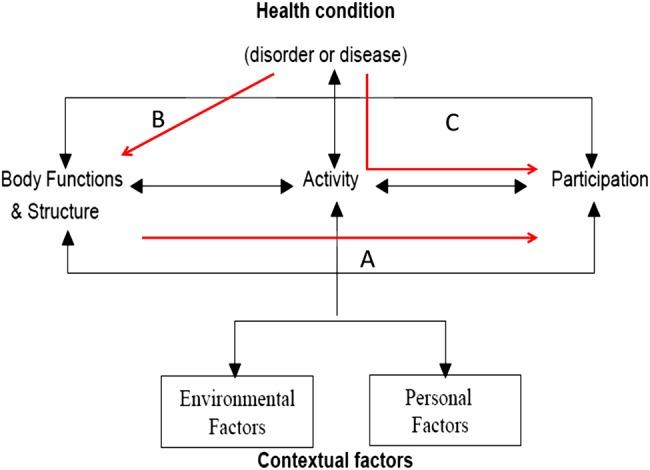
To analyse the relationships between chronic conditions, body functions, activity limitations and participation restrictions in the International Classification of Functioning, Disability and Health (ICF) framework.
DESIGN
A cross-sectional study.
SETTING
2 geographical areas in the Autonomous Region of Aragon, Spain, namely, a rural area, Cinco Villas, and an urban area in the city of Zaragoza.
PARTICIPANTS
864 individuals selected by simple random sampling from the register of Social Security card holders, aged 50 years and over, positive to disability screening.
MAIN OUTCOME MEASURES
ICF Checklist-body function domains, WHO Disability Assessment Schedule 2.0 (WHODAS 2.0, 36-item (WHODAS-36)) global scores and medical diagnoses (chronic conditions) from primary care records.
RESULTS
Mild disability (WHODAS-36 level 5-24%) was present in 51.5% of the sample. In the adjusted ordinal regression model with WHODAS-36 as the dependent variable, disability was substantially associated with moderate-to-complete impairment in the following functions: mental, OR 212.8 (95% CI 72 to 628.9); neuromusculoskeletal, OR 44.8 (24.2 to 82.8); and sensory and pain, OR 6.3 (3.5 to 11.2). In the relationship between health conditions and body function impairments, the strongest links were seen for: dementia with mental functions, OR 50.6 (25.1 to 102.1); cerebrovascular disease with neuromusculoskeletal function, OR 5.8 (3.5 to 9.7); and chronic renal failure with sensory function and pain, OR 3.0 (1.49 to 6.4). Dementia, OR 8.1 (4.4 to 14.7) and cerebrovascular disease, OR 4.1 (2.7 to 6.4) were associated with WHODAS-36 scores.
CONCLUSIONS
Body functions are heterogeneously linked to limitations in activities and restrictions on participation, with the highest impact being due to mental and musculoskeletal functions. This may be relevant for disability assessment and intervention design, particularly if defined on a body function basis. Control of specific health conditions, such as dementia and cerebrovascular disease, appears to be paramount in reducing disability among persons aged 50 years and over.
目的
在国际功能、残疾和健康分类(ICF)框架下分析慢性病、身体功能、活动受限及参与限制之间的关系。
设计
一项横断面研究。
地点
西班牙阿拉贡自治区的2个地理区域,即农村地区辛科比利亚斯和萨拉戈萨市的一个城市区域。
参与者
从社会保障卡持有者登记册中通过简单随机抽样选取的864名个体,年龄在50岁及以上,残疾筛查呈阳性。
主要观察指标
ICF检查表-身体功能领域、世界卫生组织残疾评估量表2.0(WHODAS 2.0,36项(WHODAS-36))总体评分以及初级保健记录中的医学诊断(慢性病)。
结果
样本中51.5%存在轻度残疾(WHODAS-36等级为5-24%)。在以WHODAS-36为因变量的调整后的有序回归模型中,残疾与以下功能的中度至完全受损显著相关:精神功能,比值比(OR)为212.8(95%置信区间[CI]为72至628.9);神经肌肉骨骼功能,OR为44.8(24.2至82.8);感觉和疼痛功能,OR为6.3(3.5至11.2)。在健康状况与身体功能受损的关系中,最强的关联见于:痴呆与精神功能,OR为50.6(25.1至102.1);脑血管疾病与神经肌肉骨骼功能,OR为5.8(3.5至9.7);慢性肾衰竭与感觉功能和疼痛,OR为3.0(1.49至6.4)。痴呆,OR为8.1(4.4至14.7)和脑血管疾病,OR为4.1(2.7至6.4)与WHODAS-36评分相关。
结论
身体功能与活动受限及参与限制之间存在异质性关联,其中精神和肌肉骨骼功能的影响最大。这可能与残疾评估和干预设计相关,特别是如果基于身体功能进行定义。控制特定健康状况,如痴呆和脑血管疾病,对于降低50岁及以上人群的残疾程度似乎至关重要。
 Zotero 插件