
MDM2拮抗剂idasanutlin与Bcl-2抑制剂维奈托克在p53野生型急性髓系白血病模型中的卓越抗肿瘤活性。
Superior anti-tumor activity of the MDM2 antagonist idasanutlin and the Bcl-2 inhibitor venetoclax in p53 wild-type acute myeloid leukemia models.
作者信息
Lehmann Christian, Friess Thomas, Birzele Fabian, Kiialainen Anna, Dangl Markus
机构信息
Roche Pharma Research & Early Development, Roche Innovation Center Munich, Roche Diagnostics GmbH, Nonnenwald 2, 82377, Penzberg, Germany.
Roche Pharma Research & Early Development, Roche Innovation Center Basel, F-Hoffmann-La Roche Ltd, Basel, Switzerland.
出版信息
J Hematol Oncol. 2016 Jun 28;9(1):50. doi: 10.1186/s13045-016-0280-3.
BACKGROUND
Venetoclax, a small molecule BH3 mimetic which inhibits the anti-apoptotic protein Bcl-2, and idasanutlin, a selective MDM2 antagonist, have both shown activity as single-agent treatments in pre-clinical and clinical studies in acute myeloid leukemia (AML). In this study, we deliver the rationale and molecular basis for the combination of idasanutlin and venetoclax for treatment of p53 wild-type AML.
METHODS
The effect of idasanutlin and venetoclax combination on cell viability, apoptosis, and cell cycle progression was investigated in vitro using established AML cell lines. In vivo efficacy was demonstrated in subcutaneous and orthotopic xenograft models generated in female nude or non-obese diabetic/severe combined immunodeficiency (NOD/SCID) mice. Mode-of-action analyses were performed by means of cell cycle kinetic studies, RNA sequencing as well as western blotting experiments.
RESULTS
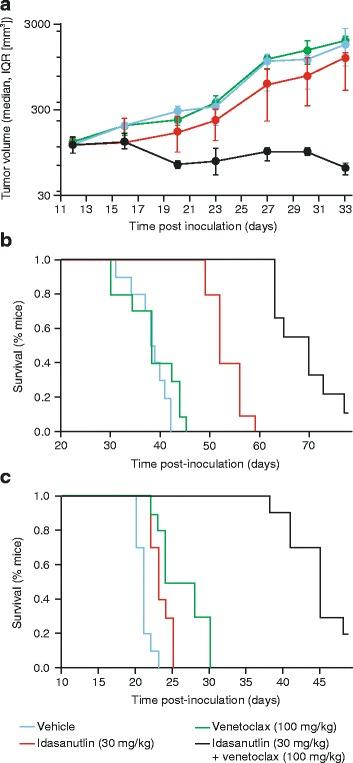
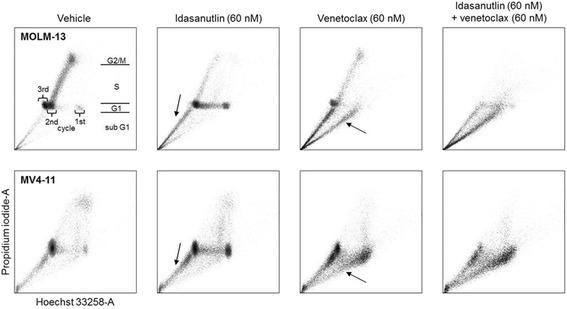
Combination treatment with venetoclax and idasanutlin results in synergistic anti-tumor activity compared with the respective single-agent treatments in vitro, in p53 wild-type AML cell lines, and leads to strongly superior efficacy in vivo, in subcutaneous and orthotopic AML models. The inhibitory effects of idasanutlin were cell-cycle dependent, with cells arresting in G1 in consecutive cycles and the induction of apoptosis only evident after cells had gone through at least two cell cycles. Combination treatment with venetoclax removed this dependency, resulting in an acceleration of cell death kinetics. As expected, gene expression studies using RNA sequencing showed significant alterations to pathways associated with p53 signaling and cell cycle arrest (CCND1 pathway) in response to idasanutlin treatment. Only few gene expression changes were observed for venetoclax treatment and combination treatment, indicating that their effects are mediated mainly at the post-transcriptional level. Protein expression studies demonstrated that inhibition of the anti-apoptotic protein Mcl-1 contributed to the activity of venetoclax and idasanutlin, with earlier inhibition of Mcl-1 in response to combination treatment contributing to the superior combined activity. The role of Mcl-1 was confirmed by small hairpin RNA gene knockdown studies.
CONCLUSIONS
Our findings provide functional and molecular insight on the superior anti-tumor activity of combined idasanutlin and venetoclax treatment in AML and support its further exploration in clinical studies.
背景
维奈托克是一种小分子BH3模拟物,可抑制抗凋亡蛋白Bcl-2;idasanutlin是一种选择性MDM2拮抗剂,在急性髓系白血病(AML)的临床前和临床研究中均显示出单药治疗活性。在本研究中,我们阐述了idasanutlin与维奈托克联合治疗p53野生型AML的理论依据和分子基础。
方法
使用已建立的AML细胞系在体外研究idasanutlin与维奈托克联合用药对细胞活力、凋亡和细胞周期进程的影响。在雌性裸鼠或非肥胖糖尿病/严重联合免疫缺陷(NOD/SCID)小鼠中建立的皮下和原位异种移植模型中证明了体内疗效。通过细胞周期动力学研究、RNA测序以及蛋白质印迹实验进行作用机制分析。
结果
在体外,与各自的单药治疗相比,维奈托克与idasanutlin联合治疗在p53野生型AML细胞系中具有协同抗肿瘤活性,并且在皮下和原位AML模型中,体内疗效显著更优。idasanutlin的抑制作用具有细胞周期依赖性,细胞在连续周期中停滞于G1期,且仅在细胞经历至少两个细胞周期后凋亡诱导才明显。与维奈托克联合治疗消除了这种依赖性,导致细胞死亡动力学加速。正如预期的那样,使用RNA测序进行的基因表达研究显示,响应idasanutlin治疗,与p53信号传导和细胞周期停滞(CCND1途径)相关的通路发生了显著改变。维奈托克治疗和联合治疗仅观察到很少的基因表达变化,表明它们的作用主要在转录后水平介导。蛋白质表达研究表明,抗凋亡蛋白Mcl-1的抑制作用有助于维奈托克和idasanutlin的活性,联合治疗时对Mcl-1的早期抑制作用有助于增强联合活性。小发夹RNA基因敲低研究证实了Mcl-1的作用。
结论
我们的研究结果为idasanutlin与维奈托克联合治疗AML的卓越抗肿瘤活性提供了功能和分子层面的见解,并支持其在临床研究中的进一步探索。




 Zotero 插件