
单电子转移的光氧化还原/镍双催化:为 sp(3)-sp(2)交叉偶联开辟新范式。
Single-Electron Transmetalation via Photoredox/Nickel Dual Catalysis: Unlocking a New Paradigm for sp(3)-sp(2) Cross-Coupling.
机构信息
Roy and Diana Vagelos Laboratories, Department of Chemistry, University of Pennsylvania , 231 South 34th Street, Philadelphia, Pennsylvania 19104-6323, United States.
出版信息
Acc Chem Res. 2016 Jul 19;49(7):1429-39. doi: 10.1021/acs.accounts.6b00214. Epub 2016 Jul 5.
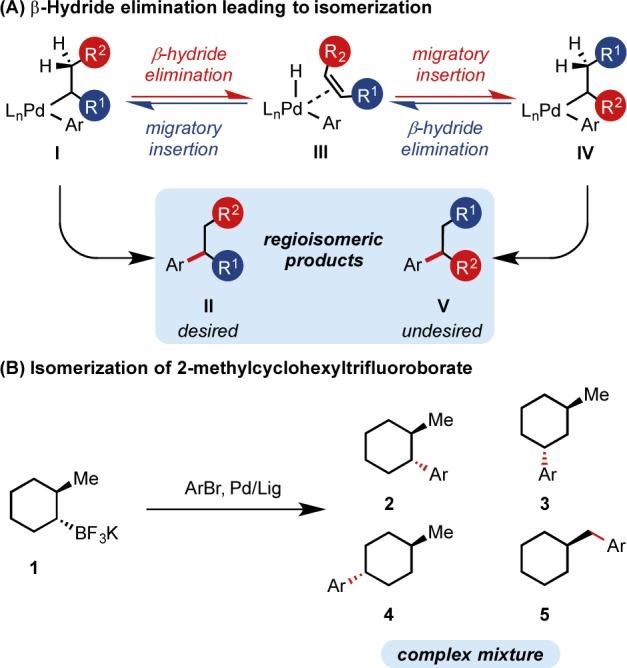
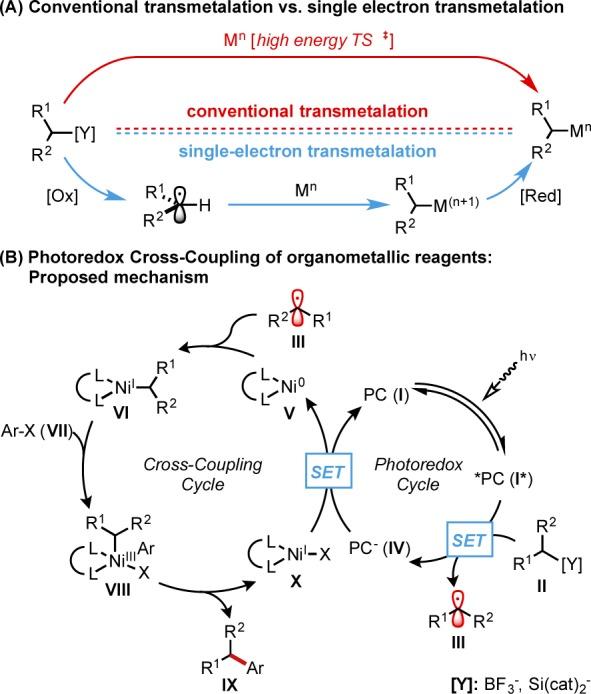
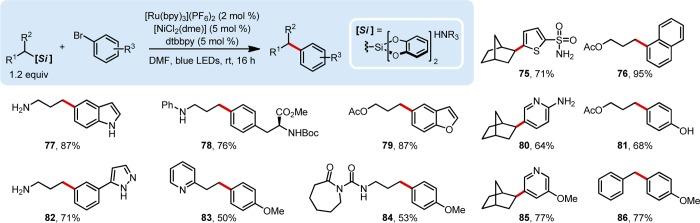
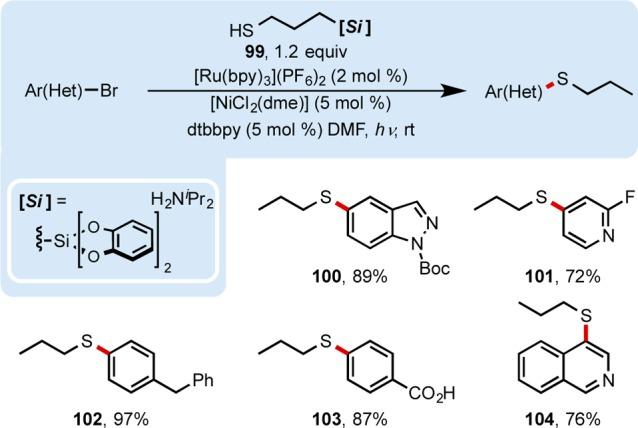
The important role of transition metal-catalyzed cross-coupling in expanding the frontiers of accessible chemical territory is unquestionable. Despite empowering chemists with Herculean capabilities in complex molecule construction, contemporary protocols are not without their Achilles' heel: Csp(3)-Csp(2)/sp(3) coupling. The underlying challenge in sp(3) cross-couplings is 2-fold: (i) methods employing conventional, bench-stable precursors are universally reliant on extreme reaction conditions because of the high activation barrier of transmetalation; (ii) circumvention of this barrier invariably relies on use of more reactive precursors, thereby sacrificing functional group tolerance, operational simplicity, and broad applicability. Despite the ubiquity of this problem, the nature of the transmetalation step has remained unchanged from the seminal reports of Negishi, Suzuki, Kumada, and Stille, thus suggesting that the challenges in Csp(3)-Csp(2)/sp(3) coupling result from inherent mechanistic constraints in the traditional cross-coupling paradigm. Rather than submitting to the limitations of this conventional approach, we envisioned that a process rooted in single-electron reactivity could furnish the same key metalated intermediate posited in two-electron transmetalation, while demonstrating entirely complementary reactivity patterns. Inspired by literature reports on the susceptibility of organoboron reagents toward photochemical, single-electron oxidative fragmentation, realization of a conceptually novel open shell transmetalation framework was achieved in the facile coupling of benzylic trifluoroborates with aryl halides via cooperative visible-light activated photoredox and Ni cross-coupling catalysis. Following this seminal study, we disclosed a suite of protocols for the cross-coupling of secondary alkyl, α-alkoxy, α-amino, and α-trifluoromethylbenzyltrifluoroborates. Furthermore, the selective cross-coupling of Csp(3) organoboron moieties in the presence of Csp(2) organoboron motifs was also demonstrated, highlighting the nuances of this approach to transmetalation. Computational modeling of the reaction mechanism uncovered useful details about the intermediates and transition-state structures involved in the nickel catalytic cycle. Most notably, a unique dynamic kinetic resolution process, characterized by radical homolysis/recombination equilibrium of a Ni(III) intermediate, was discovered. This process was ultimately found to be responsible for stereoselectivity in an enantioselective variant of these cross-couplings. Prompted by the intrinsic limitations of organotrifluoroborates, we sought other radical feedstocks and quickly identified alkylbis(catecholato)silicates as viable radical precursors for Ni/photoredox dual catalysis. These hypervalent silicate species have several notable benefits, including more favorable redox potentials that allow extension to primary alkyl systems incorporating unprotected amines as well as compatibility with less expensive Ru-based photocatalysts. Additionally, these reagents exhibit an amenability to alkenyl halide cross-coupling while simultaneously expanding the aryl halide scope. In the process of exploring these reagents, we serendipitously discovered a method to effect thioetherification of aryl halides via a H atom transfer mechanism. This latter discovery emphasizes that this robust cross-coupling paradigm is "blind" to the origins of the radical, opening opportunities for a wealth of new discoveries. Taken together, our studies in the area of photoredox/nickel dual catalysis have validated single-electron transmetalation as a powerful platform for enabling conventionally challenging Csp(3)-Csp(2) cross-couplings. More broadly, these findings represent the power of rational design in catalysis and the strategic use of mechanistic knowledge and manipulation for the development of new synthetic methods.
过渡金属催化交叉偶联在拓展可及化学领域方面的重要作用是毋庸置疑的。尽管当代的协议为化学家在复杂分子构建方面提供了强大的能力,但它们并非没有弱点:Csp(3)-Csp(2)/sp(3)偶联。sp(3)交叉偶联的根本挑战有两个方面:(i) 采用传统、稳定的前体的方法普遍依赖于极端的反应条件,因为转金属化的激活能垒很高;(ii) 为了规避这个障碍,通常需要使用更具反应性的前体,从而牺牲了官能团耐受性、操作简单性和广泛适用性。尽管这个问题普遍存在,但从 Negishi、Suzuki、Kumada 和 Stille 的开创性报告以来,转金属化步骤的性质仍然没有改变,这表明 Csp(3)-Csp(2)/sp(3)偶联中的挑战源于传统交叉偶联范式中的固有机制限制。我们不是屈服于这种传统方法的局限性,而是设想一个根植于单电子反应性的过程可以提供与双电子转金属化中假设的相同的关键金属化中间体,同时展示完全互补的反应性模式。受文献中关于有机硼试剂对光化学、单电子氧化碎片化的易感性的报告的启发,我们通过可见光激活光还原和 Ni 交叉偶联催化的协同作用,实现了苄基三氟硼酸盐与芳基卤化物之间的概念新颖的开壳层转金属化框架的简易偶联。在这项开创性研究之后,我们公开了一系列用于仲烷基、α-烷氧基、α-氨基和α-三氟甲基苄基三氟硼酸盐的交叉偶联的方案。此外,还证明了 Csp(3)有机硼部分在 Csp(2)有机硼基序存在下的选择性交叉偶联,突出了这种转金属化方法的细微差别。反应机制的计算建模揭示了镍催化循环中涉及的中间体和过渡态结构的有用细节。最值得注意的是,发现了一种独特的动态动力学分辨率过程,其特征是 Ni(III)中间体的自由基均裂/重组平衡。最终发现,这种过程是这些交叉偶联中对映选择性变体的立体选择性的原因。受有机三氟硼酸盐固有局限性的启发,我们寻找了其他自由基前体,并很快确定了烷基双(邻苯二酚酸酯)硅酸盐是 Ni/光还原双重催化的可行自由基前体。这些高价硅酸盐具有几个显著的优点,包括更有利的氧化还原电位,允许扩展到包含未保护胺的伯烷基系统,以及与更便宜的基于 Ru 的光催化剂的兼容性。此外,这些试剂表现出与烯基卤化物交叉偶联的适用性,同时扩大了芳基卤化物的范围。在探索这些试剂的过程中,我们偶然发现了一种通过 H 原子转移机制实现芳基卤化物硫醚化的方法。这一发现强调了这种强大的交叉偶联范例对自由基的来源是“盲目的”,为大量新发现开辟了机会。总之,我们在光还原/镍双重催化领域的研究验证了单电子转金属化作为一种强大的平台,可用于实现传统上具有挑战性的 Csp(3)-Csp(2)交叉偶联。更广泛地说,这些发现代表了在催化中合理设计的力量以及利用机制知识和操纵来开发新合成方法的战略。






 Zotero 插件