
新型唾液表皮生长因子受体基因突变检测用于肺癌的评估:一项初步研究。
Evaluation of a novel saliva-based epidermal growth factor receptor mutation detection for lung cancer: A pilot study.
机构信息
Lung Cancer Center, West China Hospital Sichuan University Chengdu China.
School of Dentistry, Department of Pathology University of California Los Angeles California USA.
出版信息
Thorac Cancer. 2016 Jul;7(4):428-36. doi: 10.1111/1759-7714.12350. Epub 2016 May 13.
BACKGROUND
This article describes a pilot study evaluating a novel liquid biopsy system for non-small cell lung cancer (NSCLC) patients. The electric field-induced release and measurement (EFIRM) method utilizes an electrochemical biosensor for detecting oncogenic mutations in biofluids.
METHODS
Saliva and plasma of 17 patients were collected from three cancer centers prior to and after surgical resection. The EFIRM method was then applied to the collected samples to assay for exon 19 deletion and p.L858 mutations. EFIRM results were compared with cobas results of exon 19 deletion and p.L858 mutation detection in cancer tissues.
RESULTS
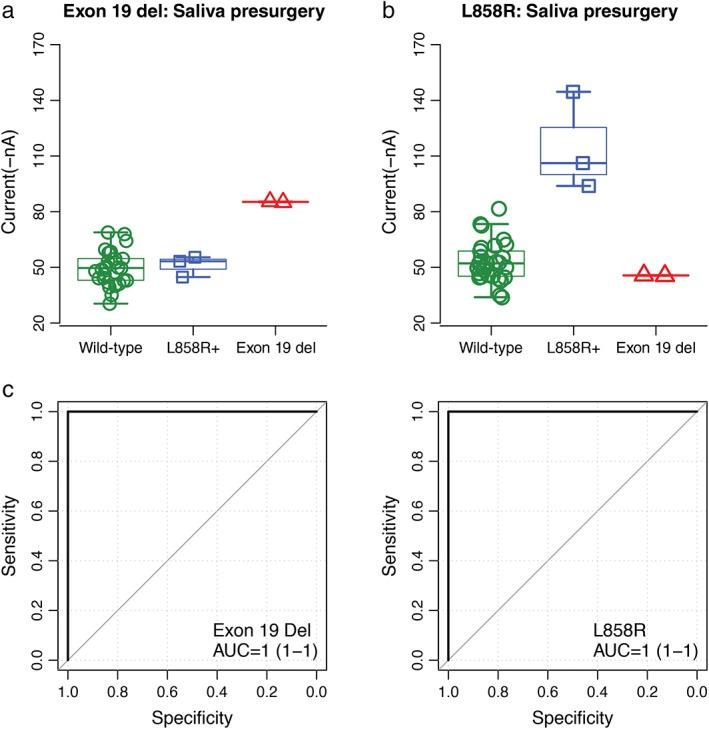
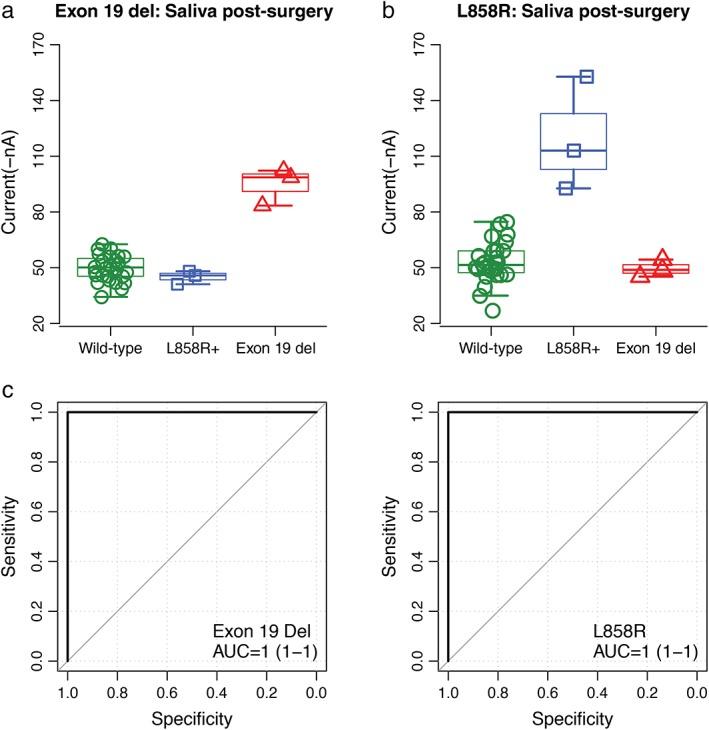
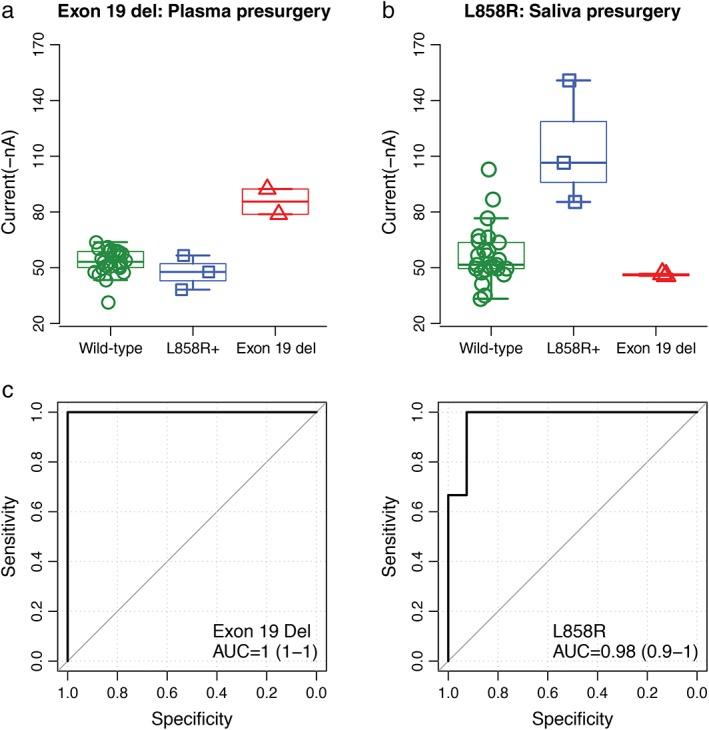
The EFIRM method was found to detect exon 19 deletion with an area under the curve (AUC) of 1.0 in both saliva and plasma samples in lung cancer patients. For L858R mutation detection, the AUC of saliva was 1.0, while the AUC of plasma was 0.98. Strong correlations were also found between presurgery and post-surgery samples for both saliva (0.86 for exon 19 and 0.98 for L858R) and plasma (0.73 for exon 19 and 0.94 for L858R).
CONCLUSION
Our study demonstrates the feasibility of utilizing EFIRM to rapidly, non-invasively, and conveniently detect epidermal growth factor receptor mutations in the saliva of patients with NSCLC, with results corresponding perfectly with the results of cobas tissue genotyping.
背景
本文描述了一项评估新型液体活检系统用于非小细胞肺癌(NSCLC)患者的初步研究。电场诱导释放和测量(EFIRM)方法利用电化学生物传感器检测生物流体中的致癌突变。
方法
在手术切除前和切除后,从三个癌症中心收集了 17 名患者的唾液和血浆。然后应用 EFIRM 方法检测收集到的样本中是否存在外显子 19 缺失和 p.L858 突变。EFIRM 结果与癌症组织中外显子 19 缺失和 p.L858 突变检测的 cobas 结果进行比较。
结果
EFIRM 方法在肺癌患者的唾液和血浆样本中均发现可检测到外显子 19 缺失,曲线下面积(AUC)分别为 1.0。对于 L858R 突变检测,唾液的 AUC 为 1.0,而血浆的 AUC 为 0.98。对于唾液(外显子 19 的 AUC 为 0.86,L858R 的 AUC 为 0.98)和血浆(外显子 19 的 AUC 为 0.73,L858R 的 AUC 为 0.94),术前和术后样本之间也存在强烈的相关性。
结论
我们的研究表明,EFIRM 可用于快速、无创、方便地检测 NSCLC 患者唾液中的表皮生长因子受体突变,其结果与 cobas 组织基因分型的结果完全吻合。

 Zotero 插件