
细胞外钙敏感受体(CaSR)表达降低与肾素-血管紧张素系统(RAS)激活相关,从而在原发性高血压发病机制中促进血管重塑。
Reduced Expression of the Extracellular Calcium-Sensing Receptor (CaSR) Is Associated with Activation of the Renin-Angiotensin System (RAS) to Promote Vascular Remodeling in the Pathogenesis of Essential Hypertension.
作者信息
Qu Yuan-Yuan, Hui Jing, Wang La-Mei, Tang Na, Zhong Hua, Liu Yong-Min, Li Zhen, Feng Qian, He Fang
机构信息
Department of Pathophysiology/Key Laboratory of Education Ministry of Xinjiang Endemic and Ethnic Diseases, Medical College of Shihezi University, Shihezi, China.
Department of Emergency and critical care medicine, the First Affiliated Hospital of Medical College of Shihezi University, Shihezi, 832008, China.
出版信息
PLoS One. 2016 Jul 8;11(7):e0157456. doi: 10.1371/journal.pone.0157456. eCollection 2016.
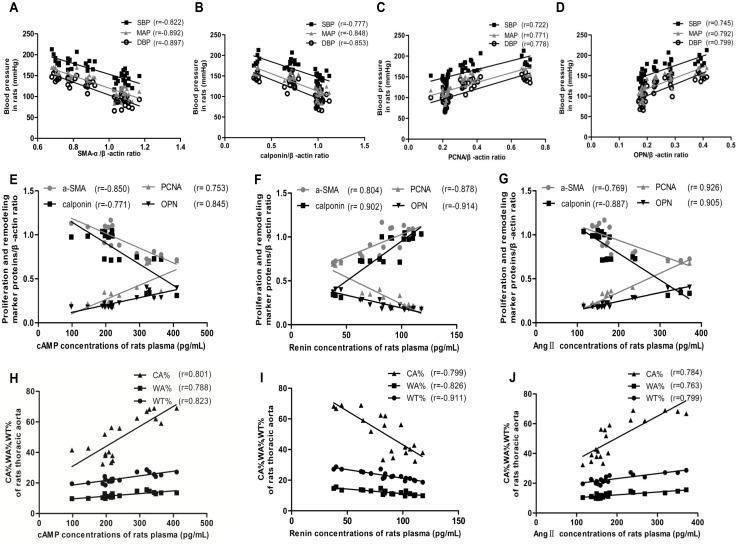
The proliferation of vascular smooth muscle cells (VSMCs), remodeling of the vasculature, and the renin-angiotensin system (RAS) play important roles in the development of essential hypertension (EH), which is defined as high blood pressure (BP) in which secondary causes, such as renovascular disease, are absent. The calcium-sensing receptor (CaSR) is involved in the regulation of BP. However, the underlying mechanisms by which the CaSR regulates BP are poorly understood. In the present study, the role of the CaSR in EH was investigated using male spontaneously hypertensive rats (SHRs) and rat and human plasma samples. The percentages of medial wall thickness to external diameter (WT%), total vessel wall cross-sectional area to the total area (WA%) of thoracic arteries, as well as the percentage of wall area occupied by collagen to total vessel wall area (CA%) were determined. Tissue protein expression and plasma concentrations of the CaSR, cyclic adenosine monophosphate (cAMP), renin, and angiotensin II (Ang II) were additionally assessed. WT%, WA%, and CA% were found to increase with increasing BP, whereas the plasma concentration of CaSR was found to decrease. With increasing BP, the levels of smooth muscle actin and calponin decreased, whereas those of osteopontin and proliferating cell nuclear antigen increased. The CaSR level negatively correlated with the levels of cAMP and Ang II, but positively correlated with those of renin. Our data suggest that reduced expression of the CaSR is correlated with activation of the RAS, which induces increased vascular remodeling and VSMC proliferation, and thereby associated with EH in the SHR model and in the Han Chinese population. Our findings provide new insights into the pathogenesis of EH.
血管平滑肌细胞(VSMC)的增殖、血管重塑以及肾素-血管紧张素系统(RAS)在原发性高血压(EH)的发生发展中起重要作用。原发性高血压被定义为不存在诸如肾血管疾病等继发性病因的高血压(BP)。钙敏感受体(CaSR)参与血压调节。然而,CaSR调节血压的潜在机制尚不清楚。在本研究中,使用雄性自发性高血压大鼠(SHR)以及大鼠和人类血浆样本,研究了CaSR在EH中的作用。测定了胸主动脉中膜厚度与外径的百分比(WT%)、血管总壁横截面积与总面积的百分比(WA%),以及胶原蛋白占血管总壁面积的百分比(CA%)。此外,还评估了CaSR、环磷酸腺苷(cAMP)、肾素和血管紧张素II(Ang II)的组织蛋白表达和血浆浓度。发现WT%、WA%和CA%随血压升高而增加,而CaSR的血浆浓度则降低。随着血压升高,平滑肌肌动蛋白和钙调蛋白水平降低,而骨桥蛋白和增殖细胞核抗原水平升高。CaSR水平与cAMP和Ang II水平呈负相关,但与肾素水平呈正相关。我们的数据表明,CaSR表达降低与RAS激活相关,RAS激活诱导血管重塑增加和VSMC增殖,从而与SHR模型和汉族人群中的EH相关。我们的研究结果为EH的发病机制提供了新的见解。


 Zotero 插件