
脊髓多巴胺能传递在奈福泮对大鼠炎性疼痛镇痛作用中的作用
The Role of Spinal Dopaminergic Transmission in the Analgesic Effect of Nefopam on Rat Inflammatory Pain.
作者信息
Kim Do Yun, Chae Joo Wung, Lim Chang Hun, Heo Bong Ha, Park Keun Suk, Lee Hyung Gon, Choi Jeong Il, Yoon Myung Ha, Kim Woong Mo
机构信息
Department of Anesthesiology and Pain Medicine, Chonnam National University Medical School, Gwangju, Korea.
Center for Creative Biomedical Scientists, Chonnam National University Medical School, Gwangju, Korea.
出版信息
Korean J Pain. 2016 Jul;29(3):164-71. doi: 10.3344/kjp.2016.29.3.164. Epub 2016 Jul 1.
BACKGROUND
Nefopam has been known as an inhibitor of the reuptake of monoamines, and the noradrenergic and/or serotonergic system has been focused on as a mechanism of its analgesic action. Here we investigated the role of the spinal dopaminergic neurotransmission in the antinociceptive effect of nefopam administered intravenously or intrathecally.
METHODS
The effects of intravenously and intrathecally administered nefopam were examined using the rat formalin test. Then we performed a microdialysis study to confirm the change of extracellular dopamine concentration in the spinal dorsal horn by nefopam. To determine whether the changes of dopamine level are associated with the nefopam analgesia, its mechanism was investigated pharmacologically via pretreatment with sulpiride, a dopaminergic D2 receptor antagonist.
RESULTS
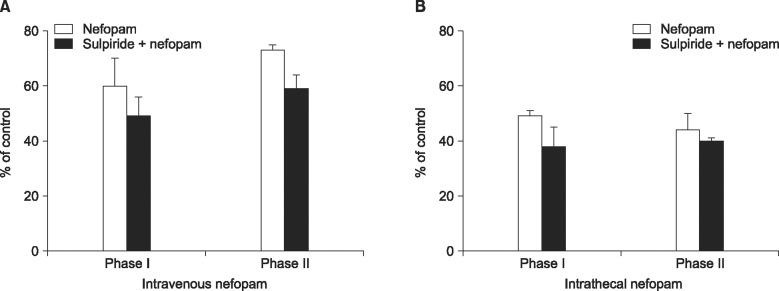
When nefopam was administered intravenously the flinching responses in phase I of the formalin test were decreased, but not those in phase II of the formalin test were decreased. Intrathecally injected nefopam reduced the flinching responses in both phases of the formalin test in a dose dependent manner. Microdialysis study revealed a significant increase of the level of dopamine in the spinal cord by intrathecally administered nefopam (about 3.8 fold the baseline value) but not by that administered intravenously. The analgesic effects of intrathecally injected nefopam were not affected by pretreatment with sulpiride, and neither were those of the intravenous nefopam.
CONCLUSIONS
Both the intravenously and intrathecally administered nefopam effectively relieved inflammatory pain in rats. Nefopam may act as an inhibitor of dopamine reuptake when delivered into the spinal cord. However, the analgesic mechanism of nefopam may not involve the dopaminergic transmission at the spinal level.
背景
奈福泮一直被认为是一种单胺再摄取抑制剂,去甲肾上腺素能和/或5-羟色胺能系统作为其镇痛作用机制受到关注。在此,我们研究了脊髓多巴胺能神经传递在静脉或鞘内注射奈福泮的抗伤害感受作用中的作用。
方法
使用大鼠福尔马林试验检测静脉和鞘内注射奈福泮的效果。然后我们进行了一项微透析研究,以确认奈福泮引起的脊髓背角细胞外多巴胺浓度的变化。为了确定多巴胺水平的变化是否与奈福泮镇痛相关,通过用多巴胺能D2受体拮抗剂舒必利预处理,从药理学角度研究其机制。
结果
静脉注射奈福泮时,福尔马林试验第一阶段的退缩反应降低,但福尔马林试验第二阶段的退缩反应未降低。鞘内注射奈福泮以剂量依赖性方式降低了福尔马林试验两个阶段的退缩反应。微透析研究显示,鞘内注射奈福泮可使脊髓中多巴胺水平显著升高(约为基线值的3.8倍),而静脉注射则无此作用。鞘内注射奈福泮的镇痛作用不受舒必利预处理的影响,静脉注射奈福泮的镇痛作用也不受影响。
结论
静脉和鞘内注射奈福泮均可有效减轻大鼠的炎性疼痛。当奈福泮注入脊髓时,它可能作为多巴胺再摄取抑制剂起作用。然而,奈福泮的镇痛机制可能不涉及脊髓水平的多巴胺能传递。


 Zotero 插件