
何去何从?干扰素诱导的GTP酶通过自噬的LC3缀合系统前往其靶膜。
Quo vadis? Interferon-inducible GTPases go to their target membranes via the LC3-conjugation system of autophagy.
作者信息
Choi Jayoung, Biering Scott B, Hwang Seungmin
机构信息
a Department of Pathology , The University of Chicago , Chicago , IL , USA.
b Committee on Microbiology, The University of Chicago , Chicago , IL , USA.
出版信息
Small GTPases. 2017 Oct 2;8(4):199-207. doi: 10.1080/21541248.2016.1213090. Epub 2016 Jul 18.
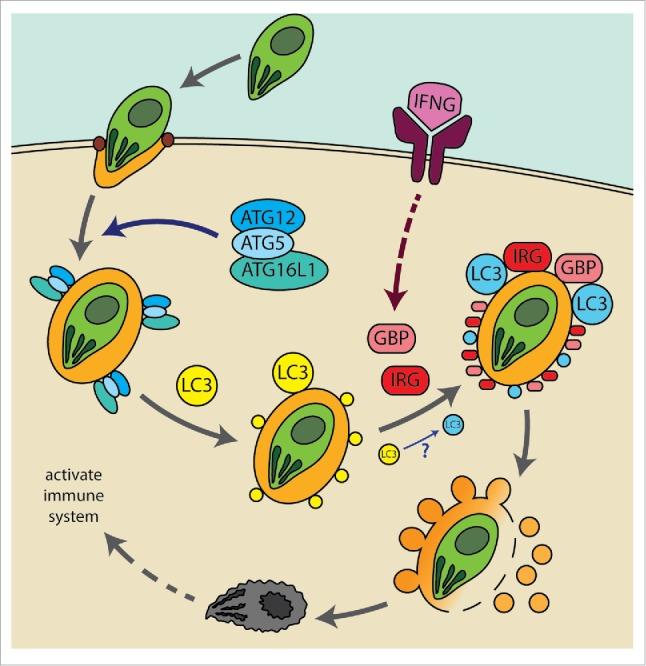
Many intracellular pathogens survive and replicate within vacuole-like structures in the cytoplasm. It has been unclear how the host immune system controls such pathogen-containing vacuoles. Interferon-inducible GTPases are dynamin-like GTPases that target the membranes of pathogen-containing vacuoles. Upon their oligomerization on the membrane, the vacuole structure disintegrates and the pathogen gets exposed to the hostile cytoplasm. What has been obscure is how the immune system detects and directs the GTPases to these pathogen shelters. Using a common protist parasite of mice, Toxoplasma gondii, we found that the LC3 conjugation system of autophagy is necessary and sufficient for targeting the interferon-inducible GTPases to membranes. We dubbed this process Targeting by AutophaGy proteins (TAG). In canonical autophagy, the LC3 conjugation system is required to form membrane-bound autophagosomes, which encircle and deliver cytosolic materials to lysosomes for degradation. In TAG, however, the conjugation system is required to mark the membranes of pathogen-containing vacuoles with ubiquitin-like LC3 homologs, which function as molecular beacons to recruit the GTPases to their target membranes. Our data suggest that the LC3 conjugation system of autophagy plays an essential role in detecting and marking pathogen-containing vacuoles for immune effector targeting by the host immune system.
许多细胞内病原体在细胞质中类似液泡的结构内生存和复制。宿主免疫系统如何控制这些含有病原体的液泡尚不清楚。干扰素诱导的GTP酶是一种类似发动蛋白的GTP酶,其作用靶点是含有病原体的液泡膜。当它们在膜上寡聚时,液泡结构解体,病原体暴露于充满敌意的细胞质中。一直不清楚的是免疫系统如何检测并将GTP酶导向这些病原体藏身之处。利用小鼠的一种常见原生动物寄生虫——刚地弓形虫,我们发现自噬的LC3偶联系统对于将干扰素诱导的GTP酶靶向到膜上是必要且充分的。我们将这个过程称为自噬蛋白靶向(TAG)。在经典自噬中,LC3偶联系统是形成膜结合自噬体所必需的,自噬体包裹并将胞质物质运送到溶酶体进行降解。然而,在TAG过程中,偶联系统需要用类泛素化的LC3同源物标记含有病原体的液泡膜,这些同源物作为分子信标将GTP酶招募到它们的靶膜上。我们的数据表明,自噬的LC3偶联系统在检测和标记含有病原体的液泡以便宿主免疫系统进行免疫效应物靶向方面起着至关重要的作用。
 Zotero 插件