
产生性T细胞:利用基因工程改造的T细胞作为载体,生成治疗药物并将其递送至肿瘤部位。
Producer T cells: Using genetically engineered T cells as vehicles to generate and deliver therapeutics to tumors.
作者信息
Tsai Alexander K, Davila Eduardo
机构信息
Marlene and Stewart Greenebaum Cancer Center, University of Maryland , Baltimore, Baltimore, MD, USA.
Marlene and Stewart Greenebaum Cancer Center, University of Maryland, Baltimore, Baltimore, MD, USA; Department of Microbiology and Immunology, University of Maryland, Baltimore, Baltimore, MD, USA.
出版信息
Oncoimmunology. 2016 Jan 15;5(5):e1122158. doi: 10.1080/2162402X.2015.1122158. eCollection 2016 May.
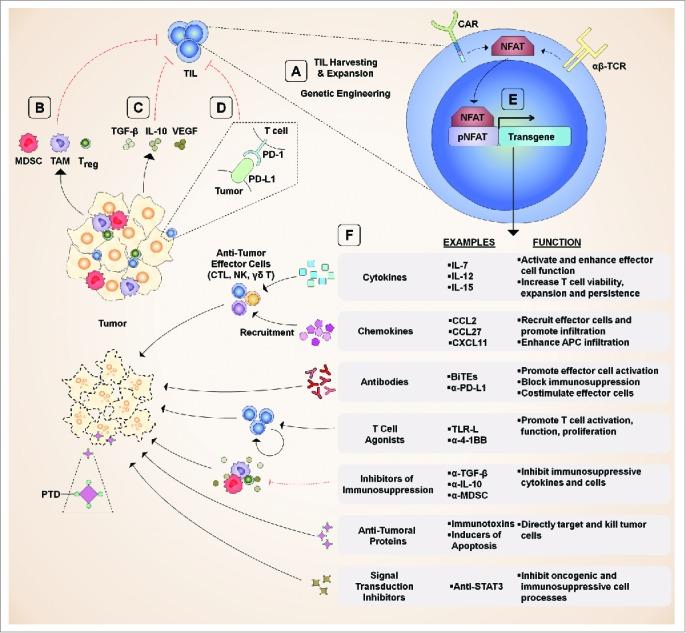
Adoptive cell transfer (ACT) is an emerging anticancer therapy that has shown promise in various malignancies. Redirecting antigen specificity by genetically engineering T cells to stably express receptors has become an effective variant of ACT. A novel extension of this approach is to utilize engineered T cells to produce and deliver anticancer therapeutics that enhance cytotoxic T cell function and simultaneously inhibit immunosuppressive processes. Here, we review the potential of using T cells as therapeutic-secreting vehicles for immunotherapies and present theoretical and established arguments in support of further development of this unique cell-based immunotherapy.
过继性细胞转移(ACT)是一种新兴的抗癌疗法,已在多种恶性肿瘤中显示出前景。通过基因工程改造T细胞以稳定表达受体来重新定向抗原特异性,已成为ACT的一种有效变体。这种方法的一种新扩展是利用工程化T细胞产生并递送抗癌治疗药物,增强细胞毒性T细胞功能,同时抑制免疫抑制过程。在此,我们综述了将T细胞用作免疫疗法的治疗性分泌载体的潜力,并提出理论和既定论据以支持进一步开发这种独特的基于细胞的免疫疗法。
 Zotero 插件