
分娩方式影响婴儿出生后第一年肠道微生物群的多样性和定植模式:一项系统综述。
The mode of delivery affects the diversity and colonization pattern of the gut microbiota during the first year of infants' life: a systematic review.
作者信息
Rutayisire Erigene, Huang Kun, Liu Yehao, Tao Fangbiao
机构信息
Department of Maternal, Child and Adolescent Health, School of Public Health, Anhui Medical University, Meishan Road 81, Hefei City, Anhui Province, 230032, People's Republic of China.
Anhui Provincial Key Laboratory of Population Health & Aristogenics, Hefei City, Anhui Province, People's Republic of China.
出版信息
BMC Gastroenterol. 2016 Jul 30;16(1):86. doi: 10.1186/s12876-016-0498-0.
BACKGROUND
The human gut is the habitat for diverse and dynamic microbial ecosystem. The human microbiota plays a critical role in functions that sustain health and is a positive asset in host defenses. Establishment of the human intestinal microbiota during infancy may be influenced by multiple factors including delivery mode. Present review compiles existing evidences on the effect of delivery mode on the diversity and colonization pattern of infants gut microbiota.
METHODS
Two investigators searched for relevant scientific publications from four databases (Pubmed, Medline, Embase, and Web of Science). The last search was performed on September 21, 2015, using key terms ((delivery mode OR caesarean delivery OR cesarean section OR vaginal delivery) AND (gut microbiota OR gut microbiome OR gut microflora OR intestinal microflora OR microbial diversity) AND (infants OR children)). All included studies described at least two types of gut microbiota in relation to delivery mode (caesarean section vs vaginal delivery) and used fecal samples to detect gut microbiota.
RESULTS
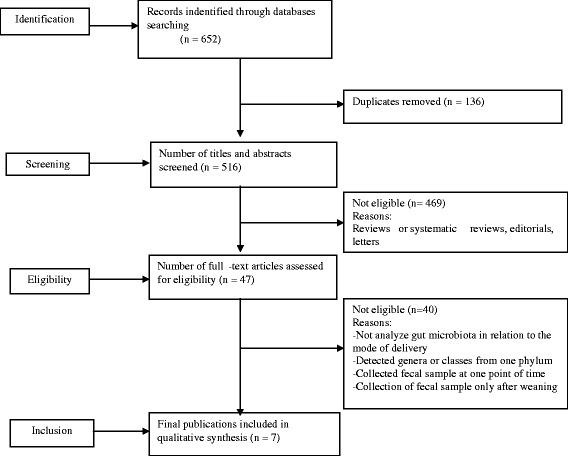
Seven out of 652 retrieved studies met inclusion criteria, were included in systematic analysis. Caesarean Section (CS) was associated with both lower abundance and diversity of the phyala Actinobacteria and Bacteroidetes, and higher abundance and diversity of the phylum Firmicute from birth to 3 months of life. At the colonization level, Bifidobacterium, and Bacteroides genera seems to be significantly more frequent in vaginally delivered infants compared with CS delivered. These infants were more colonized by the Clostridium, and Lactobacillus genera. From the reports, it is tempting to say that delivery mode has less effect on colonization and diversity of Bifidobacteria, Bacteroides, Clostridium, and Lactobacillus genera from the age of 6 to 12 months of life.
CONCLUSION
The diversity and colonization pattern of the gut microbiota were significantly associated to the mode of delivery during the first three months of life, however the observed significant differences disappears after 6 months of infants life. The healthy gut microbiota is considered to promote development and maturation of the immune system while abnormal gut is considered as the major cause of severe gastrointestinal infections during the infancy. Further studies should investigate the diversity and colonization levels of infant gut microbiota in relation to the mode of delivery and its broad impact on infants' health at each stage of life.
背景
人类肠道是多样且动态的微生物生态系统的栖息地。人类微生物群在维持健康的功能中起着关键作用,是宿主防御中的一项积极资产。婴儿期人类肠道微生物群的建立可能受到包括分娩方式在内的多种因素影响。本综述汇编了关于分娩方式对婴儿肠道微生物群的多样性和定植模式影响的现有证据。
方法
两名研究者从四个数据库(PubMed、Medline、Embase和Web of Science)检索相关科学出版物。最后一次检索于2015年9月21日进行,使用的关键词为((分娩方式或剖宫产或剖腹产或阴道分娩)且(肠道微生物群或肠道微生物组或肠道微生物区系或肠道微生物区系或微生物多样性)且(婴儿或儿童))。所有纳入研究均描述了至少两种与分娩方式(剖宫产与阴道分娩)相关的肠道微生物群类型,并使用粪便样本检测肠道微生物群。
结果
在检索到的652项研究中,有7项符合纳入标准,被纳入系统分析。剖宫产(CS)与出生至3个月大时放线菌门和拟杆菌门的丰度和多样性较低,以及厚壁菌门的丰度和多样性较高有关。在定植水平上,与剖宫产出生的婴儿相比,双歧杆菌属和拟杆菌属在阴道分娩的婴儿中似乎明显更常见。这些婴儿更多地被梭菌属和乳杆菌属定植。从报告来看,似乎可以说分娩方式对6至12个月大婴儿双歧杆菌属、拟杆菌属、梭菌属和乳杆菌属的定植和多样性影响较小。
结论
肠道微生物群的多样性和定植模式在生命的前三个月与分娩方式显著相关,然而在婴儿6个月大后观察到的显著差异消失。健康的肠道微生物群被认为可促进免疫系统的发育和成熟,而异常肠道被认为是婴儿期严重胃肠道感染的主要原因。进一步的研究应调查婴儿肠道微生物群的多样性和定植水平与分娩方式的关系及其对生命各阶段婴儿健康的广泛影响。
 Zotero 插件