
雄激素受体水平在前列腺癌细胞对新一代抗雄激素恩杂鲁胺耐药中的关键作用。
Critical role of androgen receptor level in prostate cancer cell resistance to new generation antiandrogen enzalutamide.
作者信息
Hoefer Julia, Akbor Mohammady, Handle Florian, Ofer Philipp, Puhr Martin, Parson Walther, Culig Zoran, Klocker Helmut, Heidegger Isabel
机构信息
Department of Urology, Division of Experimental Urology, Medical University of Innsbruck, Austria.
School of Biosciences and Veterinary Medicine, University of Camerino, Camerino, Italy.
出版信息
Oncotarget. 2016 Sep 13;7(37):59781-59794. doi: 10.18632/oncotarget.10926.
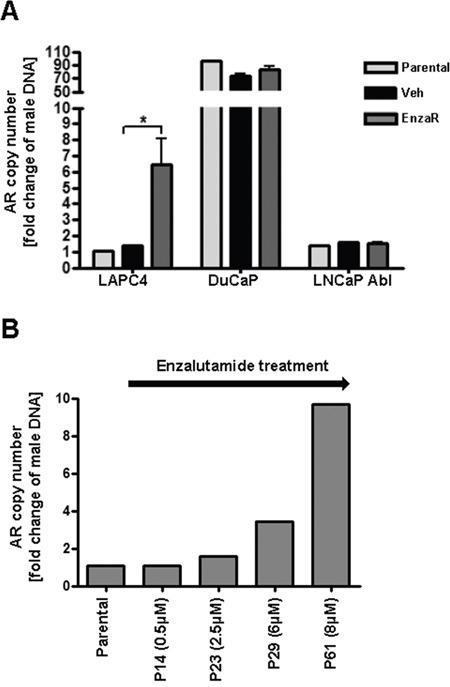
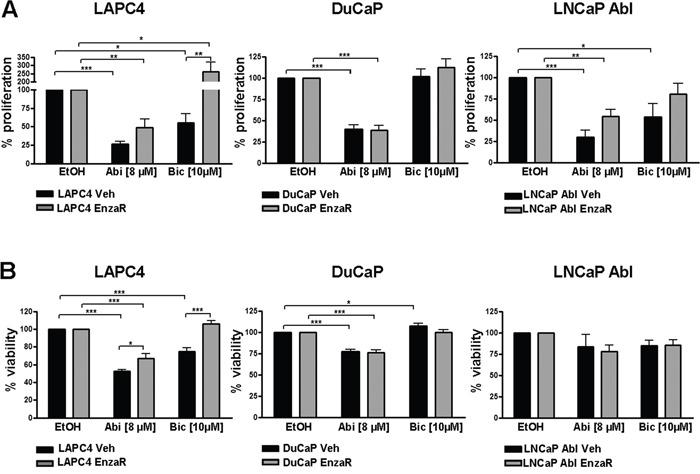
Enzalutamide is an androgen receptor (AR) inhibitor approved for therapy of metastatic castration resistant prostate cancer. However, clinical application revealed that 30 to 40% of patients acquire resistance after a short period of treatment. Currently, the molecular mechanisms underlying such resistances are not completely understood, partly due to a lack of model systems. In the present study we established three different cellular models of enzalutamide resistance including a cell line with wild type AR (LAPC4), DuCaP cells which overexpress wild-type AR, as well as a cell which has been adapted to long term androgen ablation (LNCaP Abl) and harbors the AR T878A mutation. After 10 months of cultivation, sustained growth in the presence of enzalutamide was achieved. When compared to controls, resistant cells exhibit significantly decreased sensitivity to enzalutamide as measured with 3[H]thymidine incorporation and WST assay. Moreover, these cell models exhibit partly re-activated AR signaling despite presence of enzalutamide. In addition, we show that enzalutamide resistant cells are insensitive to bicalutamide but retain considerable sensitivity to abiraterone. Mechanistically, enzalutamide resistance was accompanied by increased AR and AR-V7 mRNA and protein expression as well as AR gene amplification, while no additional AR mutations have been identified.
恩杂鲁胺是一种雄激素受体(AR)抑制剂,已被批准用于治疗转移性去势抵抗性前列腺癌。然而,临床应用显示,30%至40%的患者在短期治疗后会产生耐药性。目前,这种耐药性的分子机制尚未完全明确,部分原因是缺乏模型系统。在本研究中,我们建立了三种不同的恩杂鲁胺耐药细胞模型,包括一株具有野生型AR的细胞系(LAPC4)、过表达野生型AR的DuCaP细胞,以及一株适应长期雄激素剥夺的细胞(LNCaP Abl),其携带AR T878A突变。培养10个月后,这些细胞在恩杂鲁胺存在的情况下实现了持续生长。与对照相比,用3[H]胸苷掺入法和WST法检测发现,耐药细胞对恩杂鲁胺的敏感性显著降低。此外,尽管存在恩杂鲁胺,这些细胞模型仍表现出部分重新激活的AR信号。另外,我们发现恩杂鲁胺耐药细胞对比卡鲁胺不敏感,但对阿比特龙仍保持相当的敏感性。从机制上讲,恩杂鲁胺耐药伴随着AR和AR-V7 mRNA及蛋白表达增加以及AR基因扩增,而未发现其他AR突变。




 Zotero 插件