
血清饥饿诱导的细胞周期同步化在体细胞重编程为诱导多能干细胞的过程中刺激了小鼠核糖体DNA转录重新激活。
Serum starvation-induced cell cycle synchronization stimulated mouse rDNA transcription reactivation during somatic cell reprogramming into iPSCs.
作者信息
Zhao Qiaoshi, Wu Yanshuang, Shan Zhiyan, Bai Guangyu, Wang Zhendong, Hu Jing, Liu Li, Li Tong, Shen Jingling, Lei Lei
机构信息
Department of Histology and Embryology, Harbin Medical University, Xuefu Road 194#, Nangang District, Harbin, 150081, China.
出版信息
Stem Cell Res Ther. 2016 Aug 11;7(1):112. doi: 10.1186/s13287-016-0369-1.
BACKGROUND
rDNA, the genes encoding ribosomal RNA (rRNA), is highly demanded for ribosome production and protein synthesis in growing cells such as pluripotent stem cells. rDNA transcription activity varies between cell types, metabolism conditions, and specific environmental challenges. Embryonic stem cells (ESCs), partially reprogrammed cells, and somatic cells reveal different epigenetic signatures, including rDNA epigenetic marks. rDNA epigenetic characteristic resetting is not quite clear during induced pluripotent stem cell (iPSC) generation. Little is known that whether the different rDNA epigenetic status in donor cells will result in different rDNA transcription activities, and furthermore affect reprogramming efficiency.
METHODS
We utilized serum starvation-synchronized mouse embryonic fibroblasts (MEFs) to generate S-iPSCs. Both MEFs and serum-refeeding MEFs (S-MEFs) were reprogrammed to a pluripotent state. rDNA-related genes, UBF proteins, and rDNA methylation levels were detected during the MEF and S-MEF cell reprogramming process.
RESULTS
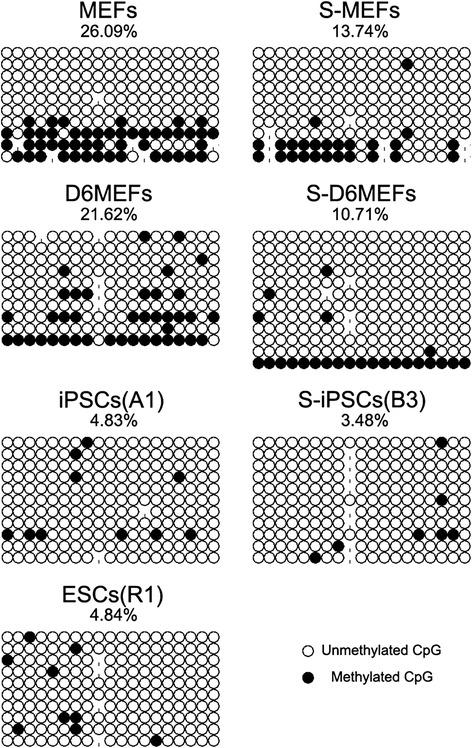
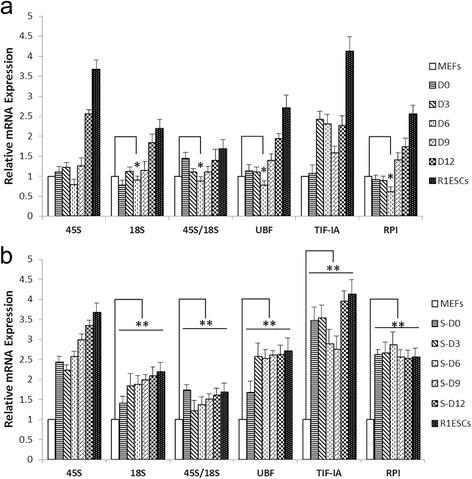
We demonstrated that, after transient inhibition, retroviral induced rRNA transcriptional activity was reprogrammed towards a pluripotent state. Serum starvation would stimulate rDNA transcription reactivation during somatic cell reprogramming. Serum starvation improved the methylation status of donor cells at rRNA gene promoter regions.
CONCLUSIONS
Our results provide insight into regulation of rDNA transcriptional activity during somatic cell reprogramming and allow for comparison of rDNA regulation patterns between iPSCs and S-iPSCs. Eventually, regulation of rDNA transcriptional activity will benefit partially reprogrammed cells to overcome the epigenetic barrier to pluripotency.
背景
核糖体DNA(rDNA),即编码核糖体RNA(rRNA)的基因,在多能干细胞等生长细胞中对核糖体产生和蛋白质合成至关重要。rDNA转录活性在不同细胞类型、代谢条件和特定环境挑战下有所不同。胚胎干细胞(ESC)、部分重编程细胞和体细胞呈现出不同的表观遗传特征,包括rDNA表观遗传标记。在诱导多能干细胞(iPSC)生成过程中,rDNA表观遗传特征的重置尚不完全清楚。目前尚不清楚供体细胞中不同的rDNA表观遗传状态是否会导致不同的rDNA转录活性,进而影响重编程效率。
方法
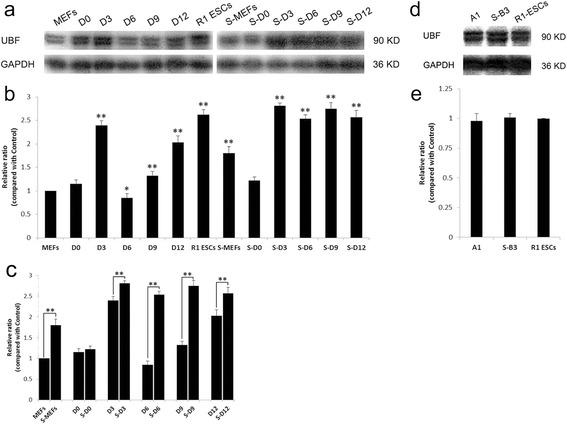
我们利用血清饥饿同步化的小鼠胚胎成纤维细胞(MEF)来生成S-iPSC。将MEF和血清再喂养的MEF(S-MEF)都重编程为多能状态。在MEF和S-MEF细胞重编程过程中检测rDNA相关基因、上游结合因子(UBF)蛋白和rDNA甲基化水平。
结果
我们证明,在短暂抑制后,逆转录病毒诱导的rRNA转录活性被重编程为多能状态。血清饥饿会在体细胞重编程过程中刺激rDNA转录重新激活。血清饥饿改善了供体细胞在rRNA基因启动子区域的甲基化状态。
结论
我们的结果为体细胞重编程过程中rDNA转录活性的调控提供了见解,并允许比较iPSC和S-iPSC之间的rDNA调控模式。最终,rDNA转录活性的调控将有助于部分重编程细胞克服多能性的表观遗传障碍。

 Zotero 插件