
利妥昔单抗在非恶性实验环境中诱导自然杀伤细胞的表型和功能变化。
Rituximab induces phenotypical and functional changes of NK cells in a non-malignant experimental setting.
作者信息
Merkt Wolfgang, Lorenz Hanns-Martin, Watzl Carsten
机构信息
Department of Hematology, Oncology and Rheumatology, Internal Medicine V, University Hospital of Heidelberg, Heidelberg, Germany.
Leibniz Research Center for Working Environment and Human Factors at TU Dortmund (IfADo), Dortmund, Germany.
出版信息
Arthritis Res Ther. 2016 Sep 15;18(1):206. doi: 10.1186/s13075-016-1101-3.
BACKGROUND
Rituximab has broad and increasing application in rheumatic diseases. It is known from lymphoma studies that natural killer (NK) cells can lyse rituximab-coated transformed B cells. However, the role of NK cells in mediating rituximab-induced depletion of non-malignant B cells is unknown. The purpose of this study was to provide fundamental data on rituximab-mediated effects on NK cells in PBMCs without tumor cells, in order to simulate effects that could be relevant in patients with rheumatic disease.
METHODS
Freshly isolated peripheral blood mononuclear cells (PBMCs) from healthy donors were cultured overnight with therapeutic antibodies. NK cells were isolated using a commercial kit or depleted from PBMCs using anti-CD56 and anti-CD16 monoclonal antibodies and magnetic beads. Cells were analyzed by multicolor flow cytometry. Cytotoxicity assays were performed using (51)Cr-labeled K562 target cells.
RESULTS
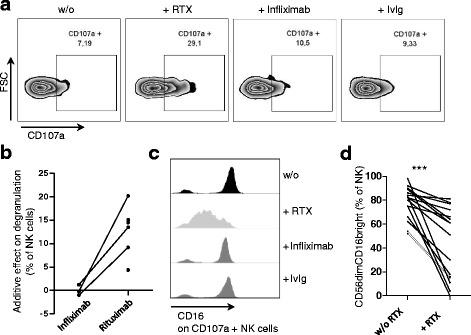
Addition of rituximab to PBMCs resulted in depletion of B cells, which was dependent on NK cells and serum factors. The extent of B cell depletion correlated with the percentage of NK cells. Following incubation with rituximab, NK cells within PBMCs were activated, degranulated and downregulated the low affinitiy Fc-γ-receptor CD16 (FcγRIIIA). The co-activating receptor CD137 (41BB) was upregulated on a fraction of NK cells. NK cell function was altered in some donors in whom we observed rituximab-dependent reduction in NK cell cytotoxicity towards K562 tumor cells.
CONCLUSIONS
NK cells mediate rituximab-induced B cell depletion. Rituximab induces altered NK cell phenotype and function.
背景
利妥昔单抗在风湿性疾病中的应用广泛且不断增加。从淋巴瘤研究中可知,自然杀伤(NK)细胞可裂解被利妥昔单抗包被的转化B细胞。然而,NK细胞在介导利妥昔单抗诱导的非恶性B细胞耗竭中的作用尚不清楚。本研究的目的是提供关于利妥昔单抗对无肿瘤细胞的外周血单个核细胞(PBMC)中NK细胞影响的基础数据,以模拟可能与风湿性疾病患者相关的效应。
方法
将从健康供体新鲜分离的外周血单个核细胞(PBMC)与治疗性抗体过夜培养。使用商业试剂盒分离NK细胞,或使用抗CD56和抗CD16单克隆抗体及磁珠从PBMC中去除NK细胞。通过多色流式细胞术分析细胞。使用(51)Cr标记的K562靶细胞进行细胞毒性测定。
结果
向PBMC中添加利妥昔单抗导致B细胞耗竭,这依赖于NK细胞和血清因子。B细胞耗竭的程度与NK细胞的百分比相关。与利妥昔单抗孵育后,PBMC中的NK细胞被激活、脱颗粒,并下调低亲和力Fc-γ受体CD16(FcγRIIIA)。共激活受体CD137(4-1BB)在一部分NK细胞上上调。在一些供体中,我们观察到利妥昔单抗依赖性地降低了NK细胞对K562肿瘤细胞的细胞毒性,NK细胞功能发生了改变。
结论
NK细胞介导利妥昔单抗诱导的B细胞耗竭。利妥昔单抗诱导NK细胞表型和功能改变。
 Zotero 插件