
高氯血症以及血清氯化物适度升高与严重脓毒症和脓毒性休克患者的急性肾损伤相关。
Hyperchloremia and moderate increase in serum chloride are associated with acute kidney injury in severe sepsis and septic shock patients.
作者信息
Suetrong Bandarn, Pisitsak Chawika, Boyd John H, Russell James A, Walley Keith R
机构信息
Centre for Heart Lung Innovation, St. Paul's Hospital, University of British Columbia, 1081 Burrard Street., Vancouver, BC, V6Z 1Y6, Canada.
Department of Pediatrics, Faculty of Medicine, Thammasat University, Pathum Thani, Thailand.
出版信息
Crit Care. 2016 Oct 6;20(1):315. doi: 10.1186/s13054-016-1499-7.
BACKGROUND
Acute kidney injury and hyperchloremia are commonly present in critically ill septic patients. Our study goal was to evaluate the association of hyperchloremia and acute kidney injury in severe sepsis and septic shock patients.
METHODS
In this retrospective cohort study in a provincial tertiary care hospital, adult patients with severe sepsis or septic shock and serum chloride measurements were included. Serum chloride was measured on a daily basis for 48 hours. Primary outcome was development of acute kidney injury (AKI) and association of AKI and serum chloride parameters was analyzed.
RESULTS
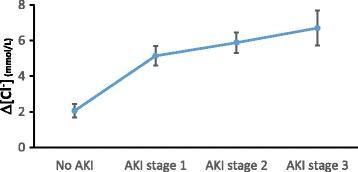
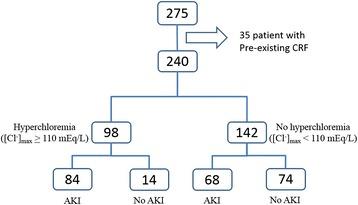
A total of 240 patients were included in the study, 98 patients (40.8 %) had hyperchloremia. The incidence of acute kidney injury (AKI) was significantly higher in the hyperchloremia group (85.7 % vs 47.9 %; p < 0.001). Maximal chloride concentration in the first 48 hours ([Cl]) was significantly associated with AKI. In multivariate analysis, [Cl] was independently associated with AKI [adjusted odds ratio (OR) for AKI = 1.28 (1.02-1.62); p = 0.037]. The increase in serum chloride (Δ[Cl] = [Cl] - initial chloride concentration) demonstrated a dose-dependent relationship with severity of AKI. The mean Δ[Cl] in patients without AKI was 2.1 mmol/L while in the patients with AKI stage 1, 2 and 3 the mean Δ[Cl] was 5.1, 5.9 and 6.7 mmol/L, respectively. A moderate increase in serum chloride (Δ[Cl] ≥ 5 mmol/L) was associated with AKI [OR = 5.70 (3.00-10.82); p < 0.001], even in patients without hyperchloremia [OR = 8.25 (3.44-19.78); p < 0.001].
CONCLUSIONS
Hyperchloremia is common in severe sepsis and septic shock and independently associated with AKI. A moderate increase in serum chloride (Δ[Cl] ≥5 mmol/L) is associated with AKI even in patients without hyperchloremia.
背景
急性肾损伤和高氯血症在重症脓毒症患者中很常见。我们的研究目的是评估严重脓毒症和脓毒性休克患者中高氯血症与急性肾损伤之间的关联。
方法
在一家省级三级护理医院进行的这项回顾性队列研究中,纳入了患有严重脓毒症或脓毒性休克且有血清氯测量值的成年患者。在48小时内每天测量血清氯。主要结局是急性肾损伤(AKI)的发生情况,并分析AKI与血清氯参数之间的关联。
结果
本研究共纳入240例患者,98例(40.8%)患有高氯血症。高氯血症组急性肾损伤(AKI)的发生率显著更高(85.7%对47.9%;p<0.001)。最初48小时内的最大氯浓度([Cl])与AKI显著相关。在多变量分析中,[Cl]与AKI独立相关[AKI的调整优势比(OR)=1.28(1.02 - 1.62);p = 0.037]。血清氯的升高(Δ[Cl]=[Cl] - 初始氯浓度)与AKI的严重程度呈剂量依赖性关系。无AKI患者的平均Δ[Cl]为2.1 mmol/L,而AKI 1期、2期和3期患者的平均Δ[Cl]分别为5.1、5.9和6.7 mmol/L。血清氯适度升高(Δ[Cl]≥5 mmol/L)与AKI相关[OR = 5.70(3.00 - 10.82);p<0.001],即使在无高氯血症的患者中也是如此[OR = 8.25(3.44 - 19.78);p<0.001]。
结论
高氯血症在严重脓毒症和脓毒性休克中很常见,且与AKI独立相关。即使在无高氯血症的患者中,血清氯适度升高(Δ[Cl]≥5 mmol/L)也与AKI相关。
 Zotero 插件