
内分泌干扰:邻苯二甲酸二(2-乙基己基)酯及其五种主要代谢物与孕酮受体相互作用的计算机模拟视角
Endocrine disruption: In silico perspectives of interactions of di-(2-ethylhexyl)phthalate and its five major metabolites with progesterone receptor.
作者信息
Sheikh Ishfaq A, Abu-Elmagd Muhammad, Turki Rola F, Damanhouri Ghazi A, Beg Mohd A, Al-Qahtani Mohammed
机构信息
King Fahd Medical Research Center, King Abdulaziz University, PO Box 80216, Jeddah, 21589, Kingdom of Saudi Arabia.
Centre of Excellence in Genomic Medicine Research, King Abdulaziz University, Jeddah, Kingdom of Saudi Arabia.
出版信息
BMC Struct Biol. 2016 Sep 30;16(Suppl 1):16. doi: 10.1186/s12900-016-0066-4.
BACKGROUND
Di-(2-ethylhexyl)phthalate (DEHP) is a common endocrine disrupting compound (EDC) present in the environment as a result of industrial activity and leaching from polyvinyl products. DEHP is used as a plasticizer in medical devices and many commercial and household items. Exposure occurs through inhalation, ingestion, and skin contact. DEHP is metabolized to a primary metabolite mono-(2-ethylhexyl)phthalate (MEHP) in the body, which is further metabolized to four major secondary metabolites, mono(2-ethyl-5-hydroxyhexyl)phthalate (5-OH-MEHP), mono(2-ethyl-5-oxyhexyl)phthalate (5-oxo-MEHP), mono(2-ethyl-5-carboxypentyl)phthalate (5-cx-MEPP) and mono[2-(carboxymethyl)hexyl]phthalate (2-cx-MMHP). DEHP and its metabolites are associated with developmental abnormalities and reproductive dysfunction within the human population. Progesterone receptor (PR) signaling is involved in important reproductive functions and is a potential target for endocrine disrupting activities of DEHP and its metabolites. This study used in silico approaches for structural binding analyses of DEHP and its five indicated major metabolites with PR.
METHODS
Protein Data bank was searched to retrieve the crystal structure of human PR (Id: 1SQN). PubChem database was used to obtain the structures of DEHP and its five metabolites. Docking was performed using Glide (Schrodinger) Induced Fit Docking module.
RESULTS
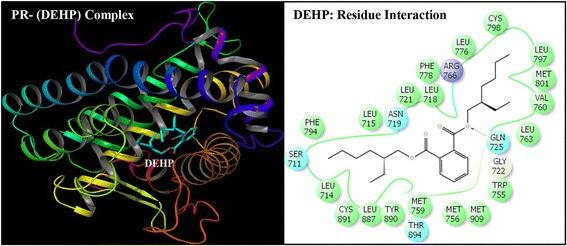
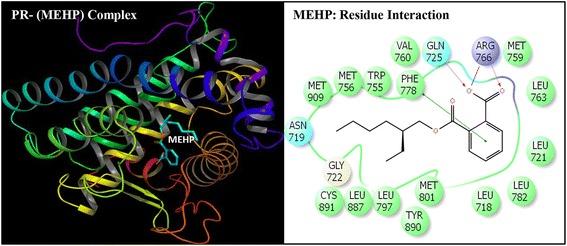
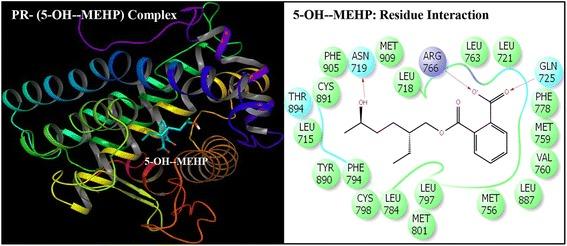
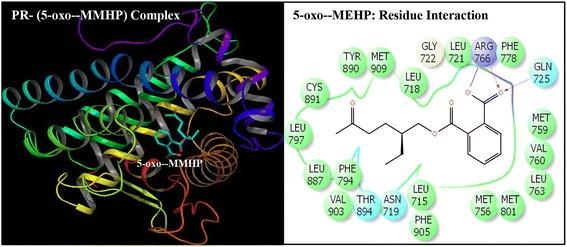
DEHP and its metabolites interacted with 19-25 residues of PR with the majority of the interacting residues overlapping (82-95 % commonality) with the native bound ligand norethindrone (NET). DEHP and each of its five metabolites formed a hydrogen bonding interaction with residue Gln-725 of PR. The binding affinity was highest for NET followed by DEHP, 5-OH-MEHP, 5-oxo-MEHP, MEHP, 5-cx-MEPP, and 2-cx-MMHP.
CONCLUSION
The high binding affinity of DEHP and its five major metabolites with PR as well as a high rate of overlap between PR interacting residues among DEHP and its metabolites and the native ligand, NET, suggested their disrupting potential in normal PR signaling, resulting in adverse reproductive effects.
背景
邻苯二甲酸二(2-乙基己基)酯(DEHP)是一种常见的内分泌干扰化合物(EDC),由于工业活动以及从聚乙烯产品中渗出而存在于环境中。DEHP被用作医疗设备以及许多商业和家用物品中的增塑剂。可通过吸入、摄入和皮肤接触发生暴露。DEHP在体内代谢为主要代谢产物单(2-乙基己基)邻苯二甲酸酯(MEHP),MEHP进一步代谢为四种主要的次要代谢产物,即单(2-乙基-5-羟基己基)邻苯二甲酸酯(5-OH-MEHP)、单(2-乙基-5-氧代己基)邻苯二甲酸酯(5-oxo-MEHP)、单(2-乙基-5-羧基戊基)邻苯二甲酸酯(5-cx-MEPP)和单[2-(羧甲基)己基]邻苯二甲酸酯(2-cx-MMHP)。DEHP及其代谢产物与人群中的发育异常和生殖功能障碍有关。孕酮受体(PR)信号传导参与重要的生殖功能,并且是DEHP及其代谢产物内分泌干扰活性的潜在靶点。本研究使用计算机模拟方法对DEHP及其五种指定的主要代谢产物与PR进行结构结合分析。
方法
在蛋白质数据库中进行搜索以检索人PR的晶体结构(编号:1SQN)。使用PubChem数据库获取DEHP及其五种代谢产物的结构。使用Glide(薛定谔公司)诱导契合对接模块进行对接。
结果
DEHP及其代谢产物与PR的19 - 25个残基相互作用,大多数相互作用残基与天然结合配体炔诺酮(NET)重叠(共性为82 - 95%)。DEHP及其五种代谢产物中的每一种都与PR的Gln-725残基形成氢键相互作用。结合亲和力最高的是NET,其次是DEHP、5-OH-MEHP、5-oxo-MEHP、MEHP、5-cx-MEPP和2-cx-MMHP。
结论
DEHP及其五种主要代谢产物与PR的高结合亲和力,以及DEHP及其代谢产物与天然配体NET之间PR相互作用残基的高重叠率,表明它们对正常PR信号传导具有干扰潜力,从而导致不良生殖效应。




 Zotero 插件