
1990 - 2015年全球、区域和国家315种疾病和损伤的伤残调整生命年(DALYs)及健康预期寿命(HALE):全球疾病负担研究2015的系统分析
Global, regional, and national disability-adjusted life-years (DALYs) for 315 diseases and injuries and healthy life expectancy (HALE), 1990-2015: a systematic analysis for the Global Burden of Disease Study 2015.
出版信息
Lancet. 2016 Oct 8;388(10053):1603-1658. doi: 10.1016/S0140-6736(16)31460-X.
BACKGROUND
Healthy life expectancy (HALE) and disability-adjusted life-years (DALYs) provide summary measures of health across geographies and time that can inform assessments of epidemiological patterns and health system performance, help to prioritise investments in research and development, and monitor progress toward the Sustainable Development Goals (SDGs). We aimed to provide updated HALE and DALYs for geographies worldwide and evaluate how disease burden changes with development.
METHODS
We used results from the Global Burden of Diseases, Injuries, and Risk Factors Study 2015 (GBD 2015) for all-cause mortality, cause-specific mortality, and non-fatal disease burden to derive HALE and DALYs by sex for 195 countries and territories from 1990 to 2015. We calculated DALYs by summing years of life lost (YLLs) and years of life lived with disability (YLDs) for each geography, age group, sex, and year. We estimated HALE using the Sullivan method, which draws from age-specific death rates and YLDs per capita. We then assessed how observed levels of DALYs and HALE differed from expected trends calculated with the Socio-demographic Index (SDI), a composite indicator constructed from measures of income per capita, average years of schooling, and total fertility rate.
FINDINGS
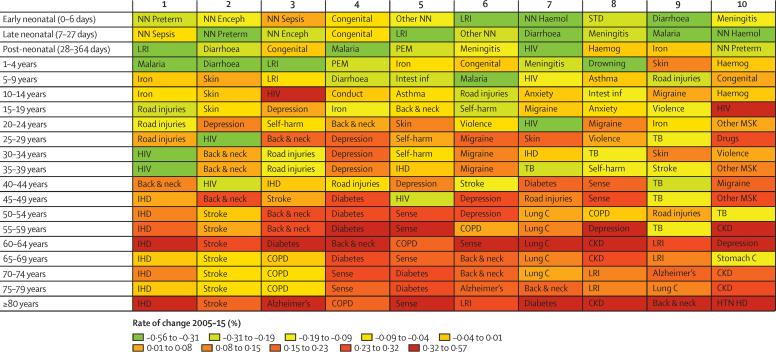
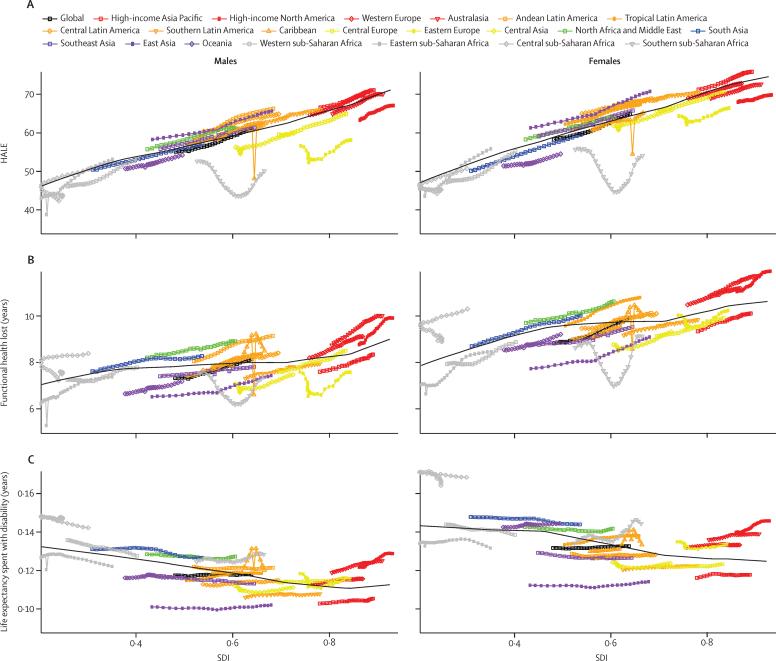
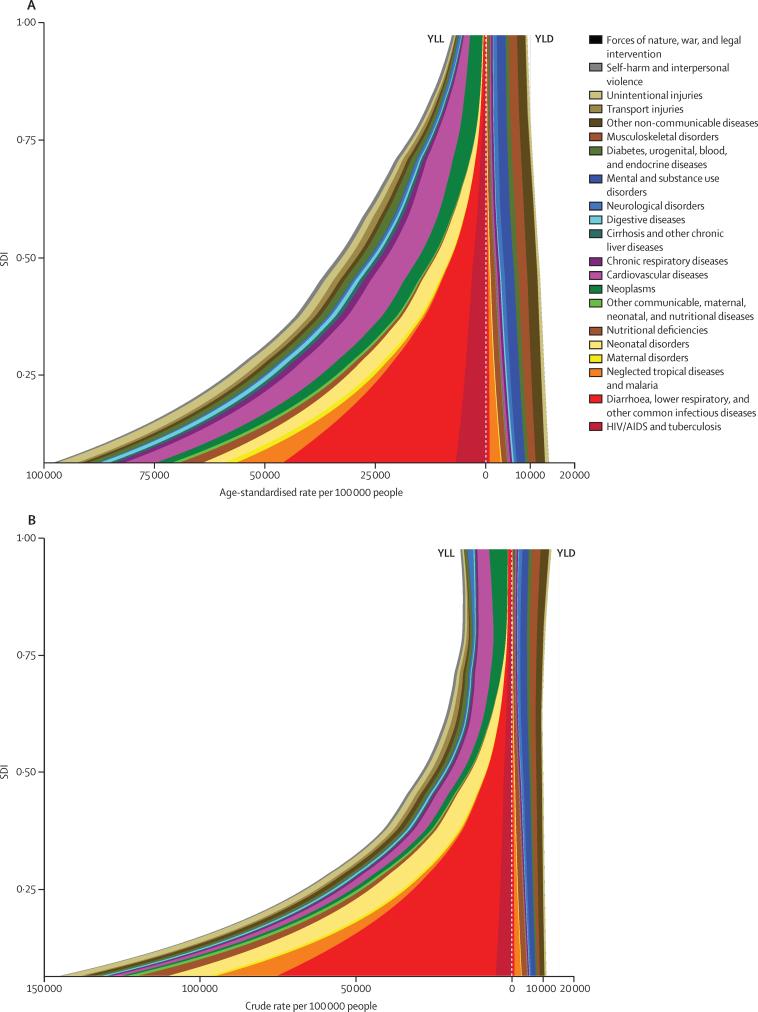
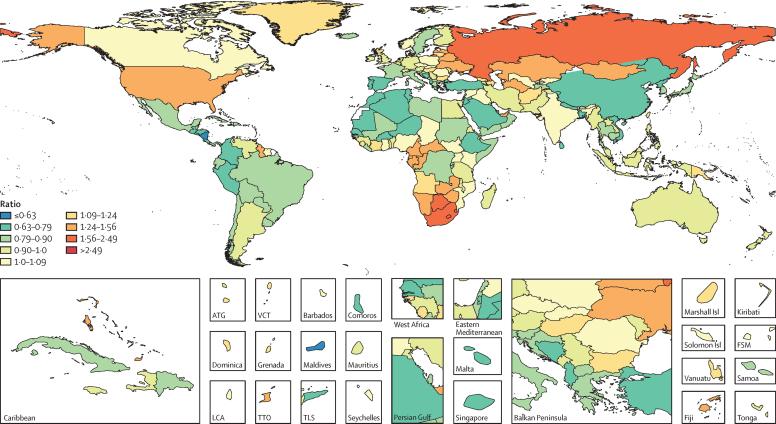
Total global DALYs remained largely unchanged from 1990 to 2015, with decreases in communicable, neonatal, maternal, and nutritional (Group 1) disease DALYs offset by increased DALYs due to non-communicable diseases (NCDs). Much of this epidemiological transition was caused by changes in population growth and ageing, but it was accelerated by widespread improvements in SDI that also correlated strongly with the increasing importance of NCDs. Both total DALYs and age-standardised DALY rates due to most Group 1 causes significantly decreased by 2015, and although total burden climbed for the majority of NCDs, age-standardised DALY rates due to NCDs declined. Nonetheless, age-standardised DALY rates due to several high-burden NCDs (including osteoarthritis, drug use disorders, depression, diabetes, congenital birth defects, and skin, oral, and sense organ diseases) either increased or remained unchanged, leading to increases in their relative ranking in many geographies. From 2005 to 2015, HALE at birth increased by an average of 2·9 years (95% uncertainty interval 2·9-3·0) for men and 3·5 years (3·4-3·7) for women, while HALE at age 65 years improved by 0·85 years (0·78-0·92) and 1·2 years (1·1-1·3), respectively. Rising SDI was associated with consistently higher HALE and a somewhat smaller proportion of life spent with functional health loss; however, rising SDI was related to increases in total disability. Many countries and territories in central America and eastern sub-Saharan Africa had increasingly lower rates of disease burden than expected given their SDI. At the same time, a subset of geographies recorded a growing gap between observed and expected levels of DALYs, a trend driven mainly by rising burden due to war, interpersonal violence, and various NCDs.
INTERPRETATION
Health is improving globally, but this means more populations are spending more time with functional health loss, an absolute expansion of morbidity. The proportion of life spent in ill health decreases somewhat with increasing SDI, a relative compression of morbidity, which supports continued efforts to elevate personal income, improve education, and limit fertility. Our analysis of DALYs and HALE and their relationship to SDI represents a robust framework on which to benchmark geography-specific health performance and SDG progress. Country-specific drivers of disease burden, particularly for causes with higher-than-expected DALYs, should inform financial and research investments, prevention efforts, health policies, and health system improvement initiatives for all countries along the development continuum.
FUNDING
Bill & Melinda Gates Foundation.
背景
健康预期寿命(HALE)和伤残调整生命年(DALYs)提供了跨地域和时间的健康综合衡量指标,可用于评估流行病学模式和卫生系统绩效,有助于确定研发投资的优先顺序,并监测可持续发展目标(SDGs)的进展情况。我们旨在提供全球各地区最新的HALE和DALYs,并评估疾病负担如何随发展而变化。
方法
我们使用了《2015年全球疾病、伤害和风险因素研究》(GBD 2015)的结果,包括全因死亡率、特定病因死亡率和非致命疾病负担,以得出1990年至2015年期间195个国家和地区按性别划分的HALE和DALYs。我们通过将每个地区、年龄组、性别和年份的生命损失年数(YLLs)和伤残生命年数(YLDs)相加来计算DALYs。我们使用沙利文方法估计HALE,该方法基于特定年龄死亡率和人均YLDs。然后,我们评估观察到的DALYs和HALE水平与使用社会人口指数(SDI)计算的预期趋势有何不同,SDI是一个由人均收入、平均受教育年限和总生育率衡量指标构建的综合指标。
结果
从1990年到2015年,全球总DALYs基本保持不变,传染病、新生儿、孕产妇和营养(第1组)疾病的DALYs下降被非传染性疾病(NCDs)导致的DALYs增加所抵消。这种流行病学转变的很大一部分是由人口增长和老龄化的变化引起的,但SDI的广泛改善加速了这一转变,而SDI的改善也与NCDs重要性的增加密切相关。到2015年,大多数第1组病因导致的总DALYs和年龄标准化DALY率均显著下降,尽管大多数NCDs的总负担有所上升,但NCDs的年龄标准化DALY率有所下降。尽管如此,几种高负担NCDs(包括骨关节炎、药物使用障碍、抑郁症、糖尿病、先天性出生缺陷以及皮肤、口腔和感官器官疾病)的年龄标准化DALY率要么上升要么保持不变,导致它们在许多地区的相对排名上升。从2005年到2015年,出生时的HALE男性平均增加了2.9岁(95%不确定区间2.9 - 3.0),女性增加了3.5岁(3.4 - 3.7),而65岁时的HALE分别提高了0.85岁(0.78 - 0.92)和1.2岁(1.1 - 1.3)。SDI的上升与持续更高的HALE以及功能健康损失所花费生命的比例略有下降相关;然而,SDI的上升与总残疾的增加有关。中美洲和撒哈拉以南非洲东部的许多国家和地区的疾病负担率低于根据其SDI预期的水平。与此同时,一部分地区的观察到的DALYs水平与预期水平之间的差距不断扩大,这一趋势主要由战争、人际暴力和各种NCDs导致的负担上升所驱动。
解读
全球健康状况正在改善,但这意味着更多人口在功能健康损失方面花费更多时间,即发病率的绝对增加。随着SDI的增加,健康不佳所花费生命的比例有所下降,即发病率的相对压缩,这支持继续努力提高个人收入、改善教育和限制生育。我们对DALYs和HALE及其与SDI关系的分析代表了一个强大的框架,可据此对特定地区的健康绩效和SDG进展进行基准评估。特定国家的疾病负担驱动因素,特别是对于DALYs高于预期的病因,应为所有处于不同发展阶段的国家的财政和研究投资、预防努力、卫生政策以及卫生系统改善举措提供参考。
资金来源
比尔及梅琳达·盖茨基金会


 Zotero 插件