
CMR 估算心肌细胞外容积可预测急性心肌梗死后的功能恢复。
Myocardial Extracellular Volume Estimation by CMR Predicts Functional Recovery Following Acute MI.
机构信息
Multidisciplinary Cardiovascular Research Centre and Division of Biomedical Imaging, Leeds Institute of Cardiovascular and Metabolic Medicine, University of Leeds, Leeds, United Kingdom.
Multidisciplinary Cardiovascular Research Centre and Division of Biomedical Imaging, Leeds Institute of Cardiovascular and Metabolic Medicine, University of Leeds, Leeds, United Kingdom; Department of Medical Physics and Engineering, Leeds Teaching Hospitals NHS Trust, Leeds, United Kingdom.
出版信息
JACC Cardiovasc Imaging. 2017 Sep;10(9):989-999. doi: 10.1016/j.jcmg.2016.06.015. Epub 2016 Oct 19.
OBJECTIVES
In the setting of reperfused acute myocardial infarction (AMI), the authors sought to compare prediction of contractile recovery by infarct extracellular volume (ECV), as measured by T1-mapping cardiac magnetic resonance (CMR), with late gadolinium enhancement (LGE) transmural extent.
BACKGROUND
The transmural extent of myocardial infarction as assessed by LGE CMR is a strong predictor of functional recovery, but accuracy of the technique may be reduced in AMI. ECV mapping by CMR can provide a continuous measure associated with the severity of tissue damage within infarcted myocardium.
METHODS
Thirty-nine patients underwent acute (day 2) and convalescent (3 months) CMR scans following AMI. Cine imaging, tissue tagging, T2-weighted imaging, modified Look-Locker inversion T1 mapping natively and 15 min post-gadolinium-contrast administration, and LGE imaging were performed. The ability of acute infarct ECV and acute transmural extent of LGE to predict convalescent wall motion, ejection fraction (EF), and strain were compared per-segment and per-patient.
RESULTS
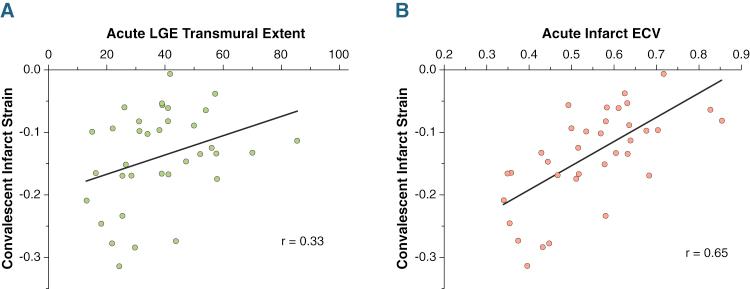
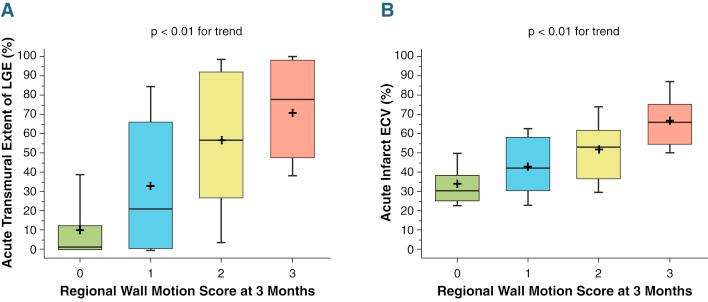
Per-segment, acute ECV and LGE transmural extent were associated with convalescent wall motion score (p < 0.01; p < 0.01, respectively). ECV had higher accuracy than LGE extent to predict improved wall motion (area under receiver-operating characteristics curve 0.77 vs. 0.66; p = 0.02). Infarct ECV ≤0.5 had sensitivity 81% and specificity 65% for prediction of improvement in segmental function; LGE transmural extent ≤0.5 had sensitivity 61% and specificity 71%. Per-patient, ECV and LGE correlated with convalescent wall motion score (r = 0.45; p < 0.01; r = 0.41; p = 0.02, respectively) and convalescent EF (p < 0.01; p = 0.04). ECV and LGE extent were not significantly correlated (r = 0.34; p = 0.07). In multivariable linear regression analysis, acute infarct ECV was independently associated with convalescent infarct strain and EF (p = 0.03; p = 0.04), whereas LGE was not (p = 0.29; p = 0.24).
CONCLUSIONS
Acute infarct ECV in reperfused AMI can complement LGE assessment as an additional predictor of regional and global LV functional recovery that is independent of transmural extent of infarction.
目的
在再灌注急性心肌梗死(AMI)的情况下,作者试图比较通过 T1 映射心脏磁共振(CMR)测量的梗死细胞外容积(ECV)对收缩功能恢复的预测与晚期钆增强(LGE)透壁程度。
背景
通过 LGE CMR 评估的心肌梗死透壁程度是功能恢复的强有力预测因素,但该技术的准确性在 AMI 中可能会降低。CMR 的 ECV 映射可以提供与梗死心肌内组织损伤严重程度相关的连续测量值。
方法
39 例 AMI 患者在急性(第 2 天)和恢复期(3 个月)进行 CMR 扫描。进行电影成像、组织标记、T2 加权成像、改良 Look-Locker 反转 T1 映射原生和 15 分钟钆对比剂给药后,以及 LGE 成像。比较每节段和每例患者的急性梗死 ECV 和急性 LGE 透壁程度对恢复期壁运动、射血分数(EF)和应变的预测能力。
结果
每节段的急性 ECV 和 LGE 透壁程度与恢复期壁运动评分相关(p<0.01;p<0.01,分别)。ECV 比 LGE 程度更能准确预测壁运动改善(受试者工作特征曲线下面积 0.77 与 0.66;p=0.02)。ECV≤0.5 预测节段功能改善的敏感性为 81%,特异性为 65%;LGE 透壁程度≤0.5 的敏感性为 61%,特异性为 71%。每例患者的 ECV 和 LGE 与恢复期壁运动评分相关(r=0.45;p<0.01;r=0.41;p=0.02,分别)和恢复期 EF(p<0.01;p=0.04)。ECV 和 LGE 程度无显著相关性(r=0.34;p=0.07)。多变量线性回归分析显示,急性梗死 ECV 与恢复期梗死应变和 EF 独立相关(p=0.03;p=0.04),而 LGE 则无相关性(p=0.29;p=0.24)。
结论
再灌注 AMI 中的急性梗死 ECV 可补充 LGE 评估,作为区域性和整体 LV 功能恢复的另一个预测因子,与梗死透壁程度无关。




 Zotero 插件