
CHOiCE试验方案:一项针对未参加有组织宫颈癌筛查项目者的基于家庭的HPV自我采样的三臂随机对照试验。
Study protocol of the CHOiCE trial: a three-armed, randomized, controlled trial of home-based HPV self-sampling for non-participants in an organized cervical cancer screening program.
作者信息
Tranberg Mette, Bech Bodil Hammer, Blaakær Jan, Jensen Jørgen Skov, Svanholm Hans, Andersen Berit
机构信息
Department of Public Health Programmes, Randers Regional Hospital, Skovlyvej 15, 8930, Randers, NØ, Denmark.
Department of Public Health, Section for Epidemiology, Aarhus University, Bartholins Allé 2, 8000, Aarhus C, Denmark.
出版信息
BMC Cancer. 2016 Nov 3;16(1):835. doi: 10.1186/s12885-016-2859-z.
BACKGROUND
The effectiveness of cervical cancer screening programs is challenged by suboptimal participation and coverage. Offering cervico-vaginal self-sampling for human papillomavirus testing (HPV self-sampling) to non-participants can increase screening participation. However, the effect varies substantially among studies, especially depending on the approach used to offer HPV self-sampling. The present trial evaluates the effect on participation in an organized screening program of a HPV self-sampling kit mailed directly to the home of the woman or mailed to the woman's home on demand only, compared with the standard second reminder for regular screening.
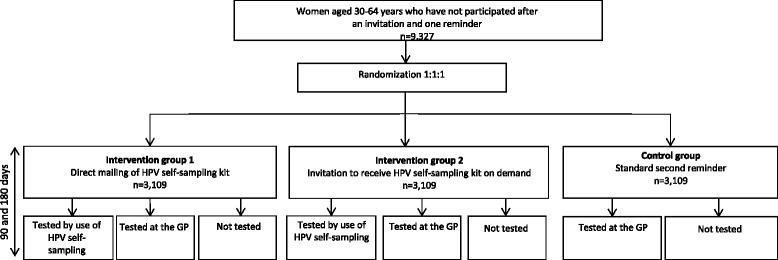
METHODS/DESIGN: The CHOiCE trial is a parallel, randomized, controlled, open-label trial. It will include 9327 women aged 30-64 years who are living in the Central Denmark Region and who have not participated in cervical cancer screening after an invitation and one reminder. The women will be equally randomized into three arms: 1) Directly mailed a second reminder including a HPV self-sampling kit; 2) Mailed a second reminder offering a HPV self-sampling kit, to be ordered by e-mail, text message, phone, or through a webpage; and 3) Mailed a second reminder for a practitioner-collected sample (control group). The primary outcome will be the proportion of women in the intervention groups who participate by returning their HPV self-sampling kit or have a practitioner-collected sample compared with the proportion of women who have a practitioner-collected sample in the control group at 90 and 180 days after mail out of the second reminders. Per-protocol and intention-to-treat analyses will be performed. The secondary outcome will be the proportion of women with a positive HPV self-collected sample who attend follow-up testing at 30, 60, or 90 days after mail out of the results.
DISCUSSION
The CHOiCE trial will provide strong and important evidence allowing us to determine if and how HPV self-sampling can be used to increase participation in cervical cancer screening. This trial therefore has the potential to improve prevention and reduce the number of deaths caused by cervical cancer.
TRIAL REGISTRATION
Current Controlled Trials NCT02680262 . Registered 10 February 2016.
背景
宫颈癌筛查项目的有效性受到参与度和覆盖率不理想的挑战。向未参与者提供宫颈阴道自我采样进行人乳头瘤病毒检测(HPV自我采样)可提高筛查参与度。然而,不同研究的效果差异很大,尤其是取决于提供HPV自我采样的方式。本试验评估直接邮寄到女性家中或仅按需邮寄到女性家中的HPV自我采样试剂盒对参与有组织筛查项目的影响,与常规筛查的标准第二次提醒进行比较。
方法/设计:CHOiCE试验是一项平行、随机、对照、开放标签试验。将纳入9327名年龄在30 - 64岁之间、居住在丹麦中部地区且在收到邀请和一次提醒后未参加宫颈癌筛查的女性。这些女性将被等比例随机分为三组:1)直接邮寄第二次提醒,包括一个HPV自我采样试剂盒;2)邮寄第二次提醒,提供HPV自我采样试剂盒,可通过电子邮件、短信、电话或网页订购;3)邮寄第二次提醒,要求由医护人员采集样本(对照组)。主要结局将是干预组中通过返还HPV自我采样试剂盒参与或有医护人员采集样本的女性比例,与第二次提醒寄出后90天和180天时对照组中有医护人员采集样本的女性比例进行比较。将进行符合方案分析和意向性分析。次要结局将是HPV自我采集样本呈阳性的女性在结果寄出后30、60或90天参加后续检测的比例。
讨论
CHOiCE试验将提供有力且重要的证据,使我们能够确定HPV自我采样是否以及如何用于提高宫颈癌筛查的参与度。因此,该试验有可能改善预防措施并减少宫颈癌导致的死亡人数。
试验注册
当前受控试验NCT02680262。2016年2月10日注册。
 Zotero 插件