
代谢通量的蛋白质成本:基于酶促速率定律和成本最小化的预测
The Protein Cost of Metabolic Fluxes: Prediction from Enzymatic Rate Laws and Cost Minimization.
作者信息
Noor Elad, Flamholz Avi, Bar-Even Arren, Davidi Dan, Milo Ron, Liebermeister Wolfram
机构信息
Institute of Molecular Systems Biology, Eidgenössische Technische Hochschule, Zürich, Switzerland.
Department of Molecular and Cellular Biology, University of California, Berkeley, Berkeley, California, United States of America.
出版信息
PLoS Comput Biol. 2016 Nov 3;12(11):e1005167. doi: 10.1371/journal.pcbi.1005167. eCollection 2016 Nov.
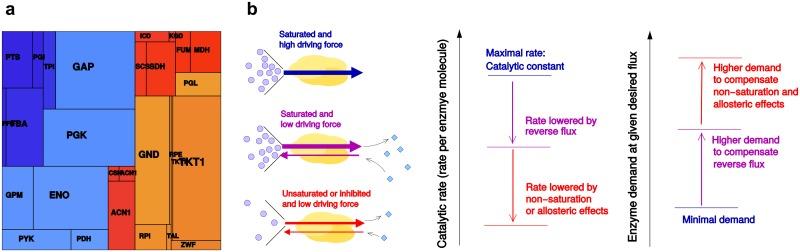
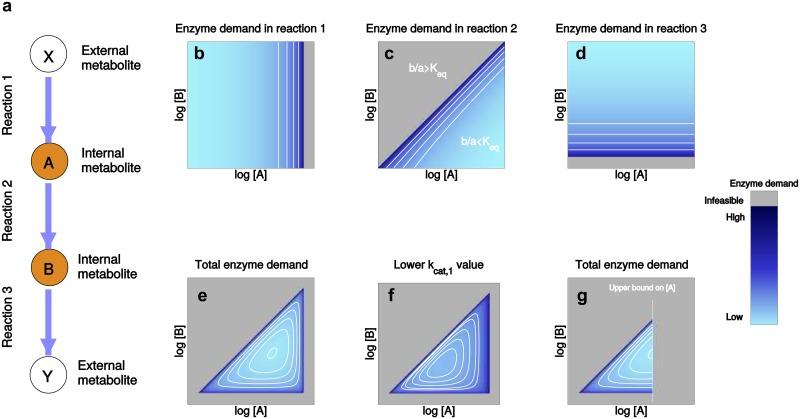
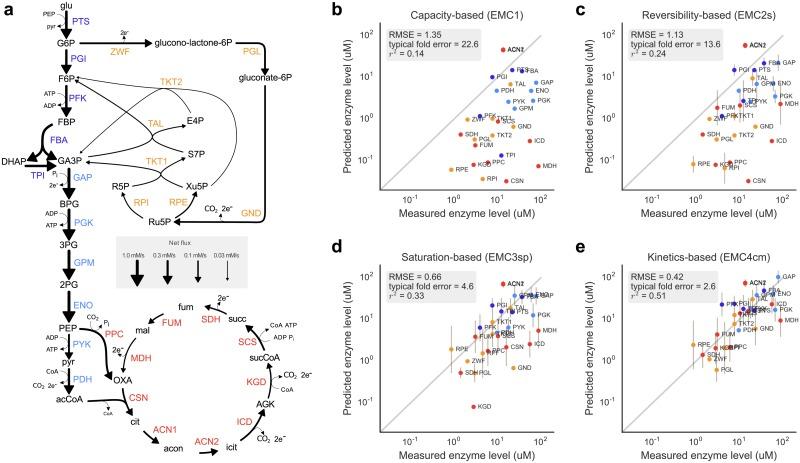
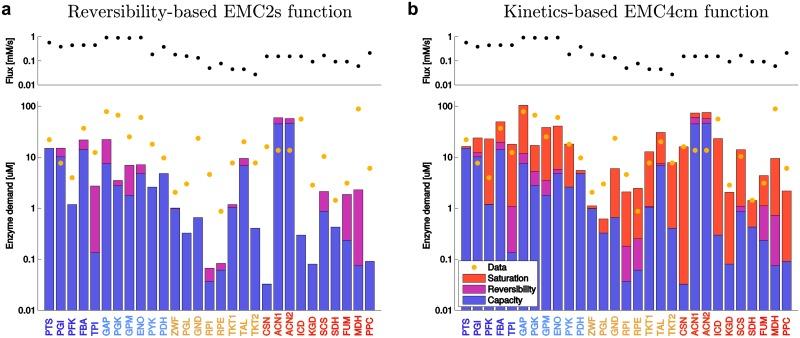
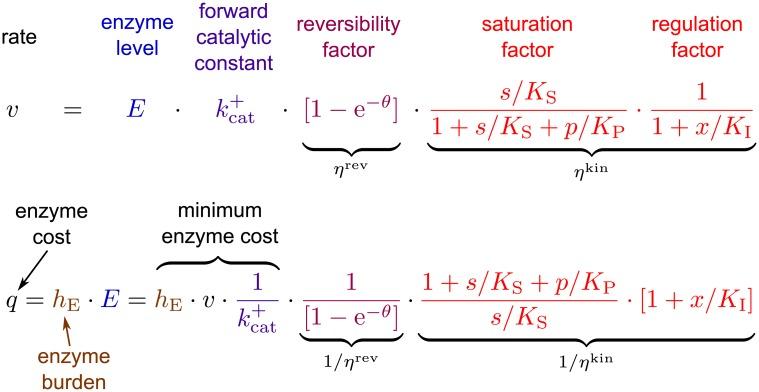
Bacterial growth depends crucially on metabolic fluxes, which are limited by the cell's capacity to maintain metabolic enzymes. The necessary enzyme amount per unit flux is a major determinant of metabolic strategies both in evolution and bioengineering. It depends on enzyme parameters (such as kcat and KM constants), but also on metabolite concentrations. Moreover, similar amounts of different enzymes might incur different costs for the cell, depending on enzyme-specific properties such as protein size and half-life. Here, we developed enzyme cost minimization (ECM), a scalable method for computing enzyme amounts that support a given metabolic flux at a minimal protein cost. The complex interplay of enzyme and metabolite concentrations, e.g. through thermodynamic driving forces and enzyme saturation, would make it hard to solve this optimization problem directly. By treating enzyme cost as a function of metabolite levels, we formulated ECM as a numerically tractable, convex optimization problem. Its tiered approach allows for building models at different levels of detail, depending on the amount of available data. Validating our method with measured metabolite and protein levels in E. coli central metabolism, we found typical prediction fold errors of 4.1 and 2.6, respectively, for the two kinds of data. This result from the cost-optimized metabolic state is significantly better than randomly sampled metabolite profiles, supporting the hypothesis that enzyme cost is important for the fitness of E. coli. ECM can be used to predict enzyme levels and protein cost in natural and engineered pathways, and could be a valuable computational tool to assist metabolic engineering projects. Furthermore, it establishes a direct connection between protein cost and thermodynamics, and provides a physically plausible and computationally tractable way to include enzyme kinetics into constraint-based metabolic models, where kinetics have usually been ignored or oversimplified.
细菌生长关键取决于代谢通量,而代谢通量受细胞维持代谢酶能力的限制。单位通量所需的酶量是进化和生物工程中代谢策略的主要决定因素。它不仅取决于酶参数(如催化常数kcat和米氏常数KM),还取决于代谢物浓度。此外,不同酶的相似量可能会给细胞带来不同成本,这取决于酶的特定属性,如蛋白质大小和半衰期。在此,我们开发了酶成本最小化(ECM)方法,这是一种可扩展的方法,用于计算以最小蛋白质成本支持给定代谢通量的酶量。酶和代谢物浓度之间复杂的相互作用,例如通过热力学驱动力和酶饱和作用,使得直接解决这个优化问题变得困难。通过将酶成本视为代谢物水平的函数,我们将ECM公式化为一个数值上易于处理的凸优化问题。其分层方法允许根据可用数据量构建不同详细程度的模型。通过用大肠杆菌中心代谢中测量的代谢物和蛋白质水平验证我们的方法,我们发现这两种数据的典型预测倍数误差分别为4.1和2.6。成本优化的代谢状态得出的这一结果明显优于随机采样的代谢物谱,支持了酶成本对大肠杆菌适应性很重要这一假设。ECM可用于预测天然和工程途径中的酶水平和蛋白质成本,并且可能是协助代谢工程项目的有价值的计算工具。此外,它在蛋白质成本和热力学之间建立了直接联系,并提供了一种物理上合理且计算上易于处理的方法,将酶动力学纳入基于约束的代谢模型,而在这些模型中,动力学通常被忽略或过度简化。



 Zotero 插件