
是时候做决定了?动力学分析预测血管生成过程中会出现部分尖端/柄部模式状态。
Time to Decide? Dynamical Analysis Predicts Partial Tip/Stalk Patterning States Arise during Angiogenesis.
作者信息
Venkatraman Lakshmi, Regan Erzsébet Ravasz, Bentley Katie
机构信息
Centre for Vascular Biology Research, Beth Israel Deaconess Medical Center, Harvard Medical School, Boston, Massachusetts, United States of America.
Department of Biochemistry and Molecular Biology, The College of Wooster, Wooster, Ohio, United States of America.
出版信息
PLoS One. 2016 Nov 15;11(11):e0166489. doi: 10.1371/journal.pone.0166489. eCollection 2016.
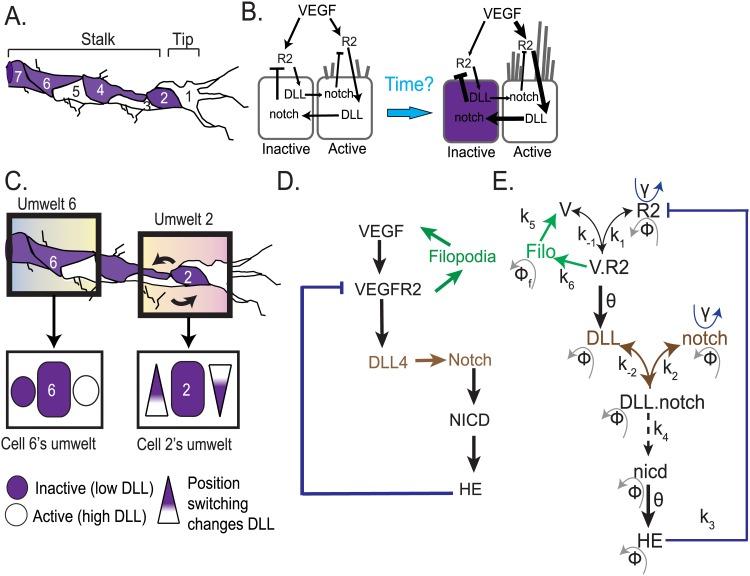
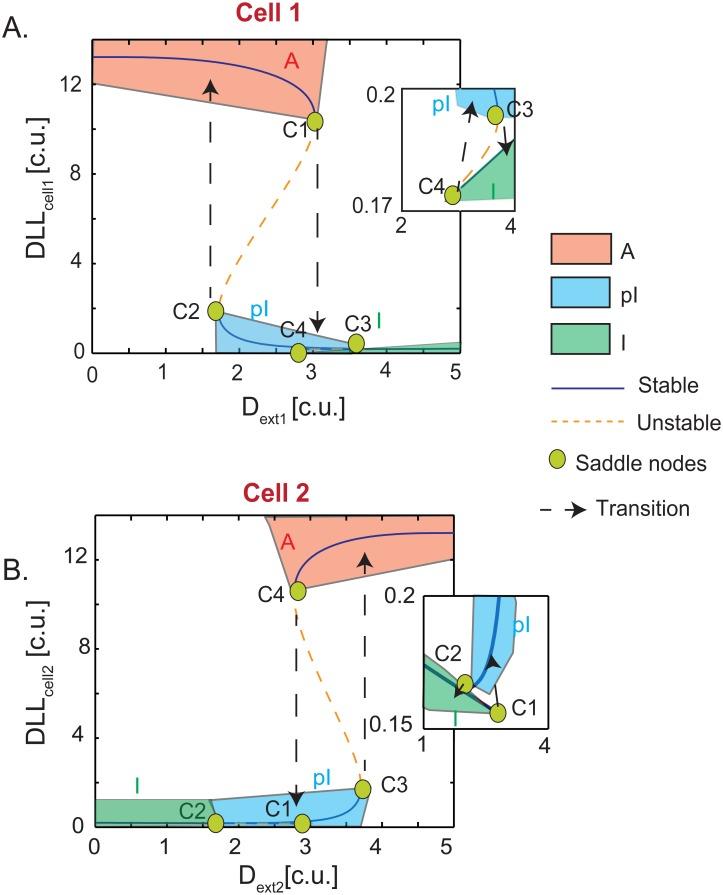
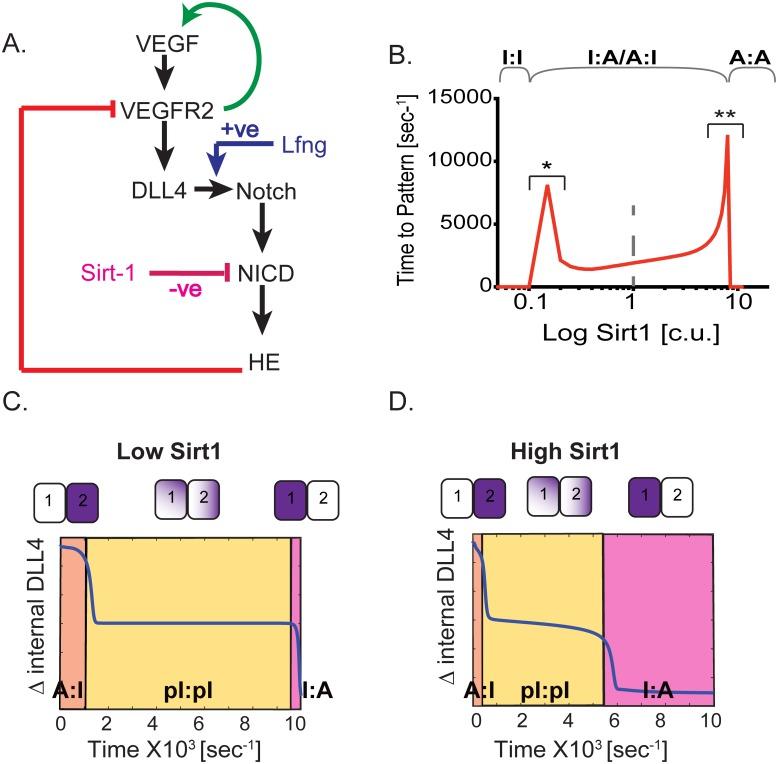
Angiogenesis is a highly dynamic morphogenesis process; however, surprisingly little is known about the timing of the different molecular processes involved. Although the role of the VEGF-notch-DLL4 signaling pathway has been established as essential for tip/stalk cell competition during sprouting, the speed and dynamic properties of the underlying process at the individual cell level has not been fully elucidated. In this study, using mathematical modeling we investigate how specific, biologically meaningful, local conditions around and within an individual cell can influence their unique tip/stalk phenotype switching kinetics. To this end we constructed an ordinary differential equation model of VEGF-notch-DLL4 signaling in a system of two, coupled endothelial cells (EC). Our studies reveal that at any given point in an angiogenic vessel the time it takes a cell to decide to take on a tip or stalk phenotype may be drastically different, and this asynchrony of tip/stalk cell decisions along vessels itself acts to speed up later competitions. We unexpectedly uncover intermediate "partial" yet stable states lying between the tip and stalk cell fates, and identify that internal cellular factors, such as NAD-dependent deacetylase sirtuin-1 (Sirt1) and Lunatic fringe 1 (Lfng1), can specifically determine the length of time a cell spends in these newly identified partial tip/stalk states. Importantly, the model predicts that these partial EC states can arise during normal angiogenesis, in particular during cell rearrangement in sprouts, providing a novel two-stage mechanism for rapid adaptive behavior to the cells highly dynamic environment. Overall, this study demonstrates that different factors (both internal and external to EC) can be used to modulate the speed of tip/stalk decisions, opening up new opportunities and challenges for future biological experiments and therapeutic targeting to manipulate vascular network topology, and our basic understanding of developmental/pathological angiogenesis.
血管生成是一个高度动态的形态发生过程;然而,令人惊讶的是,对于所涉及的不同分子过程的时间安排知之甚少。尽管血管内皮生长因子-Notch-DLL4信号通路在出芽过程中对顶端/柄细胞竞争的作用已被确定为至关重要,但在单个细胞水平上潜在过程的速度和动态特性尚未得到充分阐明。在本研究中,我们使用数学建模来研究单个细胞周围和内部的特定、具有生物学意义的局部条件如何影响其独特的顶端/柄表型转换动力学。为此,我们构建了一个由两个耦合内皮细胞(EC)组成的系统中血管内皮生长因子-Notch-DLL4信号的常微分方程模型。我们的研究表明,在血管生成血管的任何给定时刻,细胞决定呈现顶端或柄表型所需的时间可能会有很大差异,并且沿血管的顶端/柄细胞决定的这种异步性本身会加速后续竞争。我们意外地发现了介于顶端和柄细胞命运之间的中间“部分”但稳定的状态,并确定细胞内因子,如NAD依赖性脱乙酰酶sirtuin-1(Sirt1)和Lunatic fringe 1(Lfng1),可以具体决定细胞在这些新发现的部分顶端/柄状态中停留的时间长度。重要的是,该模型预测这些部分内皮细胞状态可在正常血管生成过程中出现,特别是在芽中的细胞重排期间,为细胞对高度动态环境的快速适应性行为提供了一种新的两阶段机制。总体而言,本研究表明不同因素(内皮细胞内部和外部的因素)可用于调节顶端/柄决定的速度,为未来的生物学实验和治疗靶向以操纵血管网络拓扑结构以及我们对发育/病理性血管生成的基本理解带来了新的机遇和挑战。




 Zotero 插件