
纳入阿尼什纳贝克宫颈癌筛查研究的社区随机对照试验:人乳头瘤病毒自我采样与巴氏细胞学检查对比
Community-randomised controlled trial embedded in the Anishinaabek Cervical Cancer Screening Study: human papillomavirus self-sampling versus Papanicolaou cytology.
作者信息
Zehbe Ingeborg, Jackson Robert, Wood Brianne, Weaver Bruce, Escott Nicholas, Severini Alberto, Krajden Mel, Bishop Lisa, Morrisseau Kyla, Ogilvie Gina, Burchell Ann N, Little Julian
机构信息
Probe Development and Biomarker Exploration, Thunder Bay Regional Research Institute (TBRRI), Thunder Bay, Ontario, Canada.
Department of Biology, Lakehead University, Thunder Bay, Ontario, Canada.
出版信息
BMJ Open. 2016 Oct 8;6(10):e011754. doi: 10.1136/bmjopen-2016-011754.
OBJECTIVES
The incidence of cervical cancer is up to 20-fold higher among First Nations women in Canada than the general population, probably due to lower participation in screening. Offering human papillomavirus (HPV) self-sampling in place of Papanicolaou (Pap) testing may eventually increase screening participation and reduce cervical cancer rates in this population.
DESIGN
A community-randomised controlled screening trial.
SETTING
First Nations communities in Northwest Ontario, Canada.
PARTICIPANTS
Women aged between 25 and 69, living in Robinson Superior Treaty First Nations. The community was the unit of randomisation.
INTERVENTIONS
Women were asked to complete a questionnaire and have screening by HPV self-sampling (arm A) or Pap testing (arm B).
PRIMARY OUTCOME MEASURES
The number of women who participated in cervical screening.
RANDOMISATION
Community clusters were randomised to include approximately equivalent numbers of women in each arm.
RESULTS
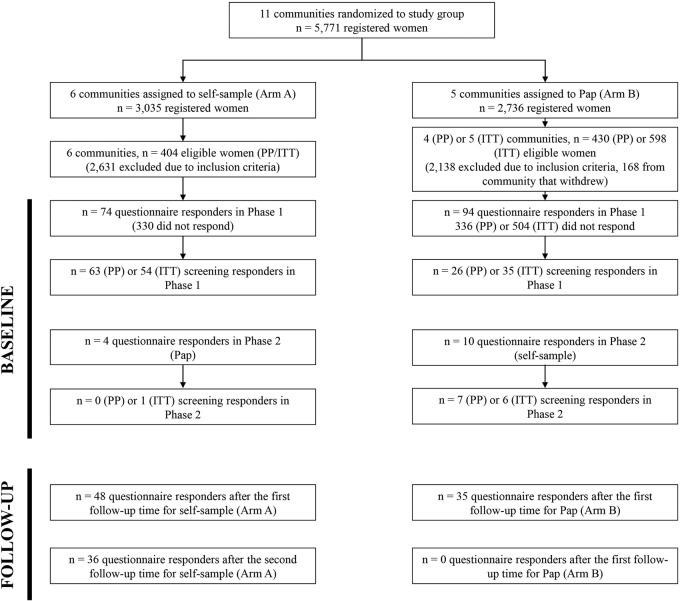
6 communities were randomised to arm A and 5 to arm B. One community withdrew, leaving 5 communities in each group (834 eligible women). Participation was <25%. Using clustered intention-to-treat (ITT) analysis, initial and cumulative averaged uptakes in arm A were 1.4-fold (20% vs 14.3%, p=0.628) and 1.3-fold (20.6% vs 16%, p=0.694) higher compared to arm B, respectively. Corresponding per protocol (PP) analysis indicates 2.2-fold (22.9% vs 10.6%, p=0.305) and 1.6-fold (22.9% vs 14.1%, p=0.448) higher uptakes in arm A compared to arm B. Screening uptake varied between communities (range 0-62.1%). Among women who completed a questionnaire (18.3% in arm A, 21.7% in arm B), the screening uptake was 1.8-fold (ITT; p=0.1132) or 3-fold (PP; p<0.01) higher in arm A versus arm B.
CONCLUSIONS
Pap and HPV self-sampling were compared in a marginalised, Canadian population. Results indicated a preference for self-sampling. More research on how to reach underscreened Indigenous women is necessary.
TRIAL REGISTRATION NUMBER
ISRCTN84617261.
目的
加拿大原住民女性宫颈癌发病率比普通人群高出20倍,这可能是由于她们参与筛查的比例较低。提供人乳头瘤病毒(HPV)自我采样以替代巴氏(Pap)检测,最终可能会提高该人群的筛查参与率并降低宫颈癌发病率。
设计
一项社区随机对照筛查试验。
地点
加拿大安大略省西北部的原住民社区。
参与者
年龄在25至69岁之间、居住在罗宾逊·苏必利尔条约原住民地区的女性。社区是随机分组单位。
干预措施
要求女性填写问卷,并通过HPV自我采样(A组)或巴氏检测(B组)进行筛查。
主要观察指标
参与宫颈筛查的女性人数。
随机分组
将社区群组随机分组,使每组中的女性人数大致相等。
结果
6个社区被随机分入A组,5个社区被随机分入B组。有1个社区退出,每组各剩下5个社区(834名符合条件的女性)。参与率低于25%。采用群组意向性分析(ITT),A组的初始平均参与率和累积平均参与率分别比B组高1.4倍(20%对14.3%,p = 0.628)和1.3倍(20.6%对16%,p = 0.694)。相应的符合方案分析(PP)表明,A组的参与率比B组高2.2倍(22.9%对10.6%,p = 0.305)和1.6倍(22.9%对14.1%,p = 0.448)。不同社区的筛查参与率有所不同(范围为0 - 62.1%)。在完成问卷的女性中(A组为18.3%,B组为21.7%),A组的筛查参与率比B组高1.8倍(ITT;p = 0.1132)或3倍(PP;p < 0.01)。
结论
在加拿大一个边缘化人群中对比了巴氏检测和HPV自我采样。结果表明更倾向于自我采样。有必要针对如何让筛查不足的原住民女性参与筛查开展更多研究。
试验注册号
ISRCTN84617261
 Zotero 插件