
富含二硫键的肽的聚类为通过噬菌体展示发现活性分子提供了支架:应用于白细胞介素-23。
Clustering of disulfide-rich peptides provides scaffolds for hit discovery by phage display: application to interleukin-23.
作者信息
Barkan David T, Cheng Xiao-Li, Celino Herodion, Tran Tran T, Bhandari Ashok, Craik Charles S, Sali Andrej, Smythe Mark L
机构信息
Protagonist Therapeutics, Inc., 521 Cottonwood Drive, Suite 100, Milpitas, CA, 95035-74521, USA.
Department of Pharmaceutical Chemistry, University of California, San Francisco, San Francisco, CA, 94158, USA.
出版信息
BMC Bioinformatics. 2016 Nov 23;17(1):481. doi: 10.1186/s12859-016-1350-9.
BACKGROUND
Disulfide-rich peptides (DRPs) are found throughout nature. They are suitable scaffolds for drug development due to their small cores, whose disulfide bonds impart extraordinary chemical and biological stability. A challenge in developing a DRP therapeutic is to engineer binding to a specific target. This challenge can be overcome by (i) sampling the large sequence space of a given scaffold through a phage display library and by (ii) panning multiple libraries encoding structurally distinct scaffolds. Here, we implement a protocol for defining these diverse scaffolds, based on clustering structurally defined DRPs according to their conformational similarity.
RESULTS
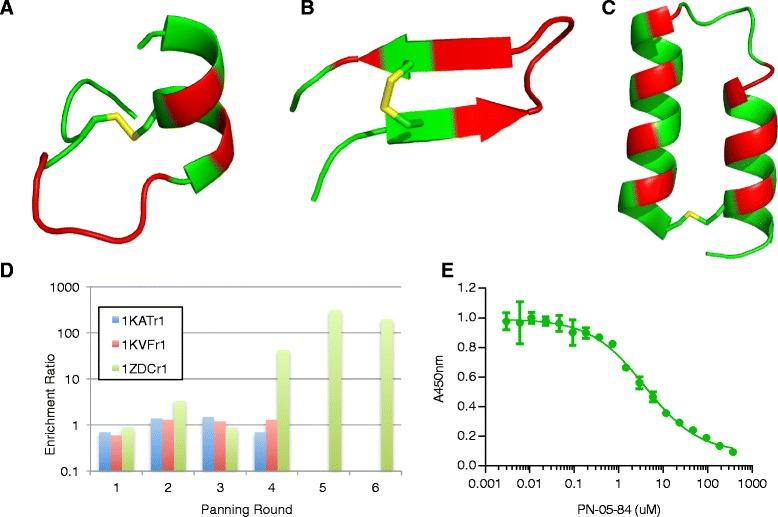
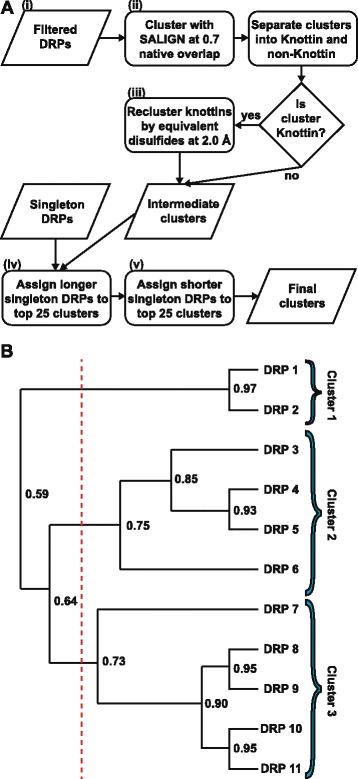
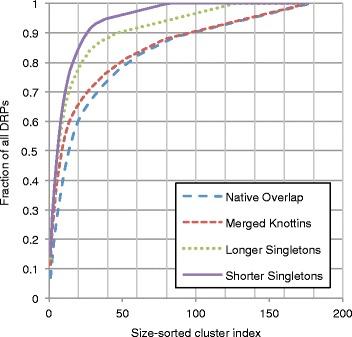
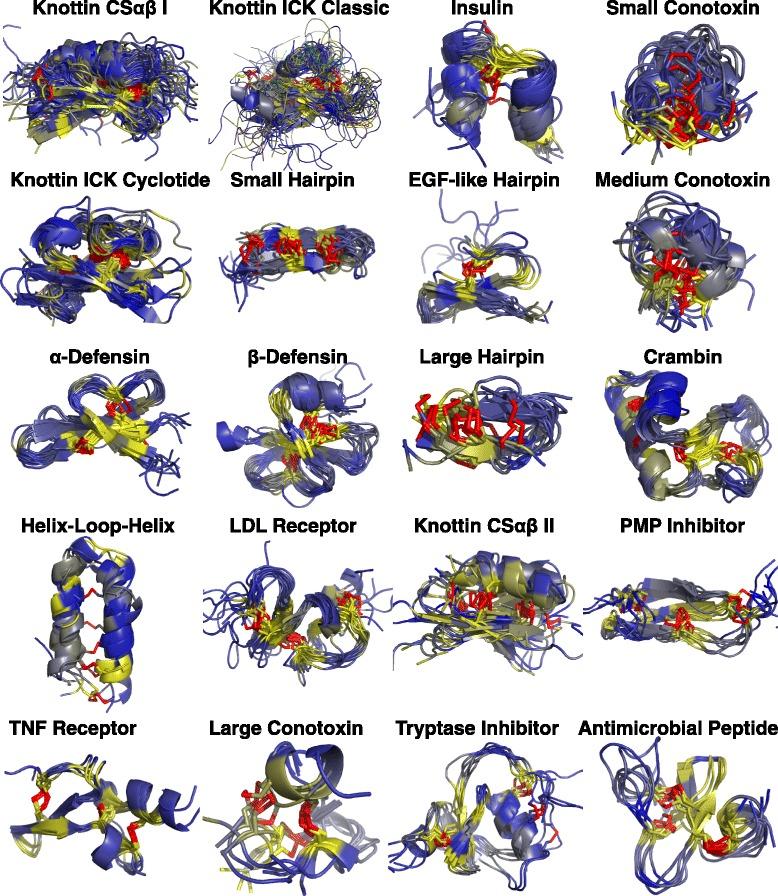
We developed and applied a hierarchical clustering protocol based on DRP structural similarity, followed by two post-processing steps, to classify 806 unique DRP structures into 81 clusters. The 20 most populated clusters comprised 85% of all DRPs. Representative scaffolds were selected from each of these clusters; the representatives were structurally distinct from one another, but similar to other DRPs in their respective clusters. To demonstrate the utility of the clusters, phage libraries were constructed for three of the representative scaffolds and panned against interleukin-23. One library produced a peptide that bound to this target with an IC of 3.3 μM.
CONCLUSIONS
Most DRP clusters contained members that were diverse in sequence, host organism, and interacting proteins, indicating that cluster members were functionally diverse despite having similar structure. Only 20 peptide scaffolds accounted for most of the natural DRP structural diversity, providing suitable starting points for seeding phage display experiments. Through selection of the scaffold surface to vary in phage display, libraries can be designed that present sequence diversity in architecturally distinct, biologically relevant combinations of secondary structures. We supported this hypothesis with a proof-of-concept experiment in which three phage libraries were constructed and panned against the IL-23 target, resulting in a single-digit μM hit and suggesting that a collection of libraries based on the full set of 20 scaffolds increases the potential to identify efficiently peptide binders to a protein target in a drug discovery program.
背景
富含二硫键的肽(DRP)在自然界中广泛存在。由于其核心较小,二硫键赋予其非凡的化学和生物学稳定性,它们是药物开发的合适支架。开发DRP疗法面临的一个挑战是设计与特定靶点的结合。这一挑战可以通过以下方式克服:(i)通过噬菌体展示文库对给定支架的大序列空间进行采样,以及(ii)淘选编码结构不同支架的多个文库。在此,我们实施了一种协议来定义这些不同的支架,该协议基于根据构象相似性对结构定义的DRP进行聚类。
结果
我们开发并应用了一种基于DRP结构相似性的层次聚类协议,随后进行两个后处理步骤,将806个独特的DRP结构分类为81个簇。20个数量最多的簇包含了所有DRP的85%。从这些簇中分别选择了代表性支架;这些代表彼此结构不同,但与其各自簇中的其他DRP相似。为了证明这些簇的实用性,针对三种代表性支架构建了噬菌体文库,并针对白细胞介素-23进行淘选。一个文库产生了一种与该靶点结合的肽,其IC50为3.3 μM。
结论
大多数DRP簇包含在序列、宿主生物体和相互作用蛋白方面存在差异的成员,这表明簇成员尽管结构相似,但功能多样。仅20种肽支架就构成了大多数天然DRP的结构多样性,为启动噬菌体展示实验提供了合适的起点。通过在噬菌体展示中选择不同的支架表面,可以设计出以结构不同、生物学相关的二级结构组合呈现序列多样性的文库。我们通过一个概念验证实验支持了这一假设,在该实验中构建了三个噬菌体文库并针对IL-23靶点进行淘选,得到了个位数微摩尔的命中结果,这表明基于全套20种支架的文库集合增加了在药物发现计划中有效鉴定与蛋白质靶点结合的肽的可能性。
 Zotero 插件