
GLI抑制剂GANT61可使胶质瘤细胞对替莫唑胺治疗敏感。
GANT61, a GLI inhibitor, sensitizes glioma cells to the temozolomide treatment.
作者信息
Li Jianlong, Cai Jinquan, Zhao Shihong, Yao Kun, Sun Ying, Li Yongli, Chen Lingchao, Li Ruiyan, Zhai Xiuwei, Zhang Junhe, Jiang Chuanlu
机构信息
Department of Neurosurgery, The Second Affiliated Hospital of Harbin Medical University, 246 Xuefu Road, Nangang, 150086, Harbin, People's Republic of China.
Chinese Glioma Cooperative Group (CGCG), Beijing, 100050, China.
出版信息
J Exp Clin Cancer Res. 2016 Nov 28;35(1):184. doi: 10.1186/s13046-016-0463-3.
BACKGROUND
The aim of this study was to investigate the effect of downregulating Hedgehog pathway by GANT61 on human glioma cells, examine the consequent changes of temozolomide (TMZ)-induced effects and explore the molecular mechanisms.
METHODS
The cytotoxicity of a Gli1/2 inhibitor, GANT61 was examined both alone and in combination with TMZ in human glioma cell lines. The mRNA and protein expression alterations were determined by quantitative real-time polymerase chain reaction (qRT-PCR) and Western blot, respectively. CCK-8 assay detected the cell proliferative capability. Apoptotic cell number was measured by flow cytometry. The transwell assay was used to test the cell invasive capability. DNA damage effect was identified by COMET assay and γH2AX expression.
RESULTS
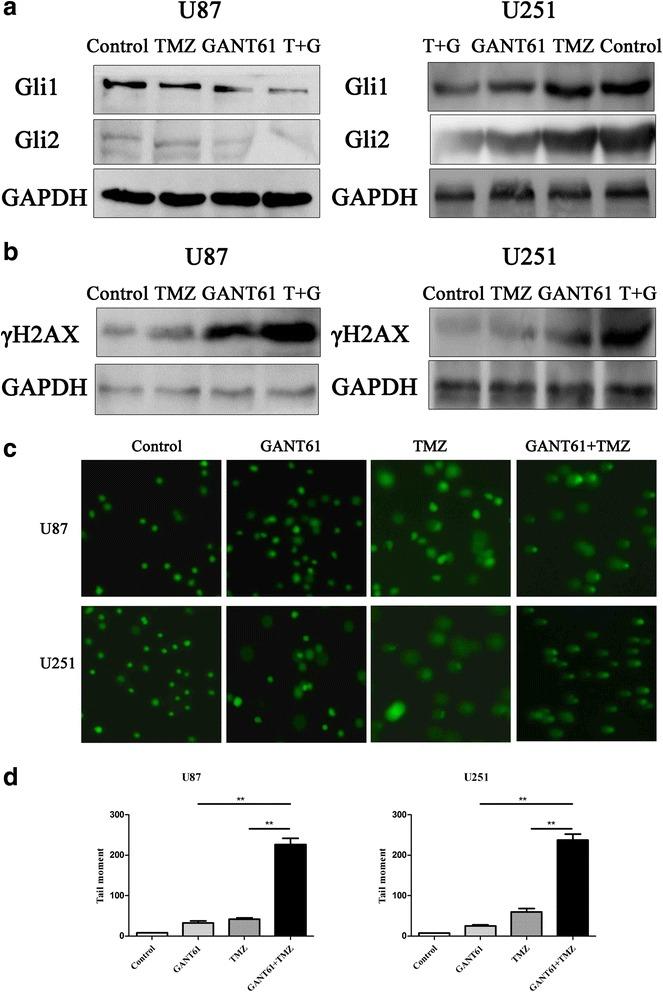
Proliferation of tumor cells treated with GANT61 in combination with TMZ was significantly suppressed compared with those treated with either drug used alone. The combination treatment induced a higher rate of apoptosis, DNA damage and reduced the invasive capability of glioma cells. DNA damage repair enzyme MGMT and the Notch1 pathway increased in the cells treated by TMZ treatment. However, GANT61 could abrogated the protein increasing.
CONCLUSIONS
GANT61 sensitizes glioma cells to TMZ treatment by enhancing DNA damage effect, decreasing MGMT expression and the Notch1 pathway.
背景
本研究旨在探讨GANT61下调Hedgehog信号通路对人胶质瘤细胞的影响,观察其对替莫唑胺(TMZ)诱导效应的后续变化,并探索分子机制。
方法
在人胶质瘤细胞系中检测Gli1/2抑制剂GANT61单独及与TMZ联合使用时的细胞毒性。分别通过定量实时聚合酶链反应(qRT-PCR)和蛋白质印迹法测定mRNA和蛋白质表达的变化。CCK-8法检测细胞增殖能力。通过流式细胞术测量凋亡细胞数。采用Transwell实验检测细胞侵袭能力。通过彗星实验和γH2AX表达鉴定DNA损伤效应。
结果
与单独使用任一药物处理的肿瘤细胞相比,GANT61与TMZ联合处理的肿瘤细胞增殖受到显著抑制。联合处理诱导更高的凋亡率、DNA损伤,并降低了胶质瘤细胞的侵袭能力。TMZ处理的细胞中DNA损伤修复酶MGMT和Notch1信号通路增加。然而,GANT61可消除蛋白增加。
结论
GANT61通过增强DNA损伤效应、降低MGMT表达和Notch1信号通路,使胶质瘤细胞对TMZ治疗敏感。


 Zotero 插件