
使用改变细胞水通透性的报告基因进行无创成像。
Non-invasive imaging using reporter genes altering cellular water permeability.
机构信息
Division of Chemistry and Chemical Engineering, California Institute of Technology, 1200 East California Boulevard, MC 210-41, Pasadena, California 91125, USA.
Division of Engineering and Applied Sciences, California Institute of Technology, Pasadena, California 91125, USA.
出版信息
Nat Commun. 2016 Dec 23;7:13891. doi: 10.1038/ncomms13891.
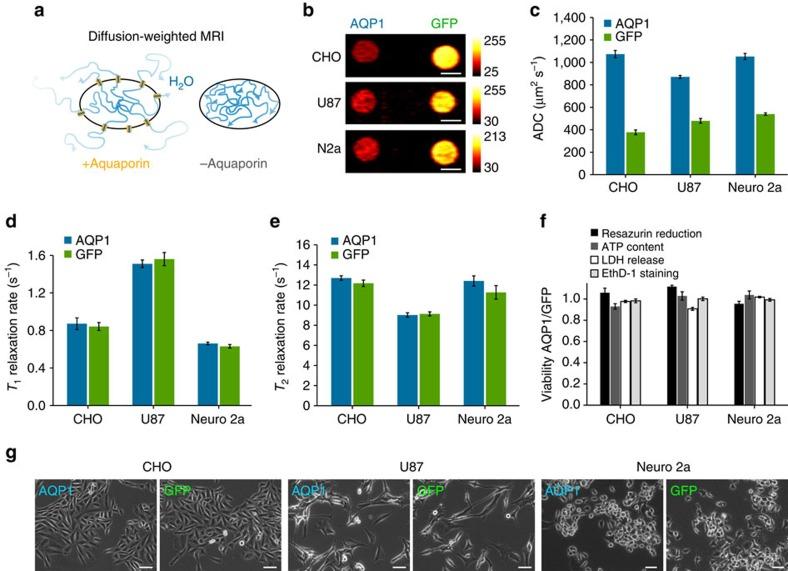
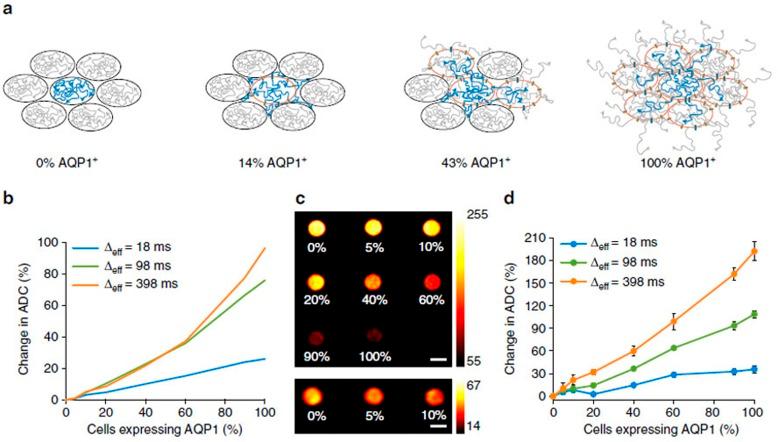
Non-invasive imaging of gene expression in live, optically opaque animals is important for multiple applications, including monitoring of genetic circuits and tracking of cell-based therapeutics. Magnetic resonance imaging (MRI) could enable such monitoring with high spatiotemporal resolution. However, existing MRI reporter genes based on metalloproteins or chemical exchange probes are limited by their reliance on metals or relatively low sensitivity. Here we introduce a new class of MRI reporters based on the human water channel aquaporin 1. We show that aquaporin overexpression produces contrast in diffusion-weighted MRI by increasing tissue water diffusivity without affecting viability. Low aquaporin levels or mixed populations comprising as few as 10% aquaporin-expressing cells are sufficient to produce MRI contrast. We characterize this new contrast mechanism through experiments and simulations, and demonstrate its utility in vivo by imaging gene expression in tumours. Our results establish an alternative class of sensitive, metal-free reporter genes for non-invasive imaging.
活体、不透明动物中基因表达的无创成像对于多种应用非常重要,包括遗传回路的监测和基于细胞的治疗方法的跟踪。磁共振成像(MRI)可以通过高时空分辨率实现这种监测。然而,现有的基于金属蛋白酶或化学交换探针的 MRI 报告基因受到其对金属的依赖或相对较低的灵敏度的限制。在这里,我们引入了一类基于人水通道 aquaporin 1 的新的 MRI 报告基因。我们发现,水通道蛋白过表达通过增加组织水扩散率而不影响细胞活力来产生扩散加权 MRI 对比。低水平的水通道蛋白或包含低至 10%水通道蛋白表达细胞的混合群体足以产生 MRI 对比。我们通过实验和模拟来描述这种新的对比机制,并通过成像肿瘤中的基因表达来证明其在体内的实用性。我们的结果为非侵入性成像建立了一类新的敏感、无金属报告基因。


 Zotero 插件