
探索视神经轴突再生。
Exploring Optic Nerve Axon Regeneration.
作者信息
Li Hong-Jiang, Sun Zhao-Liang, Yang Xi-Tao, Zhu Liang, Feng Dong-Fu
机构信息
Department of Neurosurgery, No.9 People's Hospital, Shanghai Jiaotong University, School of Medicine, Shanghai, 201999, China.
出版信息
Curr Neuropharmacol. 2017;15(6):861-873. doi: 10.2174/1570159X14666161227150250.
BACKGROUND
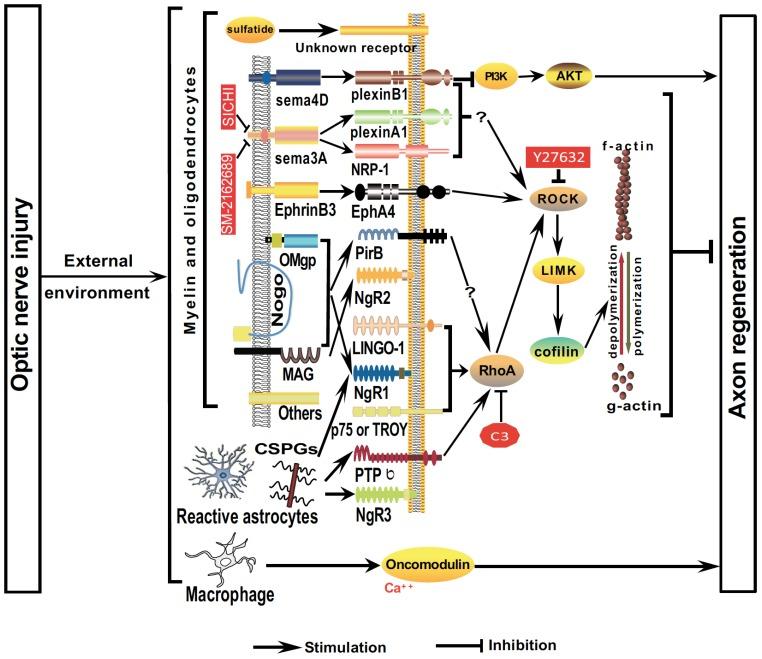
Traumatic optic nerve injury is a leading cause of irreversible blindness across the world and causes progressive visual impairment attributed to the dysfunction and death of retinal ganglion cells (RGCs). To date, neither pharmacological nor surgical interventions are sufficient to halt or reverse the progress of visual loss. Axon regeneration is critical for functional recovery of vision following optic nerve injury. After optic nerve injury, RGC axons usually fail to regrow and die, leading to the death of the RGCs and subsequently inducing the functional loss of vision. However, the detailed molecular mechanisms underlying axon regeneration after optic nerve injury remain poorly understood.
METHODS
Research content related to the detailed molecular mechanisms underlying axon regeneration after optic nerve injury have been reviewed.
RESULTS
The present review provides an overview of regarding potential strategies for axonal regeneration of RGCs and optic nerve repair, focusing on the role of cytokines and their downstream signaling pathways involved in intrinsic growth program and the inhibitory environment together with axon guidance cues for correct axon guidance. A more complete understanding of the factors limiting axonal regeneration will provide a rational basis, which contributes to develop improved treatments for optic nerve regeneration. These findings are encouraging and open the possibility that clinically meaningful regeneration may become achievable in the future.
CONCLUSION
Combination of treatments towards overcoming growth-inhibitory molecules and enhancing intrinsic growth capacity combined with correct guidance using axon guidance cues is crucial for developing promising therapies to promote axon regeneration and functional recovery after ON injury.
背景
外伤性视神经损伤是全球不可逆性失明的主要原因,可导致因视网膜神经节细胞(RGCs)功能障碍和死亡而引起的进行性视力损害。迄今为止,药物治疗和手术干预均不足以阻止或逆转视力丧失的进程。轴突再生对视神经损伤后视力的功能恢复至关重要。视神经损伤后,RGC轴突通常无法再生并死亡,导致RGCs死亡,进而引起视力功能丧失。然而,视神经损伤后轴突再生的详细分子机制仍知之甚少。
方法
对视神经损伤后轴突再生详细分子机制的相关研究内容进行了综述。
结果
本综述概述了RGCs轴突再生和视神经修复的潜在策略,重点关注细胞因子及其下游信号通路在内在生长程序和抑制环境中的作用,以及轴突导向线索对轴突正确导向的作用。更全面地了解限制轴突再生的因素将提供一个合理的基础,有助于开发改进的视神经再生治疗方法。这些发现令人鼓舞,并开启了未来可能实现具有临床意义的再生的可能性。
结论
克服生长抑制分子、增强内在生长能力并结合使用轴突导向线索进行正确导向的联合治疗,对于开发促进视神经损伤后轴突再生和功能恢复的有前景的疗法至关重要。

 Zotero 插件