
BRCA1-IRIS的过表达促进并维持肿瘤起始表型:对三阴性乳腺癌早期病变的影响。
BRCA1-IRIS overexpression promotes and maintains the tumor initiating phenotype: implications for triple negative breast cancer early lesions.
作者信息
Sinha Abhilasha, Paul Bibbin T, Sullivan Lisa M, Sims Hillary, El Bastawisy Ahmed, Yousef Hend F, Zekri Abdel-Rahman N, Bahnassy Abeer A, ElShamy Wael M
机构信息
Cancer Institute, University of Mississippi Medical Center, Jackson, MS, USA.
Department of Molecular Biology and Biophysics, University of Connecticut Health Center, Farmington, CT, USA.
出版信息
Oncotarget. 2017 Feb 7;8(6):10114-10135. doi: 10.18632/oncotarget.14357.
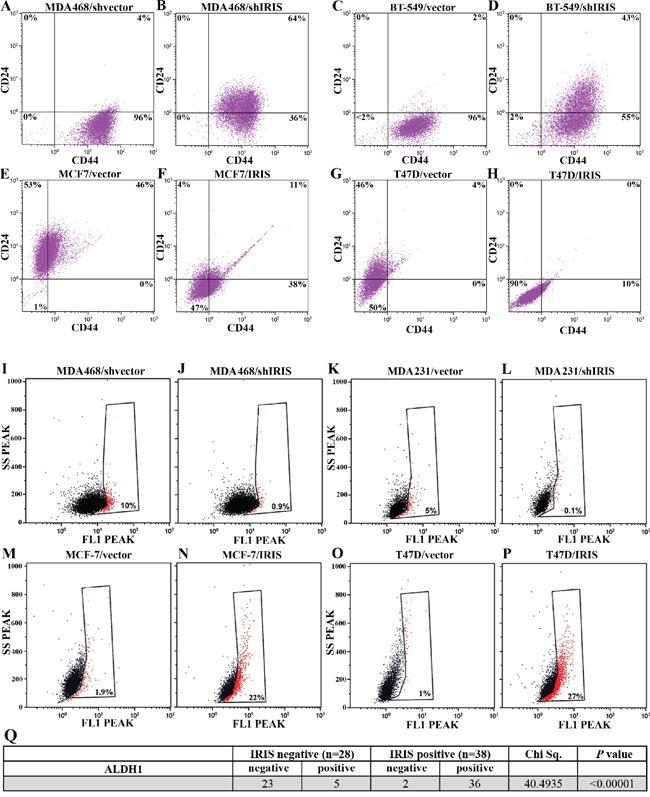
Tumor-initiating cells (TICs) are cancer cells endowed with self-renewal, multi-lineage differentiation, increased chemo-resistance, and in breast cancers the CD44+/CD24-/ALDH1+ phenotype. Triple negative breast cancers show lack of BRCA1 expression in addition to enhanced basal, epithelial-to-mesenchymal transition (EMT), and TIC phenotypes. BRCA1-IRIS (hereafter IRIS) is an oncogene produced by the alternative usage of the BRCA1 locus. IRIS is involved in induction of replication, transcription of selected oncogenes, and promoting breast cancer cells aggressiveness. Here, we demonstrate that IRIS overexpression (IRISOE) promotes TNBCs through suppressing BRCA1 expression, enhancing basal-biomarkers, EMT-inducers, and stemness-enforcers expression. IRISOE also activates the TIC phenotype in TNBC cells through elevating CD44 and ALDH1 expression/activity and preventing CD24 surface presentation by activating the internalization pathway EGFR→c-Src→cortactin. We show that the intrinsic sensitivity to an anti-CD24 cross-linking antibody-induced cell death in membranous CD24 expressing/luminal A cells could be acquired in cytoplasmic CD24 expressing IRISOE TNBC/TIC cells through IRIS silencing or inactivation. We show that fewer IRISOE TNBC/TICs cells form large tumors composed of TICs, resembling TNBCs early lesions in patients that contain metastatic precursors capable of disseminating and metastasizing at an early stage of the disease. IRIS-inhibitory peptide killed these IRISOE TNBC/TICs, in vivo and prevented their dissemination and metastasis. We propose IRIS inactivation could be pursued to prevent dissemination and metastasis from early TNBC tumor lesions in patients.
肿瘤起始细胞(TICs)是具有自我更新、多谱系分化、化疗耐药性的癌细胞,在乳腺癌中表现为CD44+/CD24-/ALDH1+表型。三阴性乳腺癌除了具有增强的基底样、上皮-间质转化(EMT)和TIC表型外,还表现出BRCA1表达缺失。BRCA1-IRIS(以下简称IRIS)是由BRCA1基因座的可变剪接产生的一种致癌基因。IRIS参与诱导复制、某些致癌基因的转录,并促进乳腺癌细胞的侵袭性。在此,我们证明IRIS过表达(IRISOE)通过抑制BRCA1表达、增强基底样生物标志物、EMT诱导因子和干性增强因子的表达来促进三阴性乳腺癌(TNBCs)的发展。IRISOE还通过提高CD44和ALDH1的表达/活性以及激活内化途径EGFR→c-Src→皮层肌动蛋白来阻止CD24的表面呈现,从而激活TNBC细胞中的TIC表型。我们发现,通过IRIS沉默或失活,在表达膜性CD24/腔面A型细胞中对抗CD24交联抗体诱导的细胞死亡具有内在敏感性,这一特性可在表达细胞质CD24的IRISOE TNBC/TIC细胞中获得。我们发现,较少的IRISOE TNBC/TICs细胞形成由TICs组成的大肿瘤,类似于患者中含有能够在疾病早期扩散和转移的转移前体的TNBC早期病变。IRIS抑制肽在体内杀死这些IRISOE TNBC/TICs,并阻止它们的扩散和转移。我们提出,可以通过使IRIS失活来预防TNBC患者早期肿瘤病变的扩散和转移。




 Zotero 插件