
葡萄酒多酚及其相关代谢产物对肠道和宿主健康影响的综合观点
An Integrated View of the Effects of Wine Polyphenols and Their Relevant Metabolites on Gut and Host Health.
作者信息
Cueva Carolina, Gil-Sánchez Irene, Ayuda-Durán Begoña, González-Manzano Susana, González-Paramás Ana María, Santos-Buelga Celestino, Bartolomé Begoña, Moreno-Arribas M Victoria
机构信息
Instituto de Investigación en Ciencias de la Alimentación (CIAL), CSIC-UAM. Nicolás Cabrera, 9. Campus de Cantoblanco, 28049 Madrid, Spain.
Grupo de Investigación en Polifenoles, Universidad de Salamanca, Campus Miguel de Unamuno, 37007 Salamanca, Spain.
出版信息
Molecules. 2017 Jan 6;22(1):99. doi: 10.3390/molecules22010099.
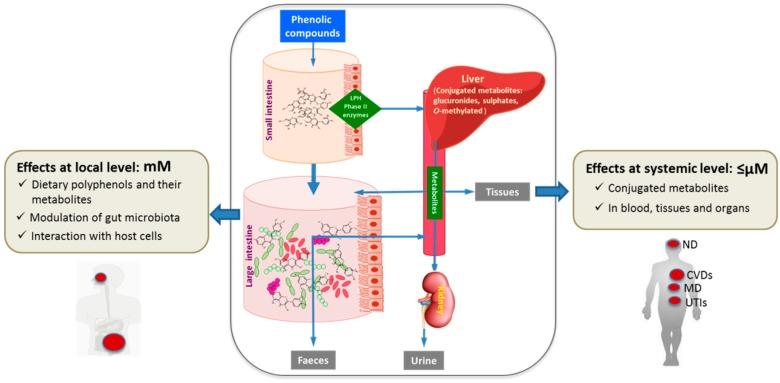
Over the last few decades, polyphenols, and flavonoids in particular, have attracted the interest of researchers, as they have been associated with the health-promoting effects derived from diets rich in vegetables and fruits, including moderate wine consumption. Recent scientific evidence suggests that wine polyphenols exert their effects through interactions with the gut microbiota, as they seem to modulate microbiota and, at the same time, are metabolized by intestinal bacteria into specific bioavailable metabolites. Microbial metabolites are better absorbed than their precursors and may be responsible for positive health activities in the digestive system (local effects) and, after being absorbed, in tissues and organs (systemic effects). Differences in gut microbiota composition and functionality among individuals can affect polyphenol activity and, therefore, their health effects. The aim of this review is to integrate the understanding of the metabolism and mechanisms of action of wine polyphenols at both local and systemic levels, underlining their impact on the gut microbiome and the inter-individual variability associated with polyphenols' metabolism and further physiological effects. The advent of promising dietary approaches linked to wine polyphenols beyond the gut microbiota community and metabolism are also discussed.
在过去几十年中,多酚类物质,尤其是黄酮类化合物,吸引了研究人员的关注,因为它们与富含蔬菜和水果的饮食(包括适量饮用葡萄酒)所带来的健康促进作用有关。最近的科学证据表明,葡萄酒中的多酚类物质通过与肠道微生物群相互作用发挥作用,因为它们似乎能调节微生物群,同时被肠道细菌代谢成特定的可生物利用的代谢产物。微生物代谢产物比其前体更容易被吸收,可能在消化系统中产生积极的健康作用(局部效应),吸收后还会在组织和器官中产生作用(全身效应)。个体之间肠道微生物群组成和功能的差异会影响多酚类物质的活性,进而影响其健康效应。本综述的目的是综合理解葡萄酒多酚类物质在局部和全身水平的代谢及作用机制,强调它们对肠道微生物群的影响以及与多酚类物质代谢和进一步生理效应相关的个体间变异性。还讨论了与葡萄酒多酚类物质相关的、超越肠道微生物群群落和代谢的有前景的饮食方法的出现。
 Zotero 插件