
使用帕利珠单抗预防风险评分工具评估孕29至32周早产儿呼吸道合胞病毒相关住院情况
Respiratory syncytial virus associated hospitalizations in preterm infants of 29 to 32 weeks gestational age using a risk score tool for palivizumab prophylaxis.
作者信息
Resch B, Bramreiter V S, Kurath-Koller S, Freidl T, Urlesberger B
机构信息
Division of Neonatology, Department of Pediatrics and Adolescent Medicine, Medical University of Graz, Auenbruggerplatz 34/2, 8036, Graz, Austria.
Research Unit for Neonatal Infectious Diseases and Epidemiology, Medical University of Graz, Graz, Austria.
出版信息
Eur J Clin Microbiol Infect Dis. 2017 Jun;36(6):1057-1062. doi: 10.1007/s10096-016-2891-6. Epub 2017 Jan 11.
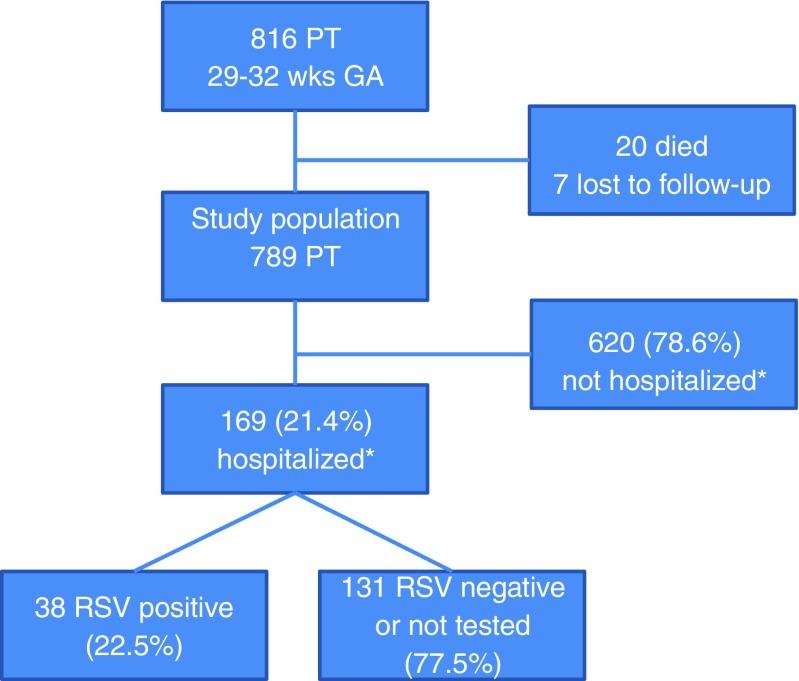
To evaluate the efficacy of palivizumab in infants of 29 to 32 weeks of gestational age (GA) based on a risk score tool developed for Austria. Retrospective single-center cohort study including all preterm infants of 29 (+0) to 32 (+6) weeks of GA born between 2004 and 2012 at a tertiary care university hospital. Data on RSV-related hospitalizations over the first 2 years of life were analyzed and compared between those having received palivizumab and those without. The study population was comprised of 789 of 816 screened infants, of whom 262 (33%) had received palivizumab and 527 (67%) had not. Nine of 107 rehospitalizations (8.4%) in the palivizumab group compared to 32 of 156 rehospitalizations (20.5%) in the group without prophylaxis were tested RSV-positive (p = 0.004; OR 0.356 [CI 90% 0.184-0.689]). Proven and calculated RSV hospitalization rate was 3.1% (8/262) in the palivizumab group and 5.9% (31/527) in the group without (p = 0.042; OR 0.504 [CI 90% 0.259-0.981]). Increasing number of risk factors (up to three) increased the RSV hospitalization rate in infants with (6.1%) and without (9.0%) prophylaxis. RSV-associated hospitalizations did not differ between groups with regard to length of stay, severity of infection, age at hospitalization, demand of supplemental oxygen, need for mechanical ventilation, and admission rate to the ICU. A risk score tool developed for infants of 29 to 32 weeks of gestational age led to a reduction of RSV-associated hospitalizations without influencing the severity of disease.
基于为奥地利开发的风险评分工具,评估帕利珠单抗对孕龄29至32周(GA)婴儿的疗效。回顾性单中心队列研究,纳入2004年至2012年在一家三级护理大学医院出生的所有GA为29(+0)至32(+6)周的早产儿。分析并比较接受帕利珠单抗治疗的婴儿和未接受治疗的婴儿在生命最初2年内与呼吸道合胞病毒(RSV)相关的住院数据。研究人群包括816名筛查婴儿中的789名,其中262名(33%)接受了帕利珠单抗治疗,527名(67%)未接受治疗。帕利珠单抗组107次再次住院中有9次(8.4%)检测出RSV阳性,而未进行预防的组156次再次住院中有32次(20.5%)检测出RSV阳性(p = 0.004;比值比0.356 [90%置信区间0.184 - 0.689])。帕利珠单抗组经证实和计算的RSV住院率为3.1%(8/262),未治疗组为5.9%(31/527)(p = 0.042;比值比0.504 [90%置信区间0.259 - 0.981])。风险因素数量增加(最多三个)会使接受预防(6.1%)和未接受预防(9.0%)的婴儿的RSV住院率升高。RSV相关住院在住院时间、感染严重程度、住院年龄、补充氧气需求、机械通气需求以及重症监护病房入住率方面,两组之间没有差异。为孕龄29至32周婴儿开发的风险评分工具可降低RSV相关住院率,且不影响疾病严重程度。
 Zotero 插件