
用于治疗高血压的β受体阻滞剂。
Beta-blockers for hypertension.
作者信息
Wiysonge Charles S, Bradley Hazel A, Volmink Jimmy, Mayosi Bongani M, Opie Lionel H
机构信息
Cochrane South Africa, South African Medical Research Council, Francie van Zijl Drive, Parow Valley, Cape Town, Western Cape, South Africa, 7505.
Centre for Evidence-based Health Care, Faculty of Medicine and Health Sciences, Stellenbosch University, Cape Town, South Africa.
出版信息
Cochrane Database Syst Rev. 2017 Jan 20;1(1):CD002003. doi: 10.1002/14651858.CD002003.pub5.
BACKGROUND
Beta-blockers refer to a mixed group of drugs with diverse pharmacodynamic and pharmacokinetic properties. They have shown long-term beneficial effects on mortality and cardiovascular disease (CVD) when used in people with heart failure or acute myocardial infarction. Beta-blockers were thought to have similar beneficial effects when used as first-line therapy for hypertension. However, the benefit of beta-blockers as first-line therapy for hypertension without compelling indications is controversial. This review is an update of a Cochrane Review initially published in 2007 and updated in 2012.
OBJECTIVES
To assess the effects of beta-blockers on morbidity and mortality endpoints in adults with hypertension.
SEARCH METHODS
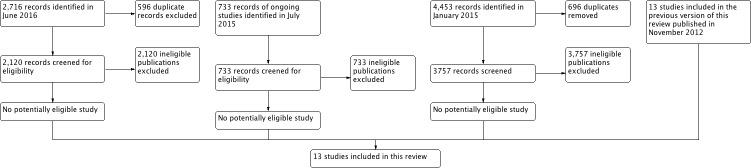
The Cochrane Hypertension Information Specialist searched the following databases for randomized controlled trials up to June 2016: the Cochrane Hypertension Specialised Register, the Cochrane Central Register of Controlled Trials (CENTRAL) (2016, Issue 6), MEDLINE (from 1946), Embase (from 1974), and ClinicalTrials.gov. We checked reference lists of relevant reviews, and reference lists of studies potentially eligible for inclusion in this review, and also searched the the World Health Organization International Clinical Trials Registry Platform on 06 July 2015.
SELECTION CRITERIA
Randomised controlled trials (RCTs) of at least one year of duration, which assessed the effects of beta-blockers compared to placebo or other drugs, as first-line therapy for hypertension, on mortality and morbidity in adults.
DATA COLLECTION AND ANALYSIS
We selected studies and extracted data in duplicate, resolving discrepancies by consensus. We expressed study results as risk ratios (RR) with 95% confidence intervals (CI) and conducted fixed-effect or random-effects meta-analyses, as appropriate. We also used GRADE to assess the certainty of the evidence. GRADE classifies the certainty of evidence as high (if we are confident that the true effect lies close to that of the estimate of effect), moderate (if the true effect is likely to be close to the estimate of effect), low (if the true effect may be substantially different from the estimate of effect), and very low (if we are very uncertain about the estimate of effect).
MAIN RESULTS
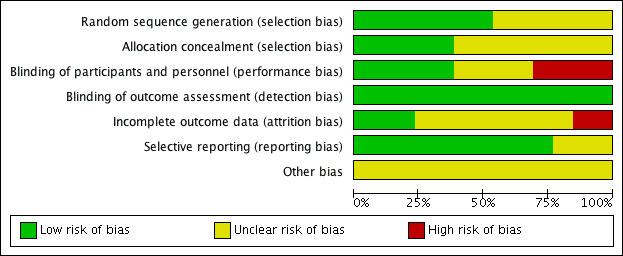
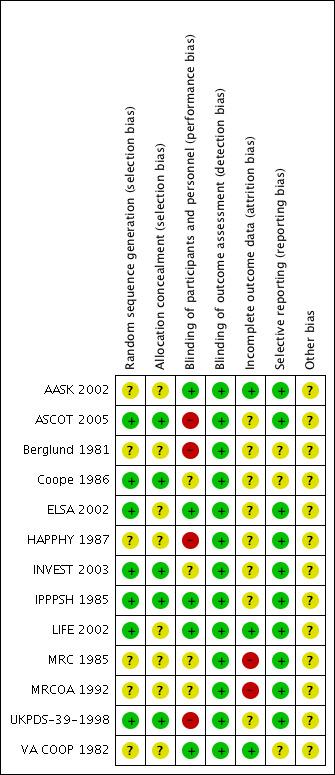
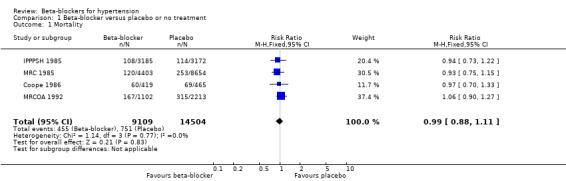
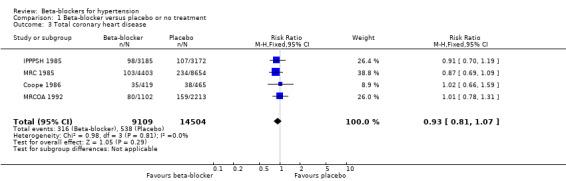
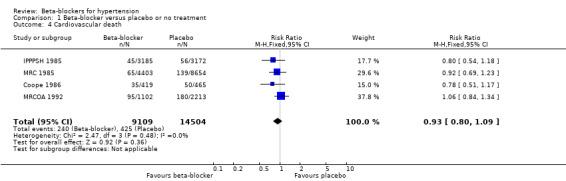
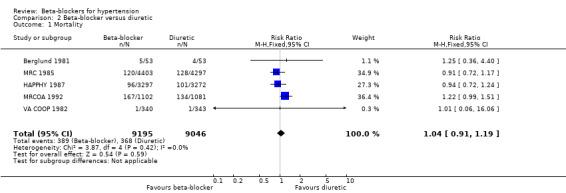
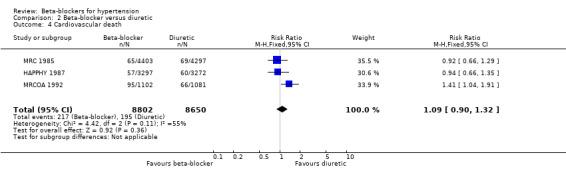
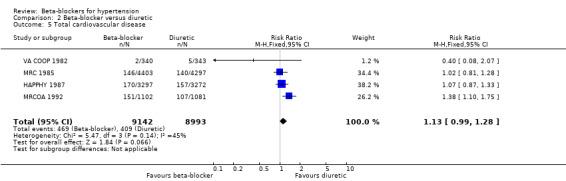
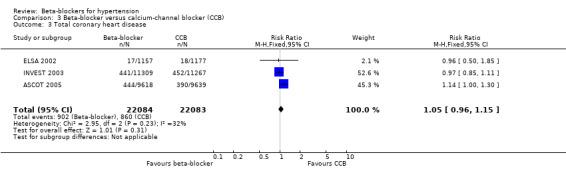
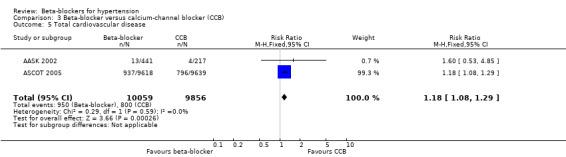
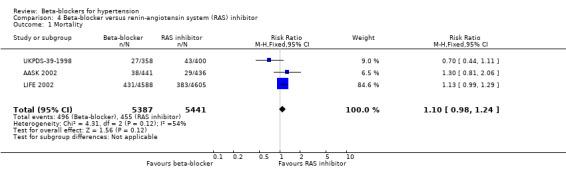
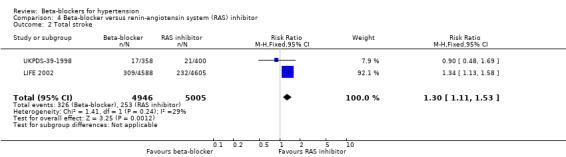
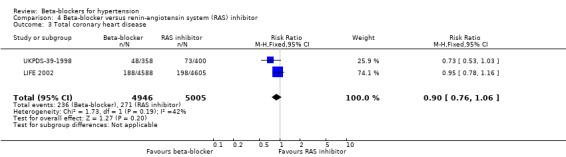
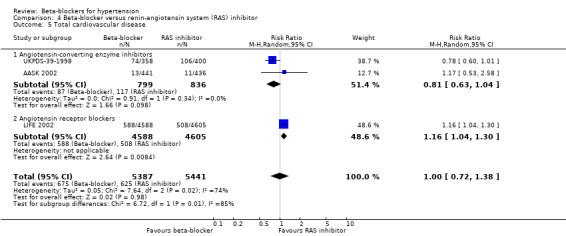
Thirteen RCTs met inclusion criteria. They compared beta-blockers to placebo (4 RCTs, 23,613 participants), diuretics (5 RCTs, 18,241 participants), calcium-channel blockers (CCBs: 4 RCTs, 44,825 participants), and renin-angiotensin system (RAS) inhibitors (3 RCTs, 10,828 participants). These RCTs were conducted between the 1970s and 2000s and most of them had a high risk of bias resulting from limitations in study design, conduct, and data analysis. There were 40,245 participants taking beta-blockers, three-quarters of them taking atenolol. We found no outcome trials involving the newer vasodilating beta-blockers (e.g. nebivolol).There was no difference in all-cause mortality between beta-blockers and placebo (RR 0.99, 95% CI 0.88 to 1.11), diuretics or RAS inhibitors, but it was higher for beta-blockers compared to CCBs (RR 1.07, 95% CI 1.00 to 1.14). The evidence on mortality was of moderate-certainty for all comparisons.Total CVD was lower for beta-blockers compared to placebo (RR 0.88, 95% CI 0.79 to 0.97; low-certainty evidence), a reflection of the decrease in stroke (RR 0.80, 95% CI 0.66 to 0.96; low-certainty evidence) since there was no difference in coronary heart disease (CHD: RR 0.93, 95% CI 0.81 to 1.07; moderate-certainty evidence). The effect of beta-blockers on CVD was worse than that of CCBs (RR 1.18, 95% CI 1.08 to 1.29; moderate-certainty evidence), but was not different from that of diuretics (moderate-certainty) or RAS inhibitors (low-certainty). In addition, there was an increase in stroke in beta-blockers compared to CCBs (RR 1.24, 95% CI 1.11 to 1.40; moderate-certainty evidence) and RAS inhibitors (RR 1.30, 95% CI 1.11 to 1.53; moderate-certainty evidence). However, there was little or no difference in CHD between beta-blockers and diuretics (low-certainty evidence), CCBs (moderate-certainty evidence) or RAS inhibitors (low-certainty evidence). In the single trial involving participants aged 65 years and older, atenolol was associated with an increased CHD incidence compared to diuretics (RR 1.63, 95% CI 1.15 to 2.32). Participants taking beta-blockers were more likely to discontinue treatment due to adverse events than participants taking RAS inhibitors (RR 1.41, 95% CI 1.29 to 1.54; moderate-certainty evidence), but there was little or no difference with placebo, diuretics or CCBs (low-certainty evidence).
AUTHORS' CONCLUSIONS: Most outcome RCTs on beta-blockers as initial therapy for hypertension have high risk of bias. Atenolol was the beta-blocker most used. Current evidence suggests that initiating treatment of hypertension with beta-blockers leads to modest CVD reductions and little or no effects on mortality. These beta-blocker effects are inferior to those of other antihypertensive drugs. Further research should be of high quality and should explore whether there are differences between different subtypes of beta-blockers or whether beta-blockers have differential effects on younger and older people.
背景
β受体阻滞剂是一类具有多种药效学和药代动力学特性的混合药物。在心衰或急性心肌梗死患者中使用时,它们已显示出对死亡率和心血管疾病(CVD)的长期有益影响。β受体阻滞剂被认为作为高血压的一线治疗药物时具有类似的有益效果。然而,在无强制适应症的情况下,β受体阻滞剂作为高血压一线治疗的益处存在争议。本综述是对最初于2007年发表并于2012年更新的Cochrane综述的更新。
目的
评估β受体阻滞剂对成年高血压患者发病和死亡终点的影响。
检索方法
Cochrane高血压信息专家检索了以下数据库以查找截至2016年6月的随机对照试验:Cochrane高血压专业注册库、Cochrane对照试验中心注册库(CENTRAL)(2016年第6期)、MEDLINE(自1946年起)、Embase(自1974年起)以及ClinicalTrials.gov。我们检查了相关综述的参考文献列表以及可能符合本综述纳入标准的研究的参考文献列表,并于2015年7月6日检索了世界卫生组织国际临床试验注册平台。
入选标准
持续时间至少一年的随机对照试验(RCT),该试验评估了β受体阻滞剂作为高血压一线治疗药物与安慰剂或其他药物相比,对成年人死亡率和发病率的影响。
数据收集与分析
我们选择研究并进行重复数据提取,通过共识解决差异。我们将研究结果表示为具有95%置信区间(CI)的风险比(RR),并酌情进行固定效应或随机效应荟萃分析。我们还使用GRADE评估证据的确定性。GRADE将证据的确定性分为高(如果我们确信真实效应接近效应估计值)、中(如果真实效应可能接近效应估计值)、低(如果真实效应可能与效应估计值有很大差异)和极低(如果我们对效应估计值非常不确定)。
主要结果
13项RCT符合纳入标准。它们将β受体阻滞剂与安慰剂(4项RCT,23613名参与者)、利尿剂(5项RCT,18241名参与者)、钙通道阻滞剂(CCB:4项RCT,44825名参与者)以及肾素 - 血管紧张素系统(RAS)抑制剂(3项RCT,10828名参与者)进行了比较。这些RCT在20世纪70年代至21世纪初进行,其中大多数由于研究设计、实施和数据分析的局限性而存在高偏倚风险。有40245名参与者服用β受体阻滞剂,其中四分之三服用阿替洛尔。我们未发现涉及新型血管舒张性β受体阻滞剂(如奈必洛尔)的结局试验。β受体阻滞剂与安慰剂、利尿剂或RAS抑制剂之间在全因死亡率上无差异(RR 0.99,95%CI 0.88至1.11),但与CCB相比更高(RR 1.07,95%CI 1.00至1.14)。所有比较中关于死亡率的证据为中等确定性。与安慰剂相比,β受体阻滞剂的总CVD更低(RR 0.88,95%CI 0.79至0.97;低确定性证据),这反映了中风的减少(RR 0.80,95%CI 0.66至0.96;低确定性证据),因为冠心病方面无差异(CHD:RR 0.93,95%CI 0.81至1.07;中等确定性证据)。β受体阻滞剂对CVD的影响比CCB更差(RR 1.18,95%CI 1.08至1.29;中等确定性证据),但与利尿剂(中等确定性)或RAS抑制剂(低确定性)无差异。此外,与CCB(RR 1.24,95%CI 1.11至1.40;中等确定性证据)和RAS抑制剂(RR 1.30,95%CI 1.11至1.53;中等确定性证据)相比,β受体阻滞剂组中风增加。然而,β受体阻滞剂与利尿剂(低确定性证据)、CCB(中等确定性证据)或RAS抑制剂(低确定性证据)之间在CHD方面几乎没有差异。在涉及65岁及以上参与者的单项试验中,与利尿剂相比,阿替洛尔与CHD发病率增加相关(RR 1.63,95%CI 1.15至2.32)。服用β受体阻滞剂的参与者因不良事件停药的可能性高于服用RAS抑制剂的参与者(RR 1.41,95%CI 1.29至1.54;中等确定性证据),但与安慰剂、利尿剂或CCB相比几乎没有差异(低确定性证据)。
作者结论
大多数关于β受体阻滞剂作为高血压初始治疗的结局RCT存在高偏倚风险。阿替洛尔是使用最多的β受体阻滞剂。当前证据表明,用β受体阻滞剂开始治疗高血压会使CVD适度降低,对死亡率几乎没有影响。这些β受体阻滞剂的效果不如其他抗高血压药物。进一步的研究应具有高质量,并应探索不同亚型的β受体阻滞剂之间是否存在差异,或者β受体阻滞剂对年轻人和老年人是否有不同影响。











 Zotero 插件