
韩国QX样传染性支气管炎病毒的比较基因组学
Comparative genomics of QX-like infectious bronchitis viruses in Korea.
作者信息
Hong Seung-Min, Kwon Hyuk-Joon, Choi Kang-Seuk, Kim Jae-Hong
机构信息
Laboratory of Avian Diseases, College of Veterinary Medicine, BK21 Plus Program for Veterinary Science and Research Institute for Veterinary Science, Seoul National University, 1 Gwanak-ro, Gwanak-gu, Seoul, 08826, Republic of Korea.
Laboratory of Poultry Production Medicine, College of Veterinary Medicine, Seoul National University, 1 Gwanak-ro, Gwanak-gu, Seoul, 08826, Republic of Korea.
出版信息
Arch Virol. 2017 May;162(5):1237-1250. doi: 10.1007/s00705-016-3208-x. Epub 2017 Jan 23.
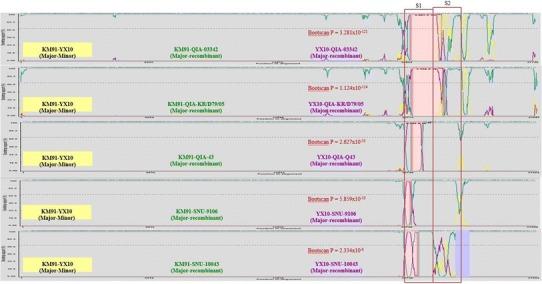
To minimize the spread of infectious bronchitis virus (IBV), domestic fowl have been extensively vaccinated with the KM91 strain. However, various IBV QX-like virus strains have become increasingly prevalent in Korea. We conducted comparative genomic analyses of seven QX-like viruses: early viruses (n = 2), new cluster 1 (NC1; recombinants of KM91 and the early QX-like viruses, n = 3) and recurrent viruses (n = 2), to understand their genomic backgrounds. The early and NC1 viruses had KM91-like backgrounds, but the recurrent viruses had QX-like genomic backgrounds. The absence of pure QX-like viruses before the appearance of the early viruses suggests that the viruses were introduced from other countries after recombination, but the NC1 viruses originated in Korea. The recent prevalence of recurrent viruses with different genomic backgrounds and spike genes from the early and the NC1 viruses may indicate the repeated introduction of different infectious bronchitis viruses from other countries and their successful evasion of vaccine immunity in the field. Furthermore, a 1ab gene-based phylogenetic analysis revealed three distinct lineages: North America-Europe, China/Taiwan, and China. KM91 and the early and NC1 viruses were included in the North America-Europe lineage, and the recurrent QX-like viruses were included in the China lineage. The phylogenetic positions of KM91-like 1ab and QX-like spike suggest frequent recombination between the North America-Europe and China lineages. Additional studies on the patterns of recombination, including donor-acceptor relationships, geographical sites, and non-poultry hosts, may be valuable for understanding the evolution of IBVs.
为尽量减少传染性支气管炎病毒(IBV)的传播,家禽已广泛接种KM91株疫苗。然而,各种IBV QX样病毒株在韩国日益普遍。我们对7种QX样病毒进行了比较基因组分析:早期病毒(n = 2)、新簇1(NC1;KM91与早期QX样病毒的重组体,n = 3)和复发性病毒(n = 2),以了解它们的基因组背景。早期和NC1病毒具有KM91样背景,但复发性病毒具有QX样基因组背景。早期病毒出现之前没有纯QX样病毒,这表明这些病毒是在重组后从其他国家引入的,但NC1病毒起源于韩国。最近具有不同基因组背景和刺突基因的复发性病毒的流行,与早期和NC1病毒不同,这可能表明不同的传染性支气管炎病毒从其他国家反复引入,并且它们在田间成功逃避了疫苗免疫。此外,基于1ab基因的系统发育分析揭示了三个不同的谱系:北美-欧洲、中国/台湾和中国。KM以及早期和NC1病毒属于北美-欧洲谱系,而复发性QX样病毒属于中国谱系。KM91样1ab和QX样刺突的系统发育位置表明北美-欧洲和中国谱系之间频繁发生重组。关于重组模式的进一步研究,包括供体-受体关系、地理位置和非家禽宿主,可能对理解IBV的进化有价值。


 Zotero 插件