
血糖失调状态下甘油三酯和高密度脂蛋白胆固醇血脂异常与冠心病及缺血性中风风险:强心研究
Triglyceride and HDL-C Dyslipidemia and Risks of Coronary Heart Disease and Ischemic Stroke by Glycemic Dysregulation Status: The Strong Heart Study.
作者信息
Lee Jennifer S, Chang Po-Yin, Zhang Ying, Kizer Jorge R, Best Lyle G, Howard Barbara V
机构信息
Division of Endocrinology, Gerontology, and Metabolism, Department of Medicine and (by courtesy) Division of Epidemiology, Department of Health Research & Policy, Stanford University Medical Center, Stanford, CA
Medical Services, VA Palo Alto Health Care System, Palo Alto, CA.
出版信息
Diabetes Care. 2017 Apr;40(4):529-537. doi: 10.2337/dc16-1958. Epub 2017 Jan 25.
OBJECTIVE
High triglyceride (TG) levels and low HDL cholesterol (HDL-C) levels are risk factors for cardiovascular disease. It is unclear whether this relationship depends on glycemic dysregulation, sex, or LDL cholesterol (LDL-C) level.
RESEARCH DESIGN AND METHODS
We studied 3,216 participants (40% men, 41% with diabetes) who were free of cardiovascular disease at baseline in a community-based, prospective cohort of American Indians (median follow-up 17.7 years). Cox models estimated hazard ratios (HRs) and 95% CIs for incident ischemic stroke and coronary heart disease (CHD) in relation to combined TG and HDL-C status, where a fasting TG level ≥150 mg/dL was "high" and a fasting HDL-C level <40 mg/dL for men (<50 mg/dL for women) was "low." Models included age, sex, BMI, smoking, diabetes, fasting LDL-C level, antihypertensive medications, physical activity, estimated glomerular filtration rate, and urinary albumin-to-creatinine ratio.
RESULTS
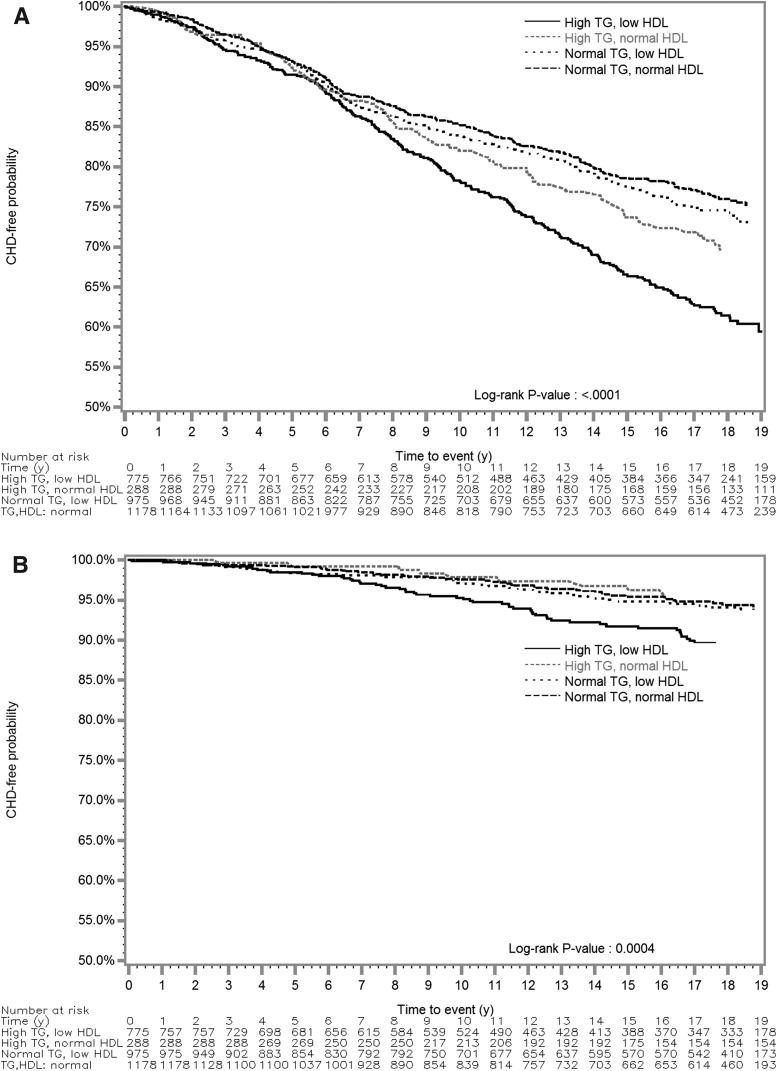
Participants with high TG and low HDL levels had a 1.32-fold greater HR (95% CI 1.06-1.64) for CHD than those with normal TG and normal HDL levels. It was observed in participants with diabetes, but not in those without diabetes, that high TG plus low HDL levels were associated with a 1.54-fold greater HR (95% CI 1.15-2.06) for CHD ( value for interaction = 0.003) and a 2.13-fold greater HR (95% CI 1.06-4.29) for stroke ( value for interaction = 0.060). High TG and low HDL level was associated with CHD risk in participants with an LDL-C level of ≥130 mg/dL, but this was not observed in those participants with lower LDL-C levels. Sex did not appear to modify these associations.
CONCLUSIONS
Adults with both high TG and low HDL-C, particularly those with diabetes, have increased risks of incident CHD and stroke. In particular, those with an LDL-C level ≥130 mg/dL may have an increased risk of incident stroke.
目的
高甘油三酯(TG)水平和低高密度脂蛋白胆固醇(HDL-C)水平是心血管疾病的危险因素。尚不清楚这种关系是否取决于血糖失调、性别或低密度脂蛋白胆固醇(LDL-C)水平。
研究设计与方法
我们研究了3216名参与者(40%为男性,41%患有糖尿病),他们在一个基于社区的美国印第安人前瞻性队列研究中基线时无心血管疾病(中位随访17.7年)。Cox模型估计了与TG和HDL-C联合状态相关的缺血性卒中和冠心病(CHD)事件的风险比(HRs)及95%置信区间(CIs),其中空腹TG水平≥150mg/dL为“高”,男性空腹HDL-C水平<40mg/dL(女性<50mg/dL)为“低”。模型纳入了年龄、性别、体重指数、吸烟、糖尿病、空腹LDL-C水平、抗高血压药物、身体活动、估计肾小球滤过率和尿白蛋白与肌酐比值。
结果
与TG和HDL水平正常的参与者相比,TG高且HDL低的参与者患冠心病的HR高1.32倍(95%CI 1.06 - 1.64)。在患有糖尿病的参与者中观察到,TG高加HDL低与患冠心病的HR高1.54倍(95%CI 1.15 - 2.06)(交互作用P值 = 0.003)以及患中风的HR高2.13倍(95%CI 1.06 - 4.29)(交互作用P值 = 0.060)相关,但在无糖尿病的参与者中未观察到这种情况。TG高且HDL低与LDL-C水平≥130mg/dL的参与者患冠心病风险相关,但在LDL-C水平较低的参与者中未观察到这种情况。性别似乎并未改变这些关联。
结论
TG高且HDL-C低的成年人,尤其是患有糖尿病的成年人,发生冠心病和中风的风险增加。特别是,LDL-C水平≥130mg/dL的人发生中风的风险可能增加。
 Zotero 插件