
帕替罗姆治疗正在使用利尿剂的慢性肾病高血压患者高钾血症的疗效。
Effectiveness of patiromer in the treatment of hyperkalemia in chronic kidney disease patients with hypertension on diuretics.
作者信息
Weir Matthew R, Mayo Martha R, Garza Dahlia, Arthur Susan A, Berman Lance, Bushinsky David, Wilson Daniel J, Epstein Murray
机构信息
aDivision of Nephrology, Department of Medicine, University of Maryland School of Medicine, Baltimore, Maryland bRelypsa, Inc., Redwood City, California cDivision of Nephrology, Department of Medicine, University of Rochester School of Medicine, Rochester, New York dDivision of Nephrology and Hypertension, University of Miami Miller School of Medicine, Miami, Florida, USA.
出版信息
J Hypertens. 2017 May;35 Suppl 1(Suppl 1):S57-S63. doi: 10.1097/HJH.0000000000001278.
OBJECTIVE
Recurrent hyperkalemia frequently limits use of renin-angiotensin-aldosterone system inhibitors (RAASi) in chronic kidney disease (CKD) patients with hypertension, diabetes, and/or heart failure. Patiromer is a sodium-free, nonabsorbed potassium (K)-binding polymer approved by the US Food and Drug Administration for the treatment of hyperkalemia. This post-hoc analysis of OPAL-HK examined the effectiveness and safety of patiromer in reducing serum K in hyperkalemic CKD patients on RAASi, with hypertension, receiving diuretic therapy versus those not on diuretics.
METHODS
Depending on the degree of hyperkalemia at baseline, CKD patients with serum K from 5.1 to less than 6.5 mmol/l on RAASi (n = 243) were assigned to a patiromer of total dose 8.4 or 16.8 g, divided twice daily. Changes in serum K, and tolerability and safety were assessed over 4 weeks in patients on and not on diuretics.
RESULTS
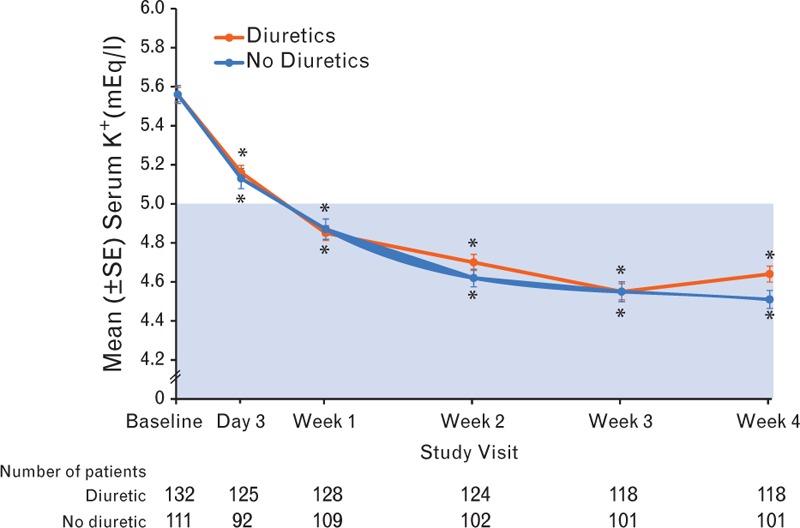
At baseline, 132 patients used diuretics and 111 were not on diuretics, mean age was 64.3 and 64.0 years, respectively, and 63 and 51% were men. Similar reductions in serum K were seen over 4 weeks in both subgroups. At week 4, serum K fell by -0.95 ± 0.04 mmol/l with any diuretic and -1.04 ± 0.05 mmol/l with no diuretic. Patiromer was well tolerated, with mild-to-moderate constipation reported as the most common adverse event (7.6 and 14.4% of patients on any diuretic or no diuretic, respectively). Hypokalemia (s-K <3.5 mEq/l) was reported in 2.3% of patients on any diuretic and in 3.7% not on diuretics.
CONCLUSION
The serum K-lowering efficacy and safety profile of patiromer in hyperkalemia patients with CKD was not compromised by diuretic therapy.
目的
复发性高钾血症常常限制肾素 - 血管紧张素 - 醛固酮系统抑制剂(RAASi)在患有高血压、糖尿病和/或心力衰竭的慢性肾脏病(CKD)患者中的使用。帕替罗默是一种无钠、不被吸收的钾(K)结合聚合物,已获美国食品药品监督管理局批准用于治疗高钾血症。OPAL - HK的这项事后分析研究了帕替罗默在降低接受RAASi治疗且患有高血压并接受利尿剂治疗的高钾血症CKD患者与未接受利尿剂治疗的患者血清钾方面的有效性和安全性。
方法
根据基线时高钾血症的程度,将血清钾在5.1至小于6.5 mmol/l且接受RAASi治疗的CKD患者(n = 243)分配至总剂量为8.4或16.8 g的帕替罗默组,每日分两次服用。对接受和未接受利尿剂治疗的患者在4周内评估血清钾的变化以及耐受性和安全性。
结果
基线时,132例患者使用利尿剂,111例未使用利尿剂,平均年龄分别为64.3岁和64.0岁,男性分别占63%和51%。两个亚组在4周内血清钾均有相似程度的降低。在第4周时,使用任何利尿剂的患者血清钾下降了 -0.95±0.04 mmol/l,未使用利尿剂的患者血清钾下降了 -1.04±0.05 mmol/l。帕替罗默耐受性良好,报告的最常见不良事件为轻度至中度便秘(分别占使用任何利尿剂或未使用利尿剂患者的7.6%和14.4%)。使用任何利尿剂的患者中有2.3%报告低钾血症(血清钾<3.5 mEq/l),未使用利尿剂的患者中有3.7%报告低钾血症。
结论
利尿剂治疗并未损害帕替罗默在CKD高钾血症患者中降低血清钾的疗效和安全性。

 Zotero 插件