
体重指数作为50至75岁健康无病预期寿命的预测指标:一项多队列研究
Body mass index as a predictor of healthy and disease-free life expectancy between ages 50 and 75: a multicohort study.
作者信息
Stenholm S, Head J, Aalto V, Kivimäki M, Kawachi I, Zins M, Goldberg M, Platts L G, Zaninotto P, Magnusson Hanson L L, Westerlund H, Vahtera J
机构信息
Department of Public Health, University of Turku and Turku University Hospital, Turku, Finland.
Department of Epidemiology and Public Health, University College London, London, UK.
出版信息
Int J Obes (Lond). 2017 May;41(5):769-775. doi: 10.1038/ijo.2017.29. Epub 2017 Jan 31.
BACKGROUND
While many studies have shown associations between obesity and increased risk of morbidity and mortality, little comparable information is available on how body mass index (BMI) impacts health expectancy. We examined associations of BMI with healthy and chronic disease-free life expectancy in four European cohort studies.
METHODS
Data were drawn from repeated waves of cohort studies in England, Finland, France and Sweden. BMI was categorized into four groups from normal weight (18.5-24.9 kg m) to obesity class II (⩾35 kg m). Health expectancy was estimated with two health indicators: sub-optimal self-rated health and having a chronic disease (cardiovascular disease, cancer, respiratory disease and diabetes). Multistate life table models were used to estimate sex-specific healthy life expectancy and chronic disease-free life expectancy from ages 50 to 75 years for each BMI category.
RESULTS
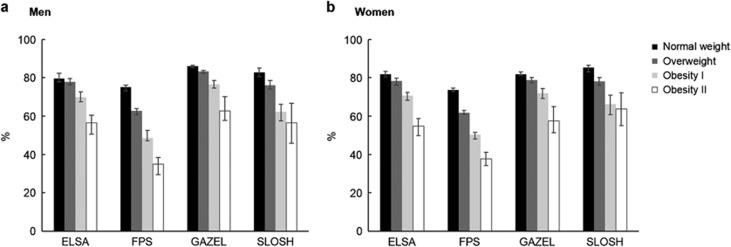
The proportion of life spent in good perceived health between ages 50 and 75 progressively decreased with increasing BMI from 81% in normal weight men and women to 53% in men and women with class II obesity which corresponds to an average 7-year difference in absolute terms. The proportion of life between ages 50 and 75 years without chronic diseases decreased from 62 and 65% in normal weight men and women and to 29 and 36% in men and women with class II obesity, respectively. This corresponds to an average 9 more years without chronic diseases in normal weight men and 7 more years in normal weight women between ages 50 and 75 years compared to class II obese men and women. No consistent differences were observed between cohorts.
CONCLUSIONS
Excess BMI is associated with substantially shorter healthy and chronic disease-free life expectancy, suggesting that tackling obesity would increase years lived in good health in populations.
背景
虽然许多研究表明肥胖与发病和死亡风险增加之间存在关联,但关于体重指数(BMI)如何影响健康预期寿命的可比信息却很少。我们在四项欧洲队列研究中考察了BMI与健康及无慢性病预期寿命之间的关联。
方法
数据取自英国、芬兰、法国和瑞典队列研究的多轮重复调查。BMI被分为四组,从正常体重(18.5 - 24.9kg/m²)到II级肥胖(≥35kg/m²)。使用两个健康指标估计健康预期寿命:自我健康评价不佳和患有慢性病(心血管疾病、癌症、呼吸系统疾病和糖尿病)。多状态生命表模型用于估计每个BMI类别在50至75岁之间按性别划分的健康预期寿命和无慢性病预期寿命。
结果
50至75岁期间,自我感觉健康良好的生命比例随着BMI的增加而逐渐下降,正常体重男性和女性为81%,II级肥胖男性和女性为53%,绝对差值平均为7年。50至75岁期间无慢性病的生命比例,正常体重男性和女性分别从62%和65%降至II级肥胖男性和女性的29%和36%。这意味着50至75岁期间,正常体重男性无慢性病的时间平均比II级肥胖男性多9年,正常体重女性比II级肥胖女性多7年。各队列之间未观察到一致的差异。
结论
BMI过高与健康及无慢性病预期寿命显著缩短有关,这表明解决肥胖问题将增加人群健康生活的年限。

 Zotero 插件