
维生素D受体(VDR)全基因组结合与全基因组关联研究(GWAS)遗传变异数据的整合揭示了VDR与核因子κB(NF-κB)结合的共现,这与免疫表型相关。
Integration of VDR genome wide binding and GWAS genetic variation data reveals co-occurrence of VDR and NF-κB binding that is linked to immune phenotypes.
作者信息
Singh Prashant K, van den Berg Patrick R, Long Mark D, Vreugdenhil Angie, Grieshober Laurie, Ochs-Balcom Heather M, Wang Jianmin, Delcambre Sylvie, Heikkinen Sami, Carlberg Carsten, Campbell Moray J, Sucheston-Campbell Lara E
机构信息
Department of Pharmacology & Therapeutics, Roswell Park Cancer Institute, Buffalo, NY, 14263, USA.
Leiden institute of Physics, Leiden University, 2300 RA, Leiden, Netherlands.
出版信息
BMC Genomics. 2017 Feb 6;18(1):132. doi: 10.1186/s12864-017-3481-4.
BACKGROUND
The nuclear hormone receptor superfamily acts as a genomic sensor of diverse signals. Their actions are often intertwined with other transcription factors. Nuclear hormone receptors are targets for many therapeutic drugs, and include the vitamin D receptor (VDR). VDR signaling is pleotropic, being implicated in calcaemic function, antibacterial actions, growth control, immunomodulation and anti-cancer actions. Specifically, we hypothesized that the biologically significant relationships between the VDR transcriptome and phenotype-associated biology could be discovered by integrating the known VDR transcription factor binding sites and all published trait- and disease-associated SNPs. By integrating VDR genome-wide binding data (ChIP-seq) with the National Human Genome Research Institute (NHGRI) GWAS catalog of SNPs we would see where and which target gene interactions and pathways are impacted by inherited genetic variation in VDR binding sites, indicating which of VDR's multiple functions are most biologically significant.
RESULTS
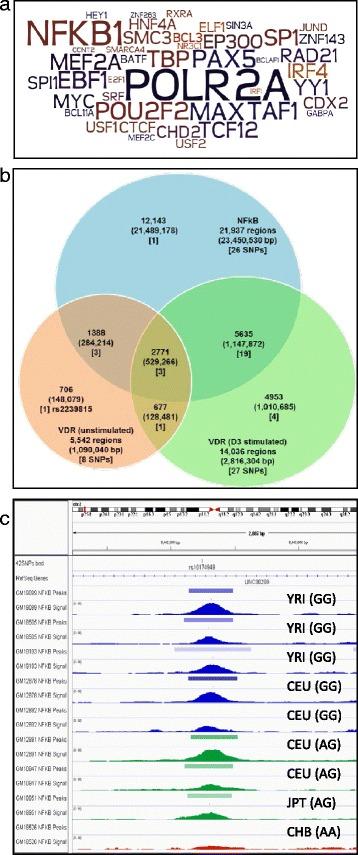
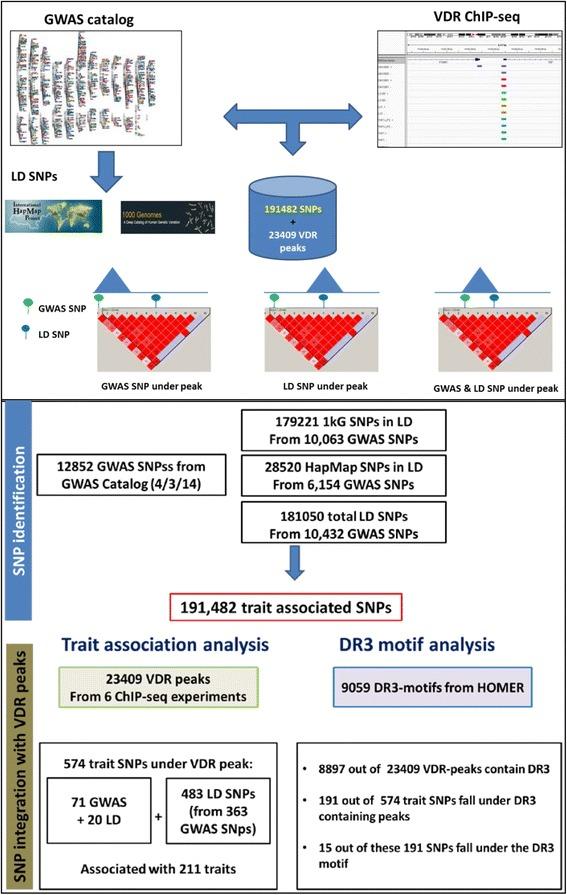
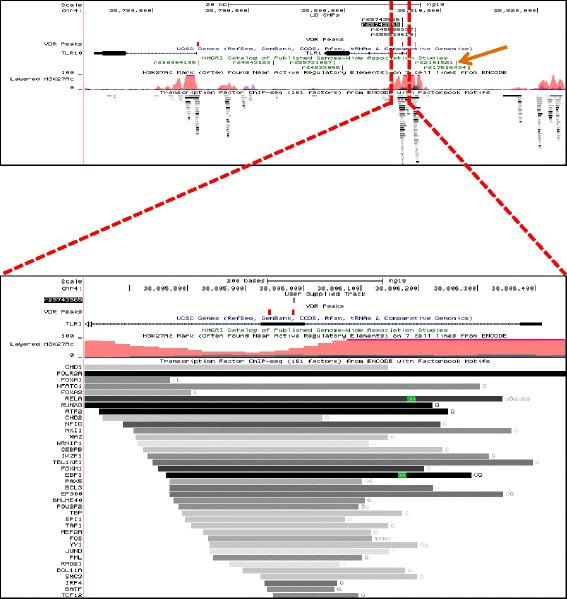
To examine how genetic variation impacts VDR function we overlapped 23,409 VDR genomic binding peaks from six VDR ChIP-seq datasets with 191,482 SNPs, derived from GWAS-significant SNPs (Lead SNPs) and their correlated variants (r > 0.8) from HapMap3 and the 1000 genomes project. In total, 574 SNPs (71 Lead and 503 SNPs in linkage disequilibrium with Lead SNPs) were present at VDR binding loci and associated with 211 phenotypes. For each phenotype a hypergeometric test was used to determine if SNPs were enriched at VDR binding sites. Bonferroni correction for multiple testing across the 211 phenotypes yielded 42 SNPs that were either disease- or phenotype-associated with seven predominately immune related including self-reported allergy; esophageal cancer was the only cancer phenotype. Motif analyses revealed that only two of these 42 SNPs reside within a canonical VDR binding site (DR3 motif), and that 1/3 of the 42 SNPs significantly impacted binding and gene regulation by other transcription factors, including NF-κB. This suggests a plausible link for the potential cross-talk between VDR and NF-κB.
CONCLUSIONS
These analyses showed that VDR peaks are enriched for SNPs associated with immune phenotypes suggesting that VDR immunomodulatory functions are amongst its most important actions. The enrichment of genetic variation in non-DR3 motifs suggests a significant role for the VDR to bind in multimeric complexes containing other transcription factors that are the primary DNA binding component. Our work provides a framework for the combination of ChIP-seq and GWAS findings to provide insight into the underlying phenotype-associated biology of a given transcription factor.
背景
核激素受体超家族作为多种信号的基因组传感器。它们的作用常常与其他转录因子相互交织。核激素受体是许多治疗药物的靶点,包括维生素D受体(VDR)。VDR信号具有多效性,涉及钙调节功能、抗菌作用、生长控制、免疫调节和抗癌作用。具体而言,我们假设通过整合已知的VDR转录因子结合位点以及所有已发表的与性状和疾病相关的单核苷酸多态性(SNP),可以发现VDR转录组与表型相关生物学之间具有生物学意义的关系。通过将VDR全基因组结合数据(ChIP-seq)与美国国立人类基因组研究所(NHGRI)的SNP全基因组关联研究(GWAS)目录相结合,我们将了解VDR结合位点的遗传变异在何处以及对哪些靶基因相互作用和途径产生影响,从而表明VDR的多种功能中哪些在生物学上最为重要。
结果
为了研究遗传变异如何影响VDR功能,我们将来自6个VDR ChIP-seq数据集的23,409个VDR基因组结合峰与191,482个SNP进行了重叠分析,这些SNP来自GWAS显著的SNP(先导SNP)及其来自HapMap3和千人基因组计划的相关变异(r > 0.8)。总共有574个SNP(71个先导SNP和503个与先导SNP处于连锁不平衡状态的SNP)存在于VDR结合位点,并与211种表型相关。对于每种表型,使用超几何检验来确定SNP是否在VDR结合位点富集。对211种表型进行多重检验的Bonferroni校正后,得到42个与疾病或表型相关的SNP,其中7种主要与免疫相关,包括自我报告的过敏;食管癌是唯一的癌症表型。基序分析显示,这42个SNP中只有两个位于典型的VDR结合位点(DR3基序)内,并且42个SNP中的1/3显著影响其他转录因子(包括NF-κB)的结合和基因调控。这表明VDR与NF-κB之间可能存在相互作用的合理联系。
结论
这些分析表明,VDR峰富含与免疫表型相关的SNP,这表明VDR的免疫调节功能是其最重要的作用之一。非DR3基序中遗传变异的富集表明VDR在包含其他作为主要DNA结合成分的转录因子的多聚体复合物中结合具有重要作用。我们的工作为结合ChIP-seq和GWAS研究结果提供了一个框架,以深入了解给定转录因子潜在的表型相关生物学特性。
 Zotero 插件