Darbre Philippa D
School of Biological Sciences, University of Reading, Reading, RG6 6UB, UK.
Curr Obes Rep. 2017 Mar;6(1):18-27. doi: 10.1007/s13679-017-0240-4.
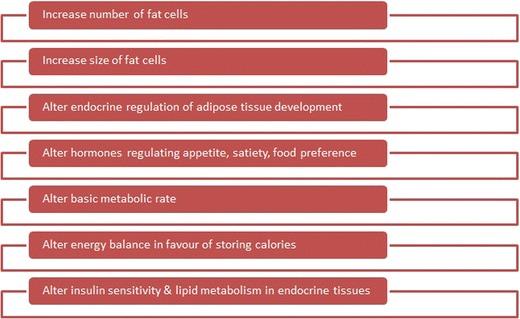
The purpose of this review was to summarise current evidence that some environmental chemicals may be able to interfere in the endocrine regulation of energy metabolism and adipose tissue structure.
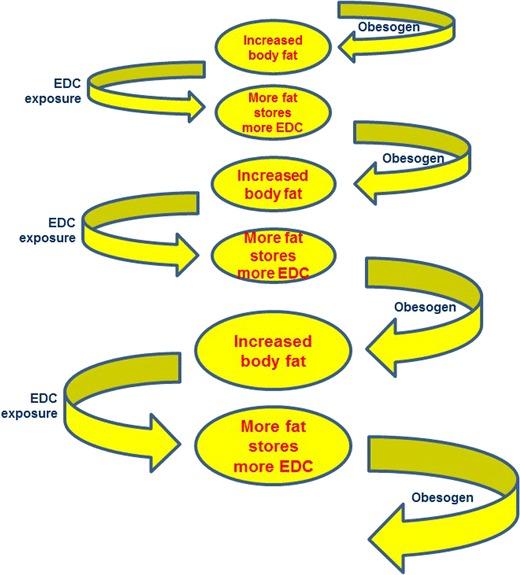
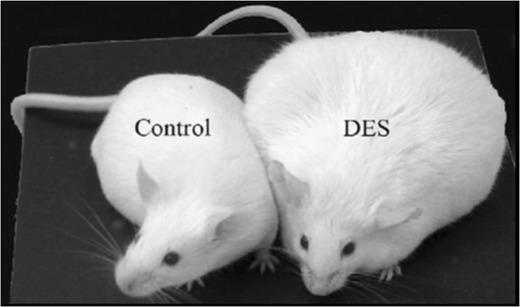
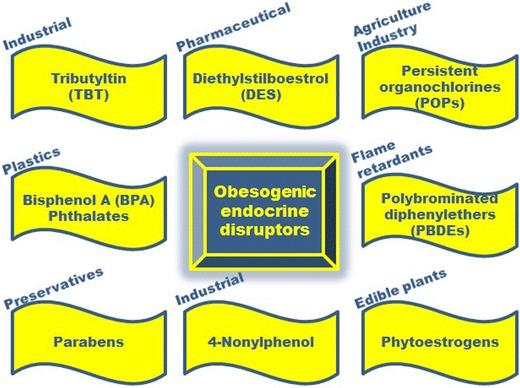
Recent findings demonstrate that such endocrine-disrupting chemicals, termed "obesogens", can promote adipogenesis and cause weight gain. This includes compounds to which the human population is exposed in daily life through their use in pesticides/herbicides, industrial and household products, plastics, detergents, flame retardants and as ingredients in personal care products. Animal models and epidemiological studies have shown that an especially sensitive time for exposure is in utero or the neonatal period. In summarising the actions of obesogens, it is noteworthy that as their structures are mainly lipophilic, their ability to increase fat deposition has the added consequence of increasing the capacity for their own retention. This has the potential for a vicious spiral not only of increasing obesity but also increasing the retention of other lipophilic pollutant chemicals with an even broader range of adverse actions. This might offer an explanation as to why obesity is an underlying risk factor for so many diseases including cancer.
本综述旨在总结当前的证据,即某些环境化学物质可能干扰能量代谢和脂肪组织结构的内分泌调节。
最新研究结果表明,这类被称为“致肥胖因子”的内分泌干扰化学物质可促进脂肪生成并导致体重增加。这包括人类在日常生活中通过使用杀虫剂/除草剂、工业和家用产品、塑料制品、洗涤剂、阻燃剂以及个人护理产品中的成分而接触到的化合物。动物模型和流行病学研究表明,一个特别敏感的暴露时期是在子宫内或新生儿期。在总结致肥胖因子的作用时,值得注意的是,由于它们的结构主要是亲脂性的,它们增加脂肪沉积的能力还会导致自身蓄积能力增强。这不仅有可能导致肥胖加剧的恶性循环,还会增加其他具有更广泛不良作用的亲脂性污染物的蓄积。这或许可以解释为什么肥胖是包括癌症在内的众多疾病的潜在危险因素。

 Zotero 插件