
单剂量预防性静脉注射布洛芬对腹腔镜胆囊切除术后阿片类药物消耗及急性疼痛的影响。
Effects of single-dose preemptive intravenous ibuprofen on postoperative opioid consumption and acute pain after laparoscopic cholecystectomy.
作者信息
Ahiskalioglu Elif Oral, Ahiskalioglu Ali, Aydin Pelin, Yayik Ahmet Murat, Temiz Ayetullah
机构信息
Department of Anesthesiology and Reanimation, Erzurum Regional Training and Research Hospital Department of Anesthesiology and Reanimation, Ataturk University School of Medicine Department of General Surgery, Erzurum Regional Training and Research Hospital, Erzurum,Turkey.
出版信息
Medicine (Baltimore). 2017 Feb;96(8):e6200. doi: 10.1097/MD.0000000000006200.
BACKGROUND
Although studies involving intravenous (IV) ibuprofen are still limited, it has been shown to have a potential role in the treatment of postoperative pain. The primary objective of this study was to investigate the effects of preemptive IV ibuprofen on postoperative 24 hour opioid consumption and postoperative pain in patients undergoing laparoscopic cholecystectomy.
METHODS
Following ethical committee approval, 60 patients aged 18 to 65, American Society of Anesthesiology (ASA) I-II, and scheduled for laparoscopic cholecystectomy were included in this prospective, randomized, double-blinded study. Patients were randomly divided into 1 of 2 groups. The control group (n = 30) received 100 mL saline solution 30 minutes before surgery, while the ibuprofen group (n = 30) received 400 mg IV ibuprofen in 100 mL saline. The same general anesthesia protocol was applied in both groups, and all operations were performed by the same surgeon using the same technique. Postoperative analgesia was assessed using a visual analogue pain scale (VAS) with active and passive movements. Twenty-four hour postoperative fentanyl consumption with patient-controlled analgesia and additional analgesia requirements were recorded. Postoperative analgesia was established with 1000 mg paracetamol once every 6 hours and patient-controlled IV fentanyl.
RESULTS
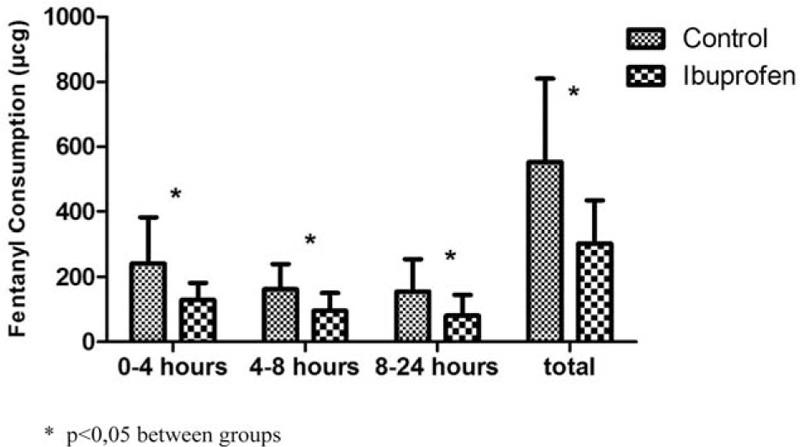
Compared with the control group, VAS scores in the IV ibuprofen group were statistically lower at postoperative 30 minutes and 1, 2, 4, 8, 12, and 24 hours (P < 0.001). Twenty-four hour opioid consumption was statistically significantly higher in the control group compared to the ibuprofen group (553.00 ± 257.04 and 303.33 ± 132.08 μcq, respectively, P < 0.001). Additional analgesia use was statistically significantly higher in the control group than in the ibuprofen group (14/30 vs 5/30, respectively, P < 0.001). The rates of nausea and vomiting were higher in group control than in group ibuprofen (13/30 vs 5/30, respectively, P = 0.024). Other side-effects were similar between the groups.
CONCLUSION
A preemptive single dose of IV ibuprofen in laparoscopic cholecystectomy reduced postoperative opioid consumption in the 1st 24 hours by 45%. It generated lower pain scores in the postoperative period compared with placebo.
背景
尽管关于静脉注射布洛芬的研究仍然有限,但已显示其在治疗术后疼痛方面具有潜在作用。本研究的主要目的是调查术前静脉注射布洛芬对接受腹腔镜胆囊切除术患者术后24小时阿片类药物消耗量及术后疼痛的影响。
方法
经伦理委员会批准,本前瞻性、随机、双盲研究纳入了60例年龄在18至65岁之间、美国麻醉医师协会(ASA)分级为I-II级且计划行腹腔镜胆囊切除术的患者。患者被随机分为两组中的一组。对照组(n = 30)在手术前30分钟接受100 mL生理盐水,而布洛芬组(n = 30)在100 mL生理盐水中接受400 mg静脉注射布洛芬。两组均采用相同的全身麻醉方案,所有手术均由同一位外科医生使用相同技术进行。使用视觉模拟疼痛量表(VAS)评估主动和被动活动时的术后镇痛情况。记录术后24小时患者自控镇痛的芬太尼消耗量及额外的镇痛需求。术后镇痛采用每6小时一次1000 mg对乙酰氨基酚及患者自控静脉注射芬太尼。
结果
与对照组相比,静脉注射布洛芬组术后30分钟、1、2、4、8、12和24小时的VAS评分在统计学上更低(P < 0.001)。对照组24小时阿片类药物消耗量在统计学上显著高于布洛芬组(分别为553.00±257.04和303.33±132.

 Zotero 插件