
睾丸特异性Y样蛋白5:基因表达、甲基化及其对前列腺癌药物敏感性的影响
Testis specific Y-like 5: gene expression, methylation and implications for drug sensitivity in prostate carcinoma.
作者信息
Kumar Senthil R, Bryan Jeffrey N, Esebua Magda, Amos-Landgraf James, May Tanner J
机构信息
Comparative Oncology Radiobiology and Epigenetics Laboratory, College of Veterinary Medicine and Surgery, University of Missouri, 1600 E Rollins, W-143 Veterinary Medicine Building, Columbia, MO, 65211, USA.
Department of Pathology and Anatomical Sciences, School of Medicine, University of Missouri, Columbia, MO, 65212, USA.
出版信息
BMC Cancer. 2017 Feb 24;17(1):158. doi: 10.1186/s12885-017-3134-7.
BACKGROUND
TSPYL5, a putative tumor suppressor gene, belongs to the nucleosome assembly protein family. The chromosomal location of the TSPYL5 gene is 8Q22.1, and its exact role in prostate cancer etiology remains unclear. Further TSPYL5 gene and protein expression in prostate carcinoma cells and diseased tissues including its susceptibility for epigenetic silencing is unknown. Also, not known is the variation in TSPYL5 protein expression with regards to progression of prostatic carcinoma and its possible role in drug sensitivity.
METHODS
TSPYL5, DNMT-1 and DNMT-B gene expression in DU145, LNCaP and RWPE-1 cells and prostate tumor tissues was analyzed by qRT-PCR and RT-PCR. Demethylation experiments were done by treating DU145 and LNCaP cells with 5-aza-2'-deoxycytidine in vitro. Methylation analysis of TSPYL5 gene was performed by methylation specific PCR and pyrosequencing. TSPYL5 protein expression in benign and diseased prostate tumor tissues was performed by immunohistochemistry and in the cells by Western blotting.
RESULTS
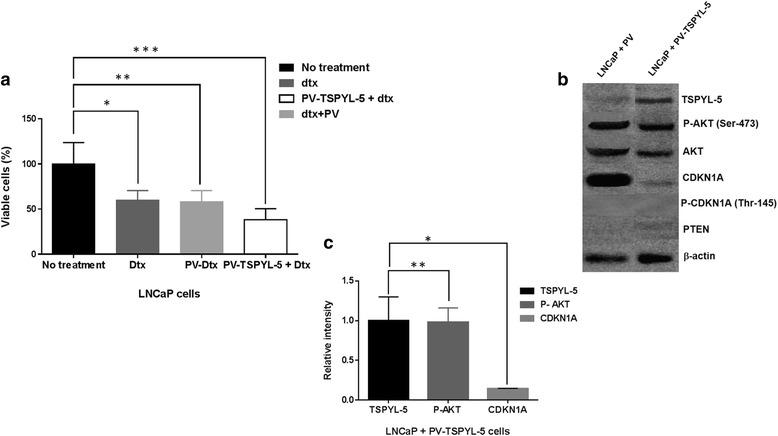
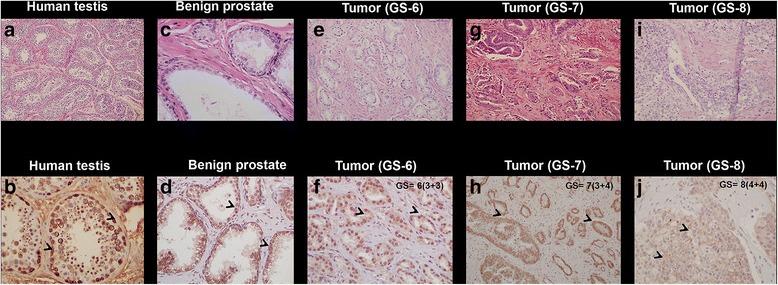
TSPYL5 was differentially expressed in non-tumorigenic prostate epithelial cells (RWPE-1), androgen independent (DU145), dependent (LNCaP) prostate carcinoma cells and tissues. Methylation-specific PCR and pyrosequencing analysis identified an inverse relationship between DNA methylation and expression leading to the silencing of TSPYL5 gene. Treatment of prostate carcinoma cells in which TSPYL5 was absent or low (DU145 and LNCaP) with the demethylating agent 5-aza-2'-deoxycytidine upregulated its expression in these cells. Immunohistochemical studies clearly identified TSPYL5 protein in benign tissue and in tumors with Gleason score (GS) of 6 and 7. TSPYL5 protein levels were very low in tumors of GS ≥ 8. TSPYL5 overexpression in LNCaP cells increased the cell sensitivity to chemotherapy drugs such as docetaxel and paclitaxel, as measured by the cellular viability. Furthermore, the cells also exhibited reduced CDKN1A expression with only marginal reduction in pAKT.
CONCLUSIONS
Decrease in TSPYL5 protein in advanced tumors might possibly function as an indicator of prostate tumor progression. Its absence due to methylation-induced silencing can lead to reduced drug sensitivity in prostate carcinoma.
背景
TSPYL5是一种假定的肿瘤抑制基因,属于核小体组装蛋白家族。TSPYL5基因的染色体定位为8Q22.1,其在前列腺癌病因学中的具体作用尚不清楚。TSPYL5基因和蛋白在前列腺癌细胞及病变组织中的表达情况,包括其对表观遗传沉默的易感性尚不清楚。此外,TSPYL5蛋白表达随前列腺癌进展的变化及其在药物敏感性中的可能作用也不清楚。
方法
采用qRT-PCR和RT-PCR分析DU145、LNCaP和RWPE-1细胞及前列腺肿瘤组织中TSPYL5、DNMT-1和DNMT-B基因的表达。通过体外使用5-氮杂-2'-脱氧胞苷处理DU145和LNCaP细胞进行去甲基化实验。通过甲基化特异性PCR和焦磷酸测序对TSPYL5基因进行甲基化分析。通过免疫组织化学检测良性和病变前列腺肿瘤组织中的TSPYL5蛋白表达,通过蛋白质印迹法检测细胞中的TSPYL5蛋白表达。
结果
TSPYL5在非致瘤性前列腺上皮细胞(RWPE-1)、雄激素非依赖性(DU145)、依赖性(LNCaP)前列腺癌细胞及组织中差异表达。甲基化特异性PCR和焦磷酸测序分析确定DNA甲基化与表达之间呈负相关,导致TSPYL5基因沉默。用去甲基化剂5-氮杂-2'-脱氧胞苷处理TSPYL5缺失或低表达的前列腺癌细胞(DU145和LNCaP)可上调这些细胞中TSPYL5的表达。免疫组织化学研究清楚地在良性组织和Gleason评分(GS)为6和7的肿瘤中鉴定出TSPYL5蛋白。在GS≥8的肿瘤中,TSPYL5蛋白水平非常低。通过细胞活力测定,LNCaP细胞中TSPYL5的过表达增加了细胞对多西他赛和紫杉醇等化疗药物的敏感性。此外,细胞还表现出CDKN1A表达降低,而pAKT仅略有降低。
结论
晚期肿瘤中TSPYL5蛋白的减少可能作为前列腺肿瘤进展的一个指标。由于甲基化诱导的沉默导致其缺失可导致前列腺癌药物敏感性降低。



 Zotero 插件