
通过唑来膦酸盐脉冲刺激增强 Vγ2Vδ2 T 细胞过继性癌症免疫治疗。
Enhancing adoptive cancer immunotherapy with Vγ2Vδ2 T cells through pulse zoledronate stimulation.
机构信息
Division of Immunology, Department of Internal Medicine, University of Iowa Carver College of Medicine, Iowa City, IA 52242 USA.
Department of Veterans Affairs, Iowa City Health Care System, Iowa City, IA 52246 USA.
出版信息
J Immunother Cancer. 2017 Feb 21;5:9. doi: 10.1186/s40425-017-0209-6. eCollection 2017.
BACKGROUND
Human γδ T cells expressing Vγ2Vδ2 T cell receptors monitor foreign- and self-prenyl pyrophosphate metabolites in isoprenoid biosynthesis to mediate immunity to microbes and tumors. Adoptive immunotherapy with Vγ2Vδ2 T cells has been used to treat cancer patients with partial and complete remissions. Most clinical trials and preclinical studies have used continuous zoledronate exposure to expand Vγ2Vδ2 cells where zoledronate is slowly diluted over the course of the culture. Zoledronate inhibits farnesyl diphosphate synthase (FDPS) in monocytes causing isopentenyl pyrophosphate to accumulate that then stimulates Vγ2Vδ2 cells. Because zoledronate inhibition of FDPS is also toxic for T cells, we hypothesized that a short period of exposure would reduce T cell toxicity but still be sufficient for monocytes uptake. Additionally, IL-15 increases the anti-tumor activity of murine αβ T cells in mice but its effect on the in vivo anti-tumor activity of human Vγ2Vδ2 cells has not been assessed.
METHODS
Human Vγ2Vδ2 T cells were expanded by pulse or continuous zoledronate stimulation with IL-2 or IL-15. Expanded Vγ2Vδ2 cells were tested for their expression of effector molecules and killing of tumor cells as well as their in vivo control of human prostate cancer tumors in immunodeficient NSG mice.
RESULTS
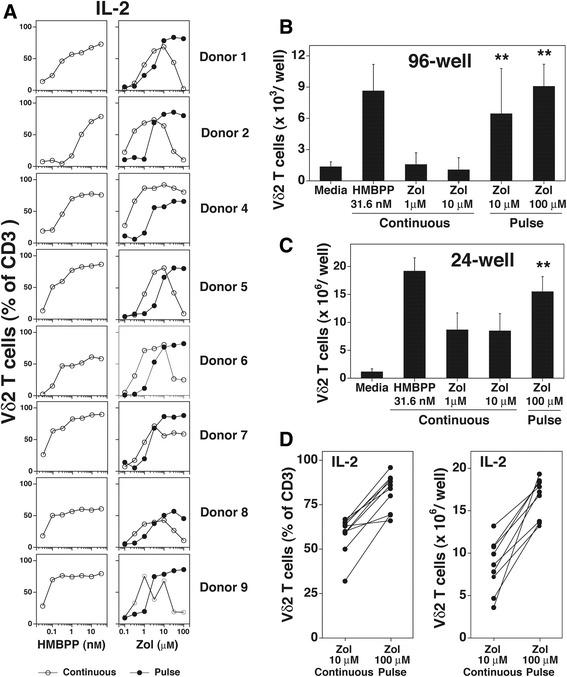
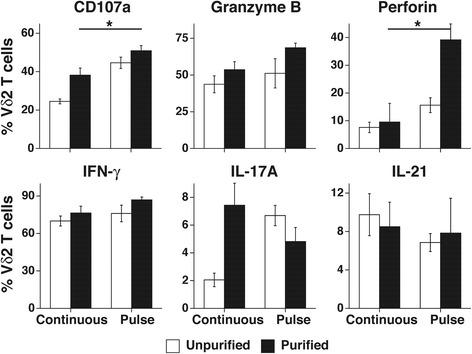
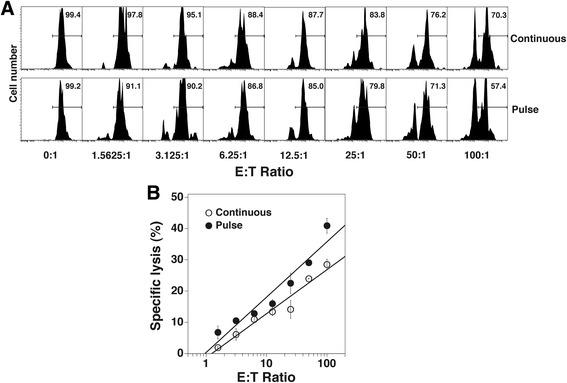
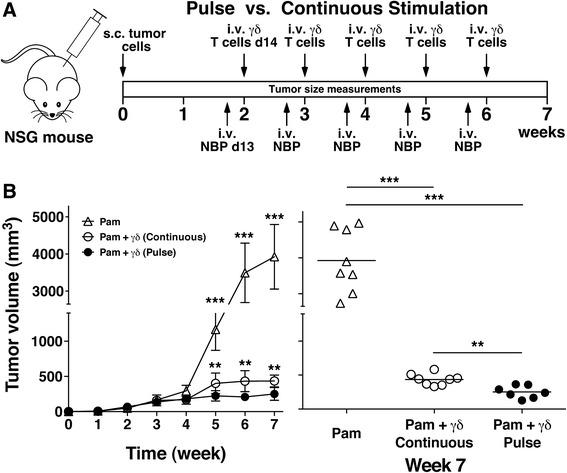
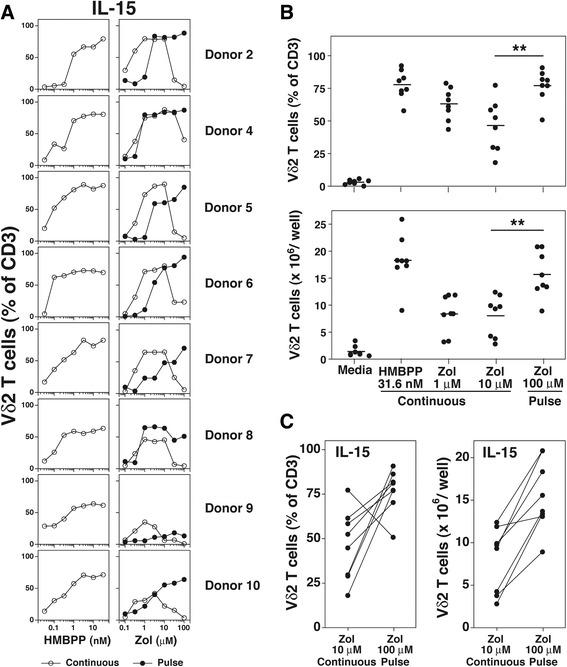
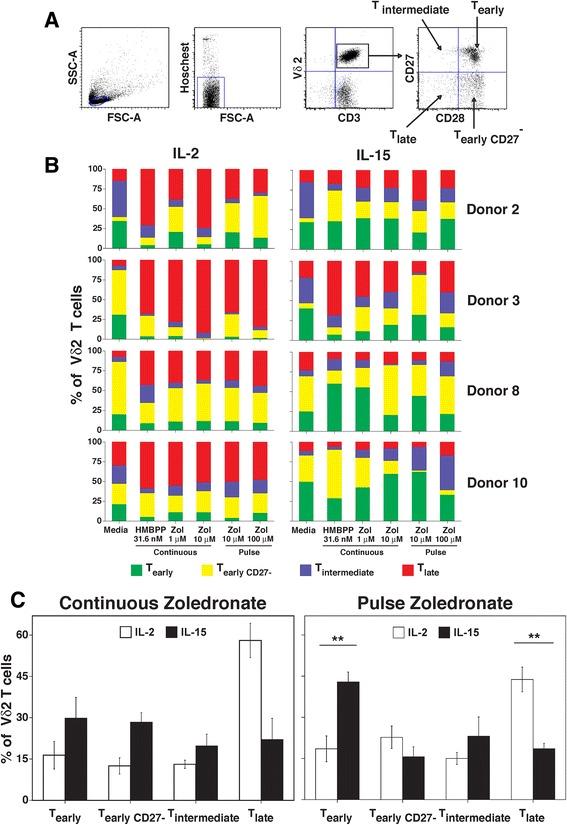
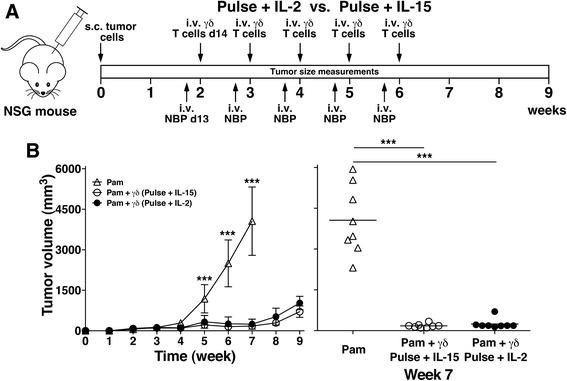
Pulse zoledronate stimulation with either IL-2 or IL-15 resulted in more uniform expansion of Vγ2Vδ2 cells with higher purity and cell numbers as compared with continuous exposure. The Vγ2Vδ2 cells had higher levels of CD107a and perforin and increased tumor cytotoxicity. Adoptive immunotherapy with Vγ2Vδ2 cells derived by pulse stimulation controlled human PC-3 prostate cancer tumors in NSG mice significantly better than those derived by continuous stimulation, halting tumor growth. Although pulse zoledronate stimulation with IL-15 preserved early memory subsets, adoptive immunotherapy with IL-15-derived Vγ2Vδ2 cells equally inhibited PC-3 tumor growth as those derived with IL-2.
CONCLUSIONS
Pulse zoledronate stimulation maximizes the purity, quantity, and quality of expanded Vγ2Vδ2 cells for adoptive immunotherapy but there is no advantage to using IL-15 over IL-2 in our humanized mouse model. Pulse zoledronate stimulation is a simple modification to existing protocols that will enhance the effectiveness of adoptively transferred Vγ2Vδ2 cells by increasing their numbers and anti-tumor activity.
背景
表达 Vγ2Vδ2 T 细胞受体的人 γδ T 细胞监测异戊烯焦磷酸代谢物和法呢基焦磷酸代谢物在异戊烯生物合成中的变化,从而介导机体对微生物和肿瘤的免疫。Vγ2Vδ2 T 细胞过继免疫治疗已被用于治疗部分缓解和完全缓解的癌症患者。大多数临床试验和临床前研究都使用唑来膦酸连续暴露来扩增 Vγ2Vδ2 细胞,其中唑来膦酸在培养过程中缓慢稀释。唑来膦酸抑制法尼基二磷酸合酶(FDPS)在单核细胞中,导致异戊烯焦磷酸积累,然后刺激 Vγ2Vδ2 细胞。由于唑来膦酸抑制 FDPS 对 T 细胞也有毒性,我们假设短期暴露会降低 T 细胞毒性,但仍足以被单核细胞摄取。此外,IL-15 增加了小鼠 αβ T 细胞的抗肿瘤活性,但尚未评估其对人类 Vγ2Vδ2 细胞体内抗肿瘤活性的影响。
方法
通过 IL-2 或 IL-15 脉冲或连续唑来膦酸刺激扩增人 Vγ2Vδ2 T 细胞。检测扩增的 Vγ2Vδ2 细胞表达效应分子和杀伤肿瘤细胞的能力,以及在免疫缺陷 NSG 小鼠中控制人前列腺癌肿瘤的能力。
结果
与连续暴露相比,IL-2 或 IL-15 脉冲唑来膦酸刺激导致 Vγ2Vδ2 细胞的扩增更均匀,纯度和细胞数量更高。Vγ2Vδ2 细胞 CD107a 和穿孔素水平更高,肿瘤细胞毒性增加。与连续刺激相比,脉冲刺激产生的 Vγ2Vδ2 细胞过继免疫治疗能显著更好地控制 NSG 小鼠的人前列腺癌 PC-3 肿瘤,从而阻止肿瘤生长。虽然 IL-15 脉冲唑来膦酸刺激保留了早期记忆亚群,但 IL-15 衍生的 Vγ2Vδ2 细胞过继免疫治疗与 IL-2 衍生的 Vγ2Vδ2 细胞一样能抑制 PC-3 肿瘤生长。
结论
唑来膦酸脉冲刺激最大限度地提高了过继免疫治疗中扩增的 Vγ2Vδ2 细胞的纯度、数量和质量,但在我们的人源化小鼠模型中,使用 IL-15 并没有优于 IL-2。唑来膦酸脉冲刺激是对现有方案的简单修改,通过增加 Vγ2Vδ2 细胞的数量和抗肿瘤活性,增强过继转移的 Vγ2Vδ2 细胞的有效性。

 Zotero 插件