
门诊护理机构的支付方式。
Payment methods for outpatient care facilities.
作者信息
Yuan Beibei, He Li, Meng Qingyue, Jia Liying
机构信息
China Center for Health Development Studies (CCHDS), Peking University, 38 Xueyuan Road, Beijing, Beijing, China, 100191.
Center for Health Management and Policy, Key Lab for Health Economics and Policy Research, Ministry of Health, Shandong University, Jinan, Shandong, China, 250012.
出版信息
Cochrane Database Syst Rev. 2017 Mar 3;3(3):CD011153. doi: 10.1002/14651858.CD011153.pub2.
BACKGROUND
Outpatient care facilities provide a variety of basic healthcare services to individuals who do not require hospitalisation or institutionalisation, and are usually the patient's first contact. The provision of outpatient care contributes to immediate and large gains in health status, and a large portion of total health expenditure goes to outpatient healthcare services. Payment method is one of the most important incentive methods applied by purchasers to guide the performance of outpatient care providers.
OBJECTIVES
To assess the impact of different payment methods on the performance of outpatient care facilities and to analyse the differences in impact of payment methods in different settings.
SEARCH METHODS
We searched the Cochrane Central Register of Controlled Trials (CENTRAL), 2016, Issue 3, part of the Cochrane Library (searched 8 March 2016); MEDLINE, OvidSP (searched 8 March 2016); Embase, OvidSP (searched 24 April 2014); PubMed (NCBI) (searched 8 March 2016); Dissertations and Theses Database, ProQuest (searched 8 March 2016); Conference Proceedings Citation Index (ISI Web of Science) (searched 8 March 2016); IDEAS (searched 8 March 2016); EconLit, ProQuest (searched 8 March 2016); POPLINE, K4Health (searched 8 March 2016); China National Knowledge Infrastructure (searched 8 March 2016); Chinese Medicine Premier (searched 8 March 2016); OpenGrey (searched 8 March 2016); ClinicalTrials.gov, US National Institutes of Health (NIH) (searched 8 March 2016); World Health Organization (WHO) International Clinical Trials Registry Platform (ICTRP) (searched 8 March 2016); and the website of the World Bank (searched 8 March 2016).In addition, we searched the reference lists of included studies and carried out a citation search for the included studies via ISI Web of Science to find other potentially relevant studies. We also contacted authors of the main included studies regarding any further published or unpublished work.
SELECTION CRITERIA
Randomised trials, non-randomised trials, controlled before-after studies, interrupted time series, and repeated measures studies that compared different payment methods for outpatient health facilities. We defined outpatient care facilities in this review as facilities that provide health services to individuals who do not require hospitalisation or institutionalisation. We only included methods used to transfer funds from the purchaser of healthcare services to health facilities (including groups of individual professionals). These include global budgets, line-item budgets, capitation, fee-for-service (fixed and unconstrained), pay for performance, and mixed payment. The primary outcomes were service provision outcomes, patient outcomes, healthcare provider outcomes, costs for providers, and any adverse effects.
DATA COLLECTION AND ANALYSIS
At least two review authors independently extracted data and assessed the risk of bias. We conducted a structured synthesis. We first categorised the comparisons and outcomes and then described the effects of different types of payment methods on different categories of outcomes. We used a fixed-effect model for meta-analysis within a study if a study included more than one indicator in the same category of outcomes. We used a random-effects model for meta-analysis across studies. If the data for meta-analysis were not available in some studies, we calculated the median and interquartile range. We reported the risk ratio (RR) for dichotomous outcomes and the relative change for continuous outcomes.
MAIN RESULTS
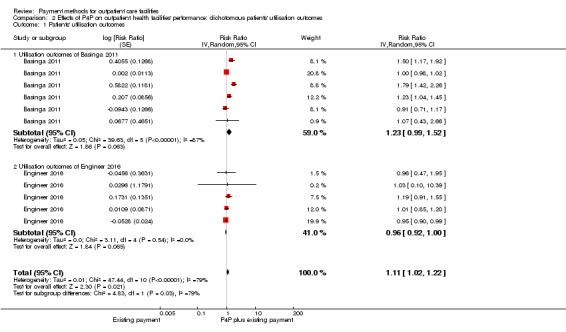
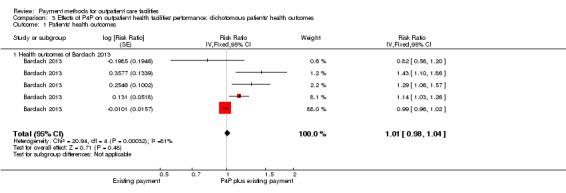
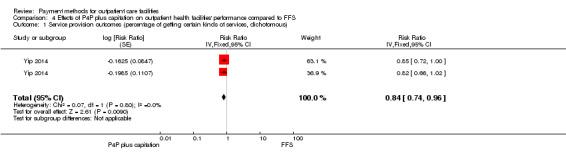
We included 21 studies from Afghanistan, Burundi, China, Democratic Republic of Congo, Rwanda, Tanzania, the United Kingdom, and the United States of health facilities providing primary health care and mental health care. There were three kinds of payment comparisons. 1) Pay for performance (P4P) combined with some existing payment method (capitation or different kinds of input-based payment) compared to the existing payment methodWe included 18 studies in this comparison, however we did not include five studies in the effects analysis due to high risk of bias. From the 13 studies, we found that the extra P4P incentives probably slightly improved the health professionals' use of some tests and treatments (adjusted RR median = 1.095, range 1.01 to 1.17; moderate-certainty evidence), and probably led to little or no difference in adherence to quality assurance criteria (adjusted percentage change median = -1.345%, range -8.49% to 5.8%; moderate-certainty evidence). We also found that P4P incentives may have led to little or no difference in patients' utilisation of health services (adjusted RR median = 1.01, range 0.96 to 1.15; low-certainty evidence) and may have led to little or no difference in the control of blood pressure or cholesterol (adjusted RR = 1.01, range 0.98 to 1.04; low-certainty evidence). 2) Capitation combined with P4P compared to fee-for-service (FFS)One study found that compared with FFS, a capitated budget combined with payment based on providers' performance on antibiotic prescriptions and patient satisfaction probably slightly reduced antibiotic prescriptions in primary health facilities (adjusted RR 0.84, 95% confidence interval 0.74 to 0.96; moderate-certainty evidence). 3) Capitation compared to FFSTwo studies compared capitation to FFS in mental health centres in the United States. Based on these studies, the effects of capitation compared to FFS on the utilisation and costs of services were uncertain (very low-certainty evidence).
AUTHORS' CONCLUSIONS: Our review found that if policymakers intend to apply P4P incentives to pay health facilities providing outpatient services, this intervention will probably lead to a slight improvement in health professionals' use of tests or treatments, particularly for chronic diseases. However, it may lead to little or no improvement in patients' utilisation of health services or health outcomes. When considering using P4P to improve the performance of health facilities, policymakers should carefully consider each component of their P4P design, including the choice of performance measures, the performance target, payment frequency, if there will be additional funding, whether the payment level is sufficient to change the behaviours of health providers, and whether the payment to facilities will be allocated to individual professionals. Unfortunately, the studies included in this review did not help to inform those considerations.Well-designed comparisons of different payment methods for outpatient health facilities in low- and middle-income countries and studies directly comparing different designs (e.g. different payment levels) of the same payment method (e.g. P4P or FFS) are needed.
背景
门诊护理机构为不需要住院或入住机构的个人提供各种基本医疗服务,通常是患者的首次接触点。提供门诊护理有助于立即大幅改善健康状况,且总医疗支出的很大一部分用于门诊医疗服务。支付方式是购买方用于引导门诊护理提供者表现的最重要激励方式之一。
目的
评估不同支付方式对门诊护理机构表现的影响,并分析不同环境下支付方式影响的差异。
检索方法
我们检索了Cochrane对照试验中心注册库(CENTRAL,2016年第3期,Cochrane图书馆的一部分,检索于2016年3月8日);MEDLINE,OvidSP(检索于2016年3月8日);Embase,OvidSP(检索于2014年4月24日);PubMed(NCBI)(检索于2016年3月8日);学位论文数据库,ProQuest(检索于2016年3月8日);会议论文引文索引(ISI科学网)(检索于2016年3月8日);IDEAS(检索于2016年3月8日);EconLit,ProQuest(检索于2016年3月8日);POPLINE, K4Health(检索于2016年3月8日);中国国家知识基础设施(检索于2016年3月8日);中国中医药文献数据库(检索于2016年3月8日);OpenGrey(检索于2016年3月8日);ClinicalTrials.gov,美国国立卫生研究院(NIH)(检索于2016年3月8日);世界卫生组织(WHO)国际临床试验注册平台(ICTRP)(检索于2016年3月8日);以及世界银行网站(检索于2016年3月8日)。此外,我们检索了纳入研究的参考文献列表,并通过ISI科学网对纳入研究进行了引文检索,以查找其他潜在相关研究。我们还就任何进一步发表或未发表的工作联系了主要纳入研究的作者。
选择标准
比较门诊医疗机构不同支付方式的随机试验、非随机试验、前后对照研究、中断时间序列研究和重复测量研究。在本综述中,我们将门诊护理机构定义为为不需要住院或入住机构的个人提供健康服务的机构。我们仅纳入用于将资金从医疗服务购买方转移到医疗机构(包括个体专业人员群体)的方法。这些方法包括全球预算、分项预算、按人头付费、按服务收费(固定和无限制)、绩效付费以及混合支付。主要结局包括服务提供结局、患者结局、医疗服务提供者结局、提供者成本以及任何不良反应。
数据收集与分析
至少两名综述作者独立提取数据并评估偏倚风险。我们进行了结构化综合分析。我们首先对比较和结局进行分类,然后描述不同类型支付方式对不同类别结局的影响。如果一项研究在同一类结局中包含多个指标,我们在研究内使用固定效应模型进行荟萃分析。我们在不同研究间使用随机效应模型进行荟萃分析。如果某些研究中没有可用于荟萃分析的数据,我们计算中位数和四分位间距。我们报告二分结局的风险比(RR)和连续结局的相对变化。
主要结果
我们纳入了来自阿富汗、布隆迪、中国、刚果民主共和国、卢旺达、坦桑尼亚、英国和美国的21项关于提供初级卫生保健和精神卫生保健的医疗机构的研究。有三种支付方式比较。1)绩效付费(P4P)与某种现有支付方式(按人头付费或不同类型的基于投入的支付)相结合与现有支付方式相比我们在该比较中纳入了18项研究,但由于偏倚风险高,我们在效应分析中未纳入5项研究。从13项研究中,我们发现额外的P4P激励可能略微改善了卫生专业人员对某些检查和治疗的使用(调整后RR中位数 = 1.095,范围1.01至1.17;中等确定性证据),并且可能导致在遵守质量保证标准方面几乎没有差异(调整后百分比变化中位数 = -1.345%,范围 -8.49%至5.8%;中等确定性证据)。我们还发现P4P激励可能导致患者对卫生服务的利用几乎没有差异(调整后RR中位数 = 1.01,范围0.96至1.15;低确定性证据),并且可能导致血压或胆固醇控制方面几乎没有差异(调整后RR = 1.01,范围0.98至1.04;低确定性证据)。2)按人头付费与P4P相结合与按服务收费(FFS)相比一项研究发现,与FFS相比,基于提供者在抗生素处方和患者满意度方面的表现的按人头预算相结合可能会略微减少初级卫生保健机构中的抗生素处方(调整后RR 0.84,95%置信区间0.74至0.96;中等确定性证据)。3)按人头付费与FFS相比两项在美国精神卫生中心的研究比较了按人头付费与FFS。基于这些研究,按人头付费与FFS相比对服务利用和成本的影响尚不确定(极低确定性证据)。
作者结论
我们的综述发现,如果政策制定者打算应用P4P激励措施来支付提供门诊服务的医疗机构,这种干预可能会导致卫生专业人员对检查或治疗的使用略有改善,特别是对于慢性病。然而,这可能对患者对卫生服务的利用或健康结局几乎没有改善。在考虑使用P4P来改善医疗机构的表现时,政策制定者应仔细考虑其P4P设计的每个组成部分,包括绩效指标的选择、绩效目标、支付频率、是否会有额外资金、支付水平是否足以改变卫生提供者的行为以及对机构的支付是否会分配给个体专业人员。不幸的是,本综述中纳入的研究无助于为这些考虑提供信息。需要对低收入和中等收入国家门诊医疗机构的不同支付方式进行精心设计的比较,以及直接比较同一支付方式(如P4P或FFS)的不同设计(如不同支付水平)的研究。


 Zotero 插件