
与社交网站(SNS)成瘾相关的大脑解剖结构改变。
Brain anatomy alterations associated with Social Networking Site (SNS) addiction.
机构信息
Faculty of Psychology, Southwest University, Beibei, Chongqing, China.
Brain and Creativity Institute, Department of Psychology, University of Southern California, Los Angeles, California, USA.
出版信息
Sci Rep. 2017 Mar 23;7:45064. doi: 10.1038/srep45064.
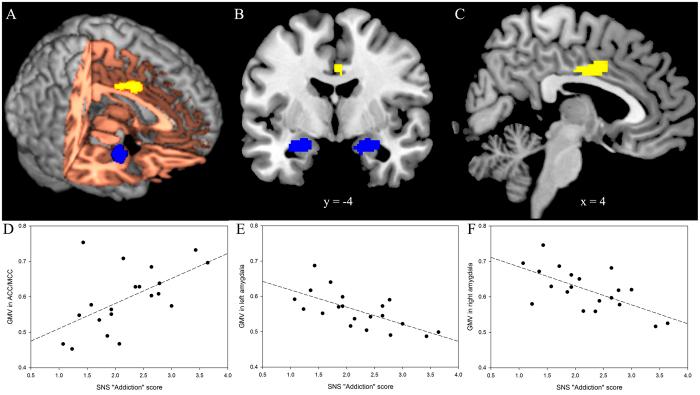
This study relies on knowledge regarding the neuroplasticity of dual-system components that govern addiction and excessive behavior and suggests that alterations in the grey matter volumes, i.e., brain morphology, of specific regions of interest are associated with technology-related addictions. Using voxel based morphometry (VBM) applied to structural Magnetic Resonance Imaging (MRI) scans of twenty social network site (SNS) users with varying degrees of SNS addiction, we show that SNS addiction is associated with a presumably more efficient impulsive brain system, manifested through reduced grey matter volumes in the amygdala bilaterally (but not with structural differences in the Nucleus Accumbens). In this regard, SNS addiction is similar in terms of brain anatomy alterations to other (substance, gambling etc.) addictions. We also show that in contrast to other addictions in which the anterior-/ mid- cingulate cortex is impaired and fails to support the needed inhibition, which manifests through reduced grey matter volumes, this region is presumed to be healthy in our sample and its grey matter volume is positively correlated with one's level of SNS addiction. These findings portray an anatomical morphology model of SNS addiction and point to brain morphology similarities and differences between technology addictions and substance and gambling addictions.
本研究依赖于关于双系统成分的神经可塑性的知识,这些成分控制着成瘾和过度行为,并表明特定感兴趣区域的灰质体积(即大脑形态)的改变与与技术相关的成瘾有关。使用基于体素的形态测量学(VBM)对 20 名社交网络网站(SNS)用户的结构磁共振成像(MRI)扫描进行分析,这些用户的 SNS 成瘾程度不同,我们发现 SNS 成瘾与冲动大脑系统的效率提高有关,表现为双侧杏仁核的灰质体积减少(但与伏隔核的结构差异无关)。在这方面,SNS 成瘾在大脑解剖结构改变方面与其他(物质、赌博等)成瘾相似。我们还表明,与其他成瘾不同的是,前/中扣带皮层受损且无法提供所需的抑制,表现为灰质体积减少,在我们的样本中,该区域被认为是健康的,其灰质体积与一个人的 SNS 成瘾程度呈正相关。这些发现描绘了 SNS 成瘾的解剖形态模型,并指出了技术成瘾与物质和赌博成瘾之间的大脑形态相似性和差异。
 Zotero 插件