
在非肥胖糖尿病(NOD)小鼠中,短疗程抗IL-7Rα抗体治疗后免疫调节机制的广泛诱导。
Broad induction of immunoregulatory mechanisms after a short course of anti-IL-7Rα antibodies in NOD mice.
作者信息
Vazquez-Mateo Cristina, Collins Justin, Fleury Michelle, Dooms Hans
机构信息
Department of Medicine, Arthritis Center/Rheumatology Section, Boston University School of Medicine, 72 East Concord Street, E519, Boston, MA, 02118, USA.
出版信息
BMC Immunol. 2017 Mar 29;18(1):18. doi: 10.1186/s12865-017-0201-4.
BACKGROUND
Type 1 diabetes is an autoimmune disease caused by T cell-mediated destruction of the insulin-producing β-cells in the pancreas. Therefore, approaches that effectively halt the pathogenic T cell response are predicted to have preventive or therapeutic benefit for type 1 diabetes patients. We previously demonstrated that long-term blocking of IL-7 signaling, which is critical for the survival and function of T cells, prevented and reversed type 1 diabetes in non-obese diabetic mice. However, such persistent inhibition of T cell responses raises concerns about causing immunodeficiency. Here, we asked whether a reduced duration of the treatment with anti-IL-7Rα antibodies retained efficacy in preventing diabetes. Moreover, we sought to identify immunoregulatory mechanisms induced by anti-IL-7Rα administration.
RESULTS
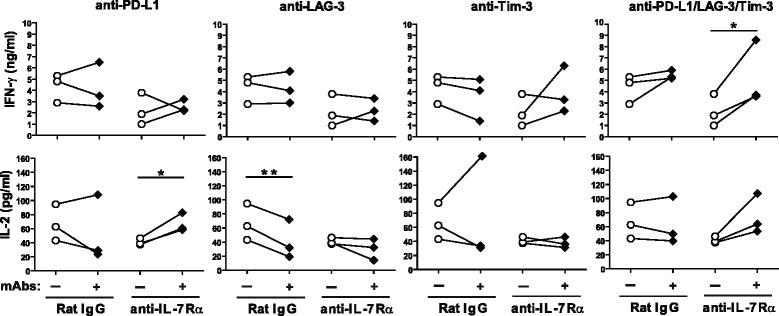
Anti-IL-7Rα antibodies were administered to prediabetic NOD mice for 3 weeks and blood samples were taken at the end of treatment and 2 weeks later to analyze changes in T cell phenotypes in response to IL-7Rα blockade. We found that the co-inhibitory receptors LAG-3, Tim-3 and PD-1 were increased on peripheral blood CD4 and CD8 T cells from anti-IL-7Rα-treated mice. Expression of these receptors contributed to reduced T cell cytokine production in response to TCR stimulation. In addition, the frequency of Tregs within the circulating CD4 T cells was increased at the end of anti-IL-7Rα antibody treatment and these Tregs showed a more activated phenotype. In vitro restimulation assays revealed that effector T cells from anti-IL-7Rα-treated mice were more sensitive to co-inhibitory receptor induction after TCR stimulation. Importantly, these changes were accompanied by delayed type 1 diabetes disease kinetics.
CONCLUSIONS
Together, our data show that short-term blockade of IL-7Rα induces detectable changes in co-inhibitory receptor expression and Treg frequencies in peripheral blood of NOD mice. These changes appear to have long-lasting effects by delaying or preventing type 1 diabetes incidence. Hence, our study provides further support for using anti-IL-7Rα antibodies to modulate autoreactive T cell responses.
背景
1型糖尿病是一种自身免疫性疾病,由T细胞介导的胰腺中产生胰岛素的β细胞破坏所致。因此,有效阻止致病性T细胞反应的方法预计对1型糖尿病患者具有预防或治疗益处。我们之前证明,长期阻断对T细胞存活和功能至关重要的IL-7信号通路,可预防和逆转非肥胖糖尿病小鼠的1型糖尿病。然而,这种对T细胞反应的持续抑制引发了对导致免疫缺陷的担忧。在此,我们询问用抗IL-7Rα抗体缩短治疗持续时间是否在预防糖尿病方面仍保留疗效。此外,我们试图确定抗IL-7Rα给药诱导的免疫调节机制。
结果
将抗IL-7Rα抗体给予糖尿病前期NOD小鼠3周,并在治疗结束时和2周后采集血样,以分析响应IL-7Rα阻断的T细胞表型变化。我们发现,抗IL-7Rα治疗小鼠外周血CD4和CD8 T细胞上的共抑制受体LAG-3、Tim-3和PD-1增加。这些受体的表达导致响应TCR刺激时T细胞细胞因子产生减少。此外,抗IL-7Rα抗体治疗结束时,循环CD4 T细胞内Tregs的频率增加,且这些Tregs表现出更活化的表型。体外再刺激试验显示,抗IL-7Rα治疗小鼠的效应T细胞在TCR刺激后对共抑制受体诱导更敏感。重要的是,这些变化伴随着1型糖尿病疾病动力学的延迟。
结论
总之,我们的数据表明,短期阻断IL-7Rα可诱导NOD小鼠外周血中共抑制受体表达和Treg频率的可检测变化。这些变化似乎通过延迟或预防1型糖尿病发病而具有持久影响。因此,我们的研究为使用抗IL-7Rα抗体调节自身反应性T细胞反应提供了进一步支持。


 Zotero 插件