
通过肿瘤样本的多区域测序对食管腺癌进行分子克隆性分析。
Molecular clonality analysis of esophageal adenocarcinoma by multiregion sequencing of tumor samples.
作者信息
van Nistelrooij Anna M J, van Marion Ronald, Koppert Linetta B, Biermann Katharina, Spaander Manon C W, Tilanus Hugo W, van Lanschot J Jan B, Wijnhoven Bas P L, Dinjens Winand N M
机构信息
Department of Pathology, Erasmus MC Cancer Institute, University Medical Center Rotterdam, P.O. Box 2040, 3000 CA, Rotterdam, The Netherlands.
Department of Surgery, Erasmus MC Cancer Institute, University Medical Center Rotterdam, P.O. Box 2040, 3000 CA, Rotterdam, The Netherlands.
出版信息
BMC Res Notes. 2017 Apr 4;10(1):144. doi: 10.1186/s13104-017-2456-5.
BACKGROUND
Intratumor heterogeneity has been demonstrated in several cancer types, following a model of branched evolution. It is unknown to which extent intratumor heterogeneity is applicable to esophageal adenocarcinoma. Therefore the aim of this study was to characterise intratumor heterogeneity in esophageal adenocarcinoma.
METHODS
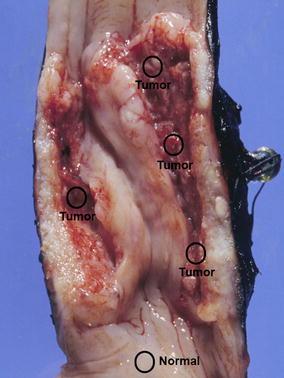
Multiregional targeted sequencing of four commonly altered genes was performed on 19 tumor regions collected from five esophageal adenocarcinomas. Alterations were classified as homogeneous or heterogeneous based on mutational and loss of heterozygosity analysis.
RESULTS
Identical TP53 mutations and homogeneously loss of heterozygosity of the TP53 locus were identified in all separated tumor regions in each of five adenocarcinomas, and in the corresponding Barrett's esophagus and tumor positive lymph node of one primary tumor. Loss of heterozygosity of the P16 locus was homogeneous among all tumor regions in four adenocarcinomas, and an identical pattern of loss of heterozygosity was present in the Barrett's esophagus. Loss of heterozygosity of the SMAD4 and APC loci was observed in a heterogeneous pattern.
CONCLUSIONS
Known driver alterations, such as TP53 and P16 are homogeneously present within each adenocarcinoma, and therefore occur early during carcinogenesis and subsequently clonally expand throughout the entire tumor. However, loss of heterozygosity of the SMAD4 and APC loci shows a heterogeneous pattern, indicating intratumor heterogeneity of esophageal adenocarcinoma.
背景
肿瘤内异质性已在多种癌症类型中得到证实,遵循分支进化模型。目前尚不清楚肿瘤内异质性在多大程度上适用于食管腺癌。因此,本研究的目的是表征食管腺癌中的肿瘤内异质性。
方法
对从5例食管腺癌中收集的19个肿瘤区域进行4个常见改变基因的多区域靶向测序。根据突变和杂合性缺失分析,将改变分类为同质或异质。
结果
在5例腺癌中的每一例的所有分离肿瘤区域,以及一例原发性肿瘤的相应巴雷特食管和肿瘤阳性淋巴结中,均鉴定出相同的TP53突变和TP53基因座的均匀杂合性缺失。4例腺癌的所有肿瘤区域中P16基因座的杂合性缺失是均匀的,并且在巴雷特食管中存在相同的杂合性缺失模式。观察到SMAD4和APC基因座的杂合性缺失呈异质模式。
结论
已知的驱动改变,如TP53和P16,在每个腺癌中均匀存在,因此在致癌过程早期发生,随后在整个肿瘤中克隆性扩增。然而,SMAD4和APC基因座的杂合性缺失呈异质模式,表明食管腺癌存在肿瘤内异质性。



 Zotero 插件