
镉对肿瘤血管生成的剂量依赖性效应。
Dose dependent effects of cadmium on tumor angiogenesis.
作者信息
Wei Tianshu, Jia Jin, Wada Youichiro, Kapron Carolyn M, Liu Ju
机构信息
Medical Research Center, Shandong Provincial Qianfoshan Hospital, Shandong University, Jinan, Shandong, China.
The Research Center for Advanced Science and Technology, Isotope Science Center, The University of Tokyo, Komaba, Meguro-Ku, Tokyo, Japan.
出版信息
Oncotarget. 2017 Jul 4;8(27):44944-44959. doi: 10.18632/oncotarget.16572.
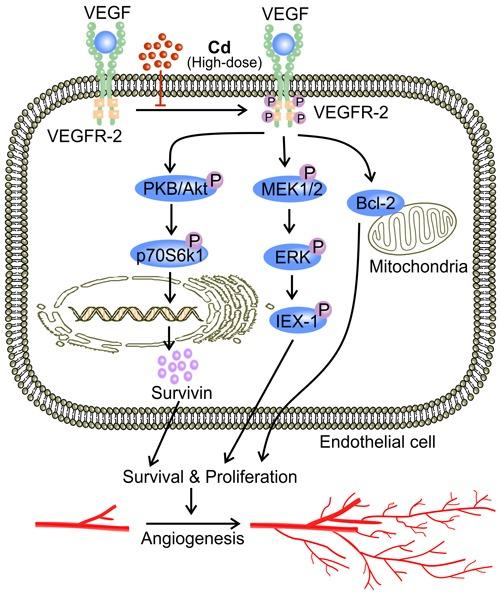
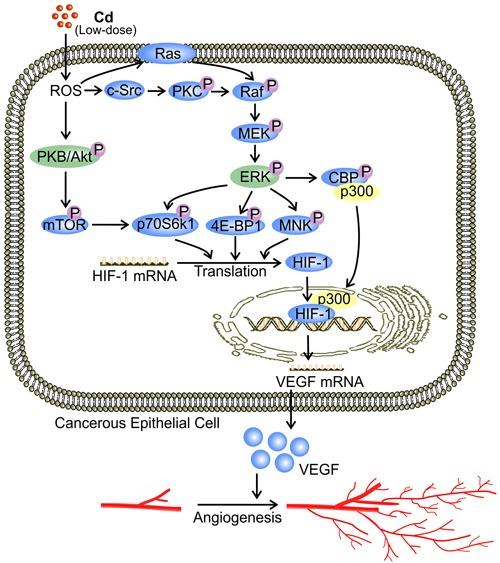
Angiogenesis is crucial for tumor growth and metastasis. Cadmium (Cd) exposure is associated with elevated cancer risk and mortality. Such association is, at least in part, attributable to Cd-induced tumor angiogenesis. Nevertheless, the reported effects of Cd on tumor angiogenesis appear to be either stimulatory or inhibitory, depending on the concentrations. Ultra-low concentrations of Cd (<0.5 μM) inhibit endothelial nitric oxide synthase activation, leading to reduced endothelial nitric oxide production and attenuated tumor angiogenesis. In contrast, low-lose Cd (1-10 μM) up-regulates vascular endothelial growth factor (VEGF)-mediated tumor angiogenesis by exerting sub-apoptotic levels of oxidative stress on both tumor cells and endothelial cells (ECs). The consequent activation of protein kinase B/Akt, nuclear factor-κB, and mitogen-activated protein kinase signaling cascades mediate the increased secretion of VEGF by tumor cells and the up-regulated VEGF receptor-2 expression in ECs. Furthermore, Cd in high concentrations (>10 μM) induces EC apoptosis via the activation of caspase-3, resulting in destruction of tumor vasculature. In this review, we summarize the current knowledge concerning the roles of Cd in tumor angiogenesis, with a focus on molecular mechanisms underlying the dose dependent effects of Cd on various EC phenotypes.
血管生成对肿瘤生长和转移至关重要。镉(Cd)暴露与癌症风险和死亡率升高有关。这种关联至少部分归因于镉诱导的肿瘤血管生成。然而,报道的镉对肿瘤血管生成的影响似乎取决于浓度,要么是刺激作用,要么是抑制作用。超低浓度的镉(<0.5μM)抑制内皮型一氧化氮合酶的激活,导致内皮一氧化氮生成减少和肿瘤血管生成减弱。相反,低剂量镉(1-10μM)通过对肿瘤细胞和内皮细胞(ECs)施加亚凋亡水平的氧化应激,上调血管内皮生长因子(VEGF)介导的肿瘤血管生成。由此激活的蛋白激酶B/Akt、核因子-κB和丝裂原活化蛋白激酶信号级联反应介导肿瘤细胞VEGF分泌增加以及ECs中VEGF受体-2表达上调。此外,高浓度(>10μM)的镉通过激活caspase-3诱导EC凋亡,导致肿瘤脉管系统破坏。在本综述中,我们总结了关于镉在肿瘤血管生成中作用的当前知识,重点关注镉对各种EC表型剂量依赖性影响的分子机制。



 Zotero 插件