
血小板与淋巴细胞比值升高与接受手术切除及发生转移的结直肠癌患者较差的临床特征和长期生存率密切相关:一项纳入24项研究的最新系统评价和Meta分析
Increased platelet-lymphocyte ratio closely relates to inferior clinical features and worse long-term survival in both resected and metastatic colorectal cancer: an updated systematic review and meta-analysis of 24 studies.
作者信息
Chen Nan, Li Wanling, Huang Kexin, Yang Wenhao, Huang Lin, Cong Tianxin, Li Qingfang, Qiu Meng
机构信息
West China School of Medicine/West China Hospital, Sichuan University, Chengdu, China.
Department of Medical Oncology, Cancer Center, the State Key Laboratory of Biotherapy, West China Hospital, Sichuan University, Chengdu, Sichuan, China.
出版信息
Oncotarget. 2017 May 9;8(19):32356-32369. doi: 10.18632/oncotarget.16020.
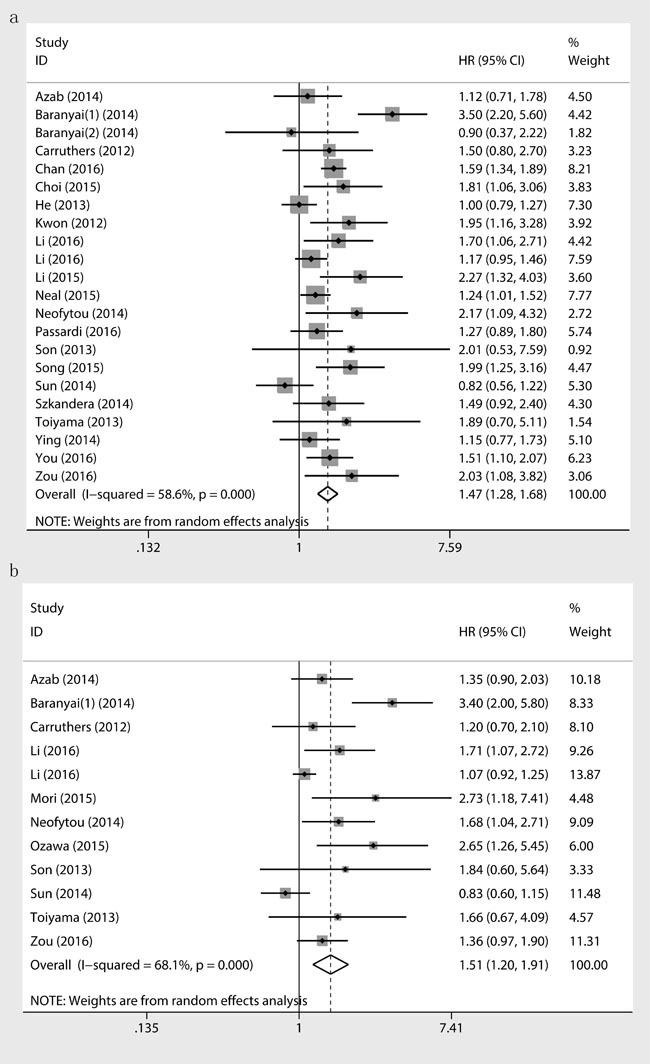
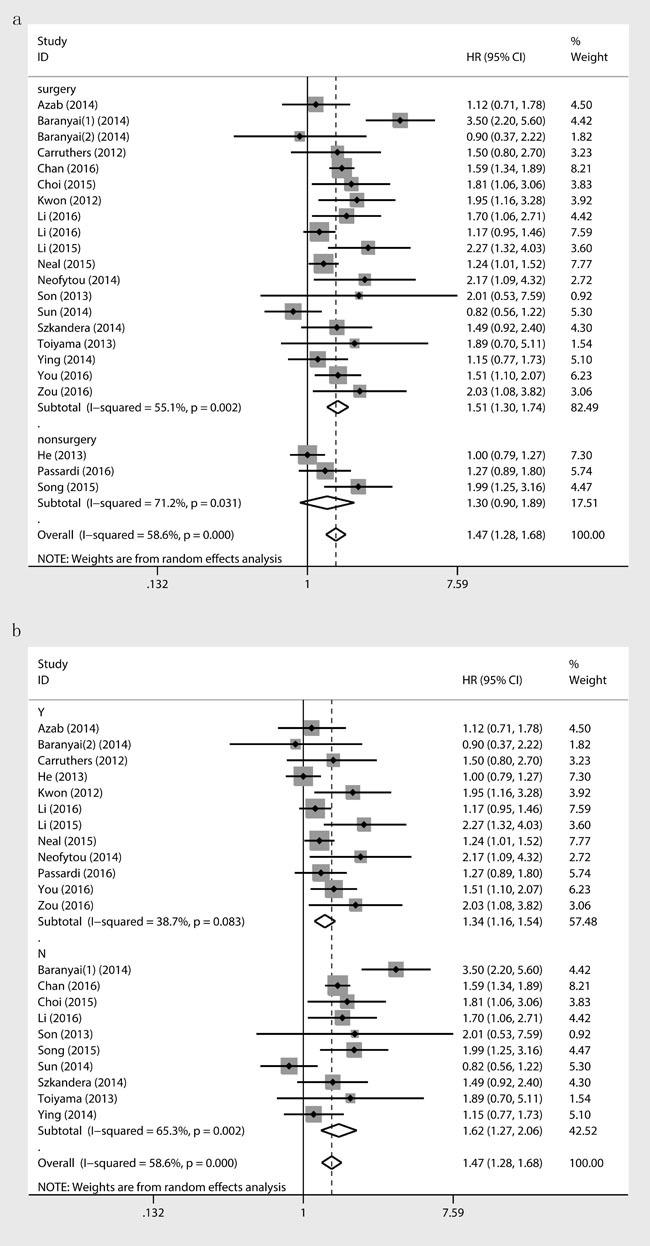
Colorectal cancer (CRC) is one of the most common cancers worldwide. However, the prognostic and clinical value of platelet-lymphocyte ratio (PLR) in colorectal cancer was still unclear, which attracted more and more researchers' considerable attention. We performed a systematic review and meta-analysis to investigate the relationship between PLR and survival as well as clinical features of CRC update to September 2016. The hazard ratio (HR) or odds ratio (OR) with 95% confidence interval (CI) were calculated to access the association. We included 24 eligible studies with a total of 13719 patients. Elevated PLR predicted shorter overall survival (OS) (HR=1.47; 95%CI, 1.28-1.68; p<0.001), poorer disease-free survival (DFS) (HR=1.51; 95% CI, 1.2-1.91; p=0.001), and worse recurrence-free survival (RFS) (HR=1.39; 95% CI, 1.03-1.86; p=0.03), but had nothing to do with Cancer-specific survival (CSS) (HR=1.14; 95% CI, 0.92-1.42; p=0.223). After trim and fill method, the connection between PLR and DFS disappeared (HR=1.143; 95%CI, 0.903-1.447; p=0.267). By subgroup analyze, we found that increased PLR predicated a worse OS and DFS in patients who underwent surgery, and this prognostic role also shown both in metastatic and nonmetastatic patients. In addition, elevated PLR was associated with poorly differentiated tumor (OR=1.51; 95% CI, 1.26-1.81; p<0.001), higher tumor stage (OR=1.25; 95% CI, 1.05-1.49; p=0.012), lymphovascular invasion (LVI) (OR=1.25; 95% CI, 1.09-1.43; p=0.001), and the recurrence of CRC (OR=2.78; 95% CI, 1.36-5.68; p=0.005). We indicated that pretreatment PLR was a good prognostic marker for CRC patients. High PLR was related to worse OS, RFS and poor clinical characteristics.
结直肠癌(CRC)是全球最常见的癌症之一。然而,血小板淋巴细胞比值(PLR)在结直肠癌中的预后及临床价值仍不明确,这引起了越来越多研究者的广泛关注。我们进行了一项系统评价和荟萃分析,以研究截至2016年9月PLR与结直肠癌患者生存率及临床特征之间的关系。计算风险比(HR)或比值比(OR)及其95%置信区间(CI)来评估相关性。我们纳入了24项符合条件的研究,共13719例患者。PLR升高预示着总生存期(OS)缩短(HR=1.47;95%CI,1.28 - 1.68;p<0.001)、无病生存期(DFS)较差(HR=1.51;95%CI,1.2 - 1.91;p=0.001)以及无复发生存期(RFS)更差(HR=1.39;95%CI,1.03 - 1.86;p=0.03),但与癌症特异性生存期(CSS)无关(HR=1.14;95%CI,0.92 - 1.42;p=0.223)。采用剪补法后,PLR与DFS之间的关联消失(HR=1.143;95%CI,0.903 - 1.447;p=0.267)。通过亚组分析,我们发现PLR升高预示着接受手术患者的OS和DFS更差,并且这种预后作用在转移性和非转移性患者中均有体现。此外,PLR升高与肿瘤低分化(OR=1.51;95%CI,1.26 - 1.81;p<0.001)、更高的肿瘤分期(OR=1.25;95%CI,1.05 - 1.49;p=0.012)、淋巴管侵犯(LVI)(OR=1.25;95%CI,1.09 - 1.43;p=0.001)以及结直肠癌复发(OR=2.78;95%CI,1.36 - 5.68;p=0.005)相关。我们指出,治疗前PLR是结直肠癌患者良好的预后标志物。高PLR与更差的OS、RFS以及不良临床特征相关。



 Zotero 插件