
持续表皮生长因子受体(EGFR)抑制的疗效以及刺猬信号通路(Hedgehog)在具有EGFR激活突变的人肺癌细胞EGFR获得性耐药中的作用
Efficacy of continuous EGFR-inhibition and role of Hedgehog in EGFR acquired resistance in human lung cancer cells with activating mutation of EGFR.
作者信息
Della Corte Carminia Maria, Malapelle Umberto, Vigliar Elena, Pepe Francesco, Troncone Giancarlo, Ciaramella Vincenza, Troiani Teresa, Martinelli Erika, Belli Valentina, Ciardiello Fortunato, Morgillo Floriana
机构信息
Oncologia Medica, Dipartimento Medico-Chirurgico di Internistica Clinica e Sperimentale "F. Magrassi e A. Lanzara," Università degli studi della Campania "Luigi Vanvitelli", Naples, Italy.
Dipartimento di Sanità Pubblica, Università degli Studi di Napoli Federico II, Naples, Italy.
出版信息
Oncotarget. 2017 Apr 4;8(14):23020-23032. doi: 10.18632/oncotarget.15479.
PURPOSE
The aim of this work was to investigate the efficacy of sequential treatment with first-, second- and third-generation epidermal growth factor receptor (EGFR) tyrosine kinase inhibitors and the mechanisms of acquired resistance occurring during the sequential use of these inhibitors.
EXPERIMENTAL DESIGN
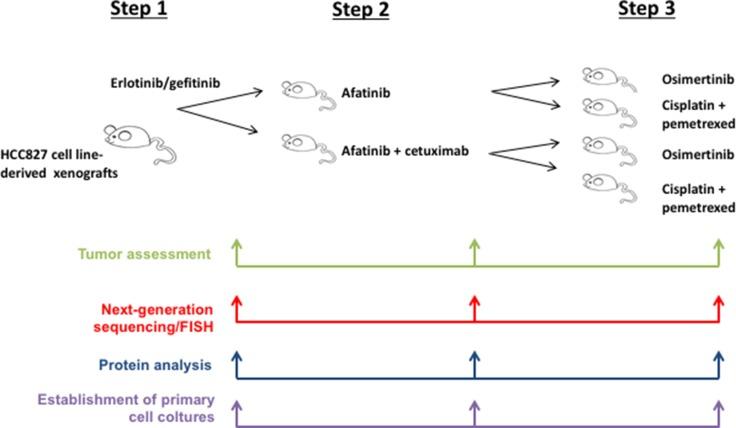
We developed an in vivo model of acquired resistance to EGFR-inhibitors by treating nude mice xenografted with HCC827, a human non-small-cell lung cancer (NSCLC) cell line harboring EGFR activating mutation, with a sequence of first-generation EGFR tyrosine kinase inhibitors (EGFR-TKIs) (erlotinib and gefitinib), of second-generation EGFR-TKI (afatinib) plus/minus the anti-EGFR monoclonal antibody cetuximab, and of third-generation EGFR-TKI (osimertinib).
RESULTS
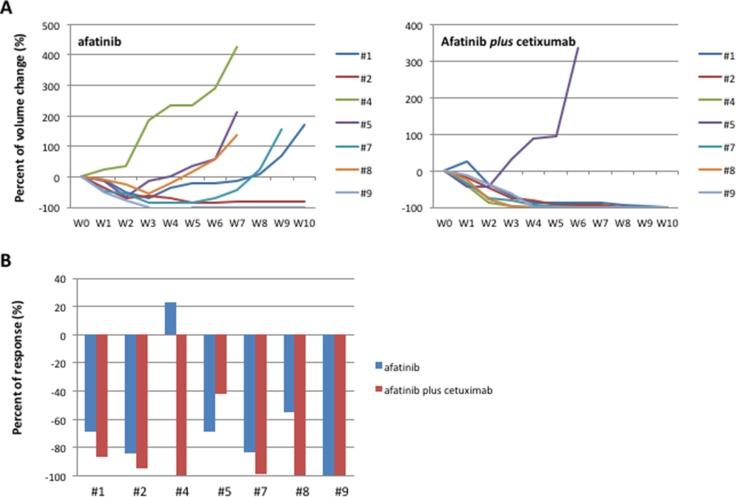
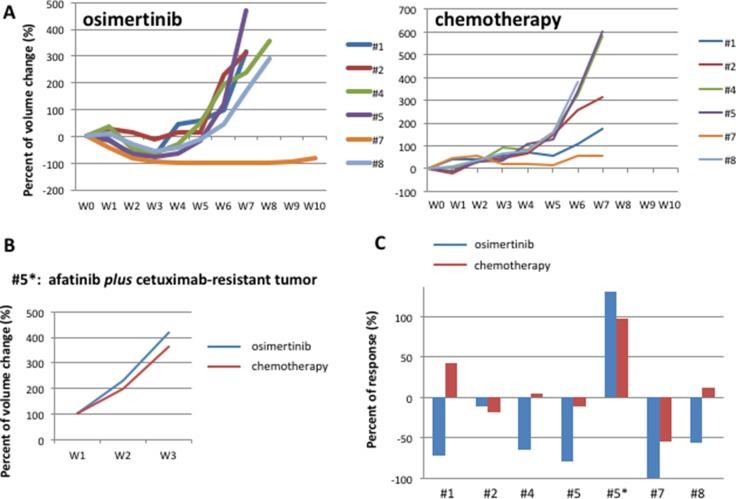
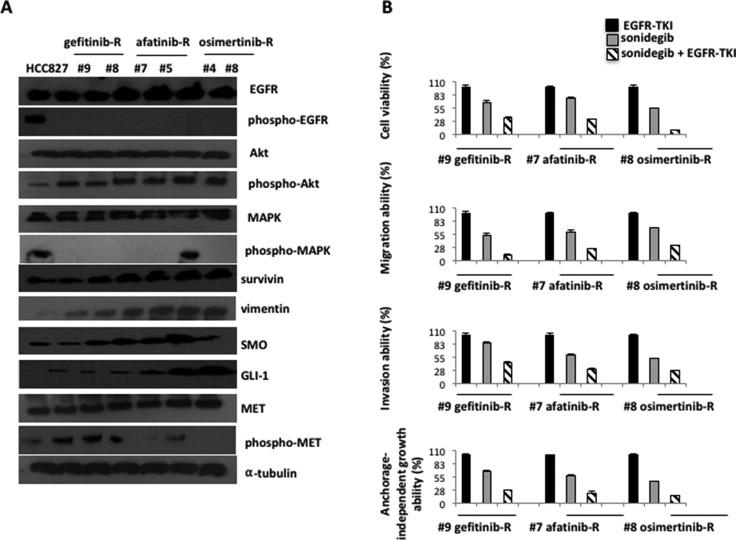
HCC827-derived xenografts and with acquired resistance to EGFR-inhibitors were sensitive to the sequential use of first-, second- and third-generation EGFR-TKIs. Continuous EGFR inhibition of first-generation resistant tumors by sequential treatment with afatinib plus/minus cetuximab, followed by osimertinib, represented an effective therapeutic strategy in this model. Whereas T790M resistance mutation was not detected, a major mechanism of acquired resistance was the activation of components of the Hedgehog (Hh) pathway. This phenomenon was accompanied by epithelial-to-mesenchymal transition. Cell lines established in vitro from gefitinib-, or afatinib- or osimertinib-resistant tumors showed metastatic properties and maintained EGFR-TKIs resistance in vitro, that was reverted by the combined blockade of Hh, with the selective SMO inhibitor sonidegib, and EGFR.
CONCLUSIONS
EGFR-mutant NSCLC can benefit from continuous treatment with EGFR-inhibitors, indepenently from mechanisms of resistance. In a complex and heterogenous scenario, Hh showed an important role in mediating resistance to EGFR-inhibitors through the induction of mesenchymal properties.
目的
本研究旨在探讨第一代、第二代和第三代表皮生长因子受体(EGFR)酪氨酸激酶抑制剂序贯治疗的疗效,以及在这些抑制剂序贯使用过程中获得性耐药的机制。
实验设计
我们通过对移植了HCC827(一种携带EGFR激活突变的人非小细胞肺癌(NSCLC)细胞系)的裸鼠,依次给予第一代EGFR酪氨酸激酶抑制剂(EGFR-TKIs)(厄洛替尼和吉非替尼)、第二代EGFR-TKI(阿法替尼)加/减抗EGFR单克隆抗体西妥昔单抗以及第三代EGFR-TKI(奥希替尼),建立了一种对EGFR抑制剂获得性耐药的体内模型。
结果
源自HCC827的异种移植瘤以及对EGFR抑制剂获得性耐药的肿瘤,对第一代、第二代和第三代EGFR-TKIs的序贯使用敏感。在该模型中,先用阿法替尼加/减西妥昔单抗序贯治疗,然后用奥希替尼持续抑制第一代耐药肿瘤的EGFR,是一种有效的治疗策略。虽然未检测到T790M耐药突变,但获得性耐药的主要机制是刺猬信号(Hh)通路成分的激活。这种现象伴随着上皮-间质转化。从吉非替尼、阿法替尼或奥希替尼耐药肿瘤体外建立的细胞系具有转移特性,并在体外维持EGFR-TKIs耐药性,而通过联合使用选择性SMO抑制剂索尼德吉阻断Hh和EGFR可逆转这种耐药性。
结论
EGFR突变的NSCLC可从EGFR抑制剂的持续治疗中获益,而与耐药机制无关。在复杂且异质性的情况下,Hh通过诱导间质特性在介导对EGFR抑制剂的耐药中发挥重要作用。



 Zotero 插件