
MTA1促进非小细胞肺癌中的上皮-间质转化和转移。
MTA1 promotes epithelial to mesenchymal transition and metastasis in non-small-cell lung cancer.
作者信息
Ma Ke, Fan Yangwei, Dong Xuyuan, Dong Danfeng, Guo Yuyan, Wei Xin, Ning Jing, Geng Qianqian, Wang Chuying, Hu Yuan, Li Mengya, Niu Wenxia, Li Enxiao, Wu Yinying
机构信息
Department of Medical Oncology, The First Affiliated Hospital of Xi'an Jiaotong University, Xi'an, Shaanxi 710061, P.R. China.
Department of Medical Radiation Oncology, The First Affiliated Hospital of Xi'an Jiaotong University, Xi'an, Shaanxi 710061, P.R. China.
出版信息
Oncotarget. 2017 Jun 13;8(24):38825-38840. doi: 10.18632/oncotarget.16404.
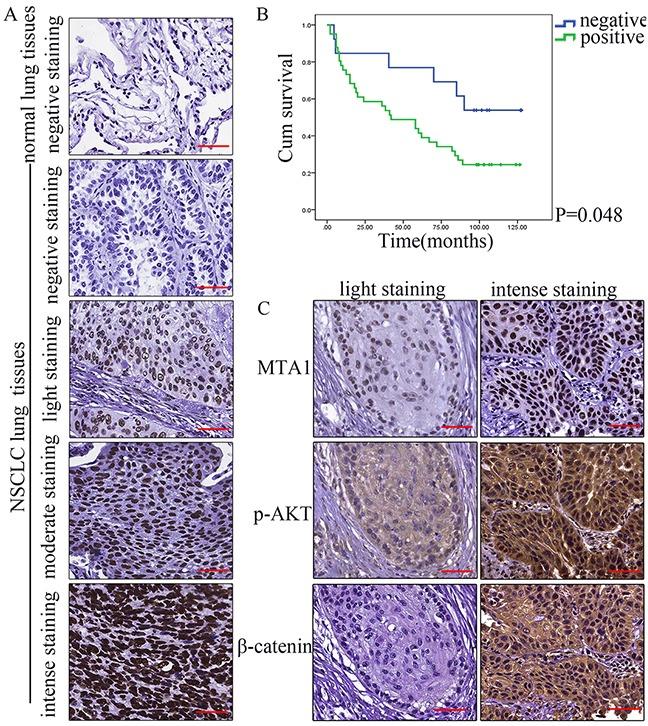
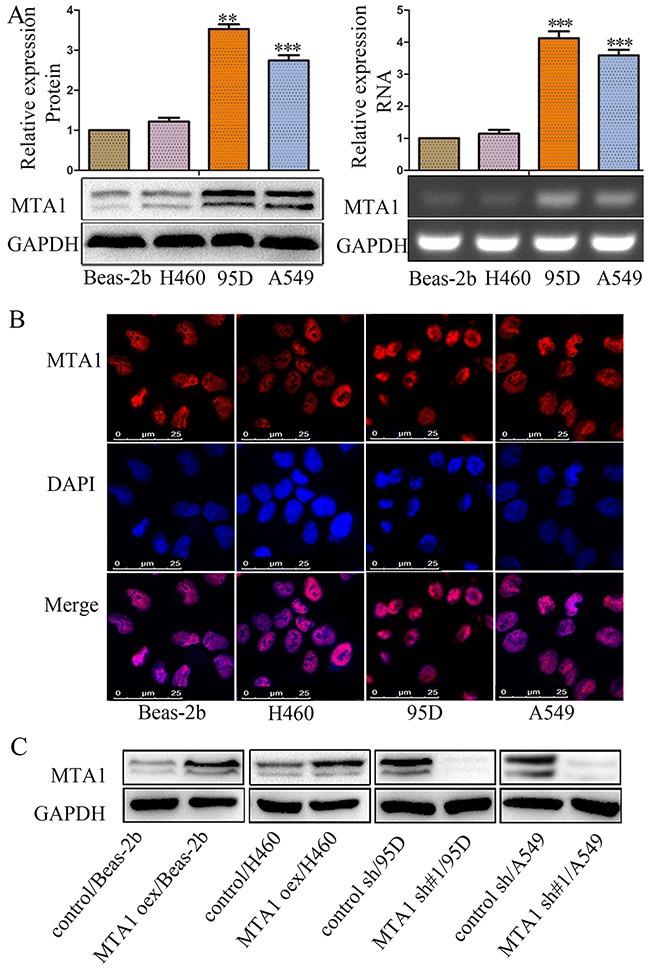
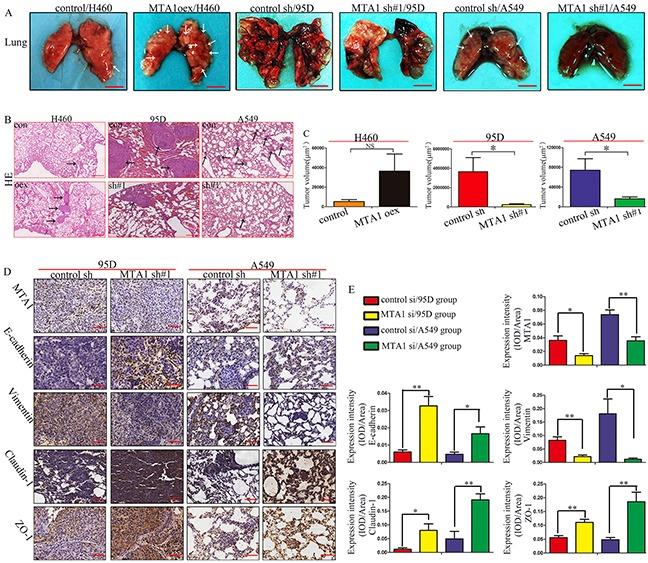
The present study assessed the role of metastasis-associated protein 1 (MTA1) in epithelial to mesenchymal transition (EMT) and metastasis in non-small-cell lung cancer (NSCLC) cells using a normal lung epithelium cell line, three NSCLC cell lines, a mouse NSCLC model, and 56 clinical NSCLC samples. We observed that MTA1 overexpression decreased cellular adhesion, promoted migration and invasion, and changed cytoskeletal polarity. MTA1 knockdown had the opposite effects. MTA1 overexpression decreased E-cadherin, Claudin-1, and ZO-1 levels and increased Vimentin expression in vitro and in vivo, through activation of AKT/GSK3β/β-catenin signaling. However, treatment with the AKT inhibitor MK2206 did not completely rescue effects associated with MTA1 expression changes, indicating that pathways other than the AKT/GSK3β/β-catenin pathway could be involved in MTA1-induced EMT. Compared with normal lung tissues, MTA1 expression was elevated in NSCLC patient tissues and was correlated with American Joint Committee on Cancer stage, T stage, lymphatic metastasis, and patient overall survival. Additionally, MTA1 expression was positively associated with p-AKT and cytoplasmic β-catenin levels. These findings indicate MTA1 promotes NSCLC cell EMT and metastasis via AKT/GSK3β/β-catenin signaling, which suggests MTA1 may be an effective anti-NSCLC therapeutic target.
本研究使用一种正常肺上皮细胞系、三种非小细胞肺癌(NSCLC)细胞系、一个小鼠NSCLC模型以及56份临床NSCLC样本,评估了转移相关蛋白1(MTA1)在NSCLC细胞上皮-间质转化(EMT)及转移中的作用。我们观察到,MTA1过表达降低了细胞黏附性,促进了迁移和侵袭,并改变了细胞骨架极性。敲低MTA1则产生相反的效果。在体外和体内,MTA1过表达通过激活AKT/GSK3β/β-连环蛋白信号通路,降低了E-钙黏蛋白、Claudin-1和ZO-1的水平,并增加了波形蛋白的表达。然而,用AKT抑制剂MK2206处理并不能完全挽救与MTA1表达变化相关的效应,这表明除AKT/GSK3β/β-连环蛋白通路外的其他通路可能参与了MTA1诱导的EMT。与正常肺组织相比,MTA1在NSCLC患者组织中的表达升高,且与美国癌症联合委员会分期、T分期、淋巴转移及患者总生存期相关。此外,MTA1表达与p-AKT和细胞质β-连环蛋白水平呈正相关。这些发现表明,MTA1通过AKT/GSK3β/β-连环蛋白信号通路促进NSCLC细胞的EMT和转移,这提示MTA1可能是一个有效的抗NSCLC治疗靶点。




 Zotero 插件