
肌醇多磷酸多激酶通过稳定 TRAF6 促进 Toll 样受体诱导的炎症反应。
Inositol polyphosphate multikinase promotes Toll-like receptor-induced inflammation by stabilizing TRAF6.
机构信息
Department of Biological Sciences, Korea Advanced Institute of Science and Technology (KAIST), Daejeon 34141, Korea.
School of Biological Sciences and Institute for Molecular Biology and Genetics, Seoul National University, Seoul 08826, Korea.
出版信息
Sci Adv. 2017 Apr 21;3(4):e1602296. doi: 10.1126/sciadv.1602296. eCollection 2017 Apr.
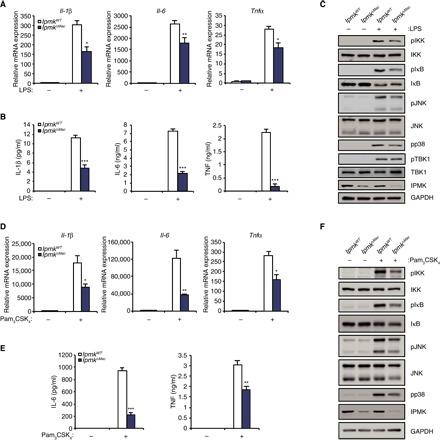
Toll-like receptor (TLR) signaling is tightly controlled to protect hosts from microorganisms while simultaneously preventing uncontrolled immune responses. Tumor necrosis factor receptor-associated factor 6 (TRAF6) is a critical mediator of TLR signaling, but the precise mechanism of how TRAF6 protein stability is strictly controlled still remains obscure. We show that myeloid-specific deletion of inositol polyphosphate multikinase (IPMK), which has both inositol polyphosphate kinase activities and noncatalytic signaling functions, protects mice against polymicrobial sepsis and lipopolysaccharide-induced systemic inflammation. IPMK depletion in macrophages results in decreased levels of TRAF6 protein, thereby dampening TLR-induced signaling and proinflammatory cytokine production. Mechanistically, the regulatory role of IPMK is independent of its catalytic function, instead reflecting its direct binding to TRAF6. This interaction stabilizes TRAF6 by blocking its K48-linked ubiquitination and subsequent degradation by the proteasome. Thus, these findings identify IPMK as a key determinant of TRAF6 stability and elucidate the physiological function of IPMK in TLR-induced innate immunity.
Toll 样受体 (TLR) 信号受到严格控制,以保护宿主免受微生物侵害,同时防止免疫反应失控。肿瘤坏死因子受体相关因子 6 (TRAF6) 是 TLR 信号的关键介质,但 TRAF6 蛋白稳定性如何受到严格控制的精确机制仍不清楚。我们发现,肌样细胞特异性缺失肌醇多磷酸激酶 (IPMK)(具有肌醇多磷酸激酶活性和非催化信号功能)可保护小鼠免受多微生物脓毒症和脂多糖诱导的全身炎症。巨噬细胞中 IPMK 的缺失导致 TRAF6 蛋白水平降低,从而抑制 TLR 诱导的信号转导和促炎细胞因子的产生。从机制上讲,IPMK 的调节作用与其催化功能无关,而是反映了其与 TRAF6 的直接结合。这种相互作用通过阻止 TRAF6 的 K48 连接泛素化及其随后被蛋白酶体降解来稳定 TRAF6。因此,这些发现确定了 IPMK 是 TRAF6 稳定性的关键决定因素,并阐明了 IPMK 在 TLR 诱导的先天免疫中的生理功能。




 Zotero 插件