
烯醇化酶的完整分子与免疫保护特性分析
Complete Molecular and Immunoprotective Characterization of Enolase.
作者信息
Liu Xiangye, Zheng Chen, Gao Xiaoge, Chen Jiaxu, Zheng Kuiyang
机构信息
Jiangsu Province Key Laboratory of Immunity and Metabolism, Department of Pathogenic Biology and Immunology, Xuzhou Medical UniversityXuzhou, China.
Jiangsu Center for the Collaboration and Innovation of Cancer Biotherapy, Cancer Institute, Xuzhou Medical UniversityXuzhou, China.
出版信息
Front Microbiol. 2017 Apr 11;8:622. doi: 10.3389/fmicb.2017.00622. eCollection 2017.
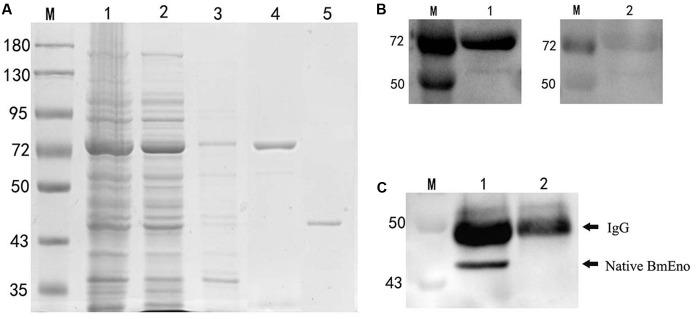
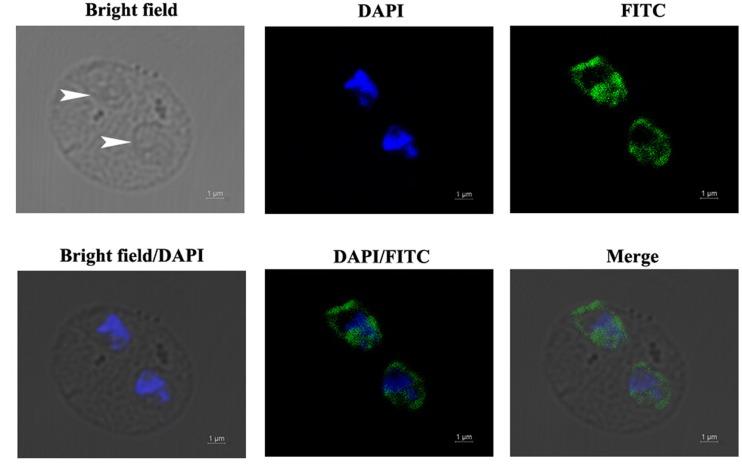
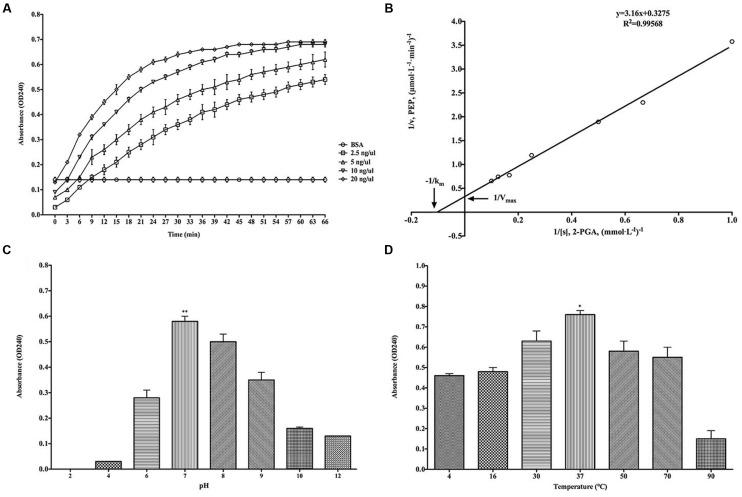
The apicomplexan is the primary causative agent of human babesiosis, one of the most broadly distributed tick-borne diseases worldwide. undergoes a complex lifecycle within both the mammalian host and the tick vector, and employs several different specific molecular mechanisms to enter host cells. Enolase, the key glycolytic enzyme in intracellular glucose metabolism, can also be expressed on the parasite's outer surface, binds to human plasminogen, and coordinates apicomplexan parasite invasion of host cells, however, it lacks sorting sequences or lipoprotein anchor sites. In the present study, we isolated the coding gene of enolase (BmEno), expressed it within and purified the recombinant BmEno protein (rBmEno). Consequently, we confirmed cytoplasmic and surface localization of BmEno via immunofluorescence, and demonstrated that rBmEno catalyzes the dehydration of 2-phospho-D-glycerate to phosphoenolpyruvate. Moreover, our results showed that rBmEno binds to human plasminogen, and that the lysine analog ε-aminocaproic acid significantly inhibited this binding. Furthermore plasminogen bound to rBmEno converts to active plasmin. Additionally, actively immunizing mice with rBmEno could evoke a partial protective immunity against infection following challenge. In conclusion, enolase is a multifunctional cytoplasmic protein which is also expressed at the parasitic outer surface, facilitates binding to host plasminogen, and could partially protect hosts against parasite infection.
顶复门原虫是人类巴贝斯虫病的主要病原体,巴贝斯虫病是全球分布最广泛的蜱传疾病之一。它在哺乳动物宿主和蜱载体中经历复杂的生命周期,并采用几种不同的特定分子机制进入宿主细胞。烯醇化酶是细胞内葡萄糖代谢中的关键糖酵解酶,也可在寄生虫外表面表达,与人类纤溶酶原结合,并协同顶复门寄生虫对宿主细胞的入侵,然而,它缺乏分选序列或脂蛋白锚定位点。在本研究中,我们分离了烯醇化酶(BmEno)的编码基因,在体内表达并纯化了重组BmEno蛋白(rBmEno)。因此,我们通过免疫荧光证实了BmEno的细胞质和表面定位,并证明rBmEno催化2-磷酸-D-甘油酸脱水生成磷酸烯醇丙酮酸。此外,我们的结果表明rBmEno与人类纤溶酶原结合,赖氨酸类似物ε-氨基己酸显著抑制这种结合。此外,与rBmEno结合的纤溶酶原转化为活性纤溶酶。另外,用rBmEno主动免疫小鼠可在攻毒后诱发针对感染的部分保护性免疫。总之,烯醇化酶是一种多功能细胞质蛋白,也在寄生虫外表面表达,促进与宿主纤溶酶原的结合,并可部分保护宿主免受寄生虫感染。



 Zotero 插件