
土壤酸化加剧中国南方青枯病的发生。
Soil Acidification Aggravates the Occurrence of Bacterial Wilt in South China.
作者信息
Li Shili, Liu Yongqin, Wang Jiao, Yang Liang, Zhang Shuting, Xu Chen, Ding Wei
机构信息
Laboratory of Natural Products Pesticides, Southwest UniversityChongqing, China.
Chongqing Tobacco Science Research InstituteChongqing, China.
出版信息
Front Microbiol. 2017 Apr 25;8:703. doi: 10.3389/fmicb.2017.00703. eCollection 2017.
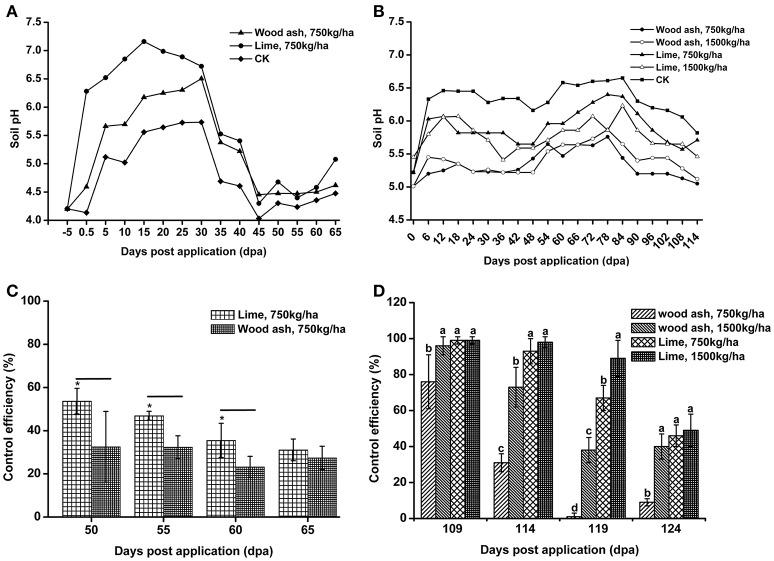
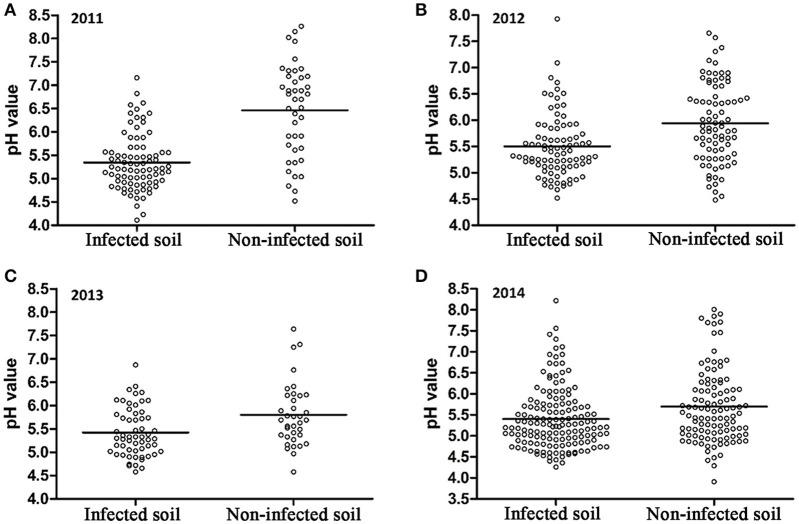
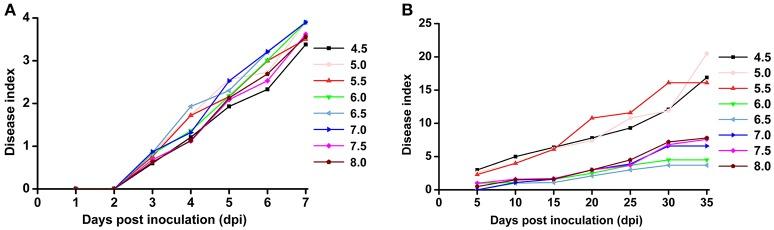
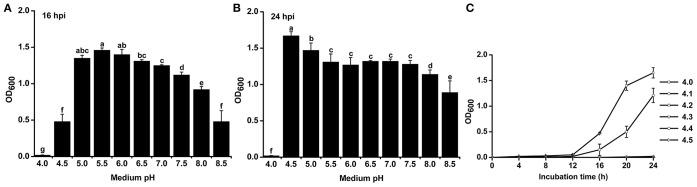
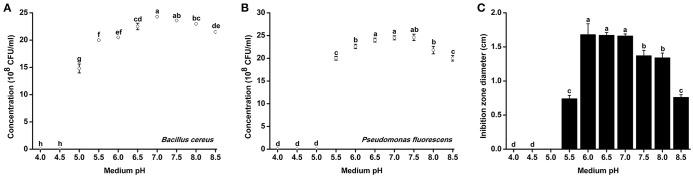
Soil acidification is a major problem in modern agricultural systems and is an important factor affecting the soil microbial community and soil health. However, little is known about the effect of soil acidification on soil-borne plant diseases. We performed a 4-year investigation in South China to evaluate the correlation between soil acidification and the occurrence of bacterial wilt. The results showed that the average soil pH in fields infected by bacterial wilt disease was much lower than that in non-disease fields. Moreover, the proportion of infected soils with pH lower than 5.5 was much higher than that of non-infected soils, and this phenomenon became more obvious as the area of bacterial wilt disease increased at soil pH lower than 5.5 from 2011 to 2014. Then, in a field pot experiment, bacterial wilt disease developed more quickly and severely in acidic conditions of pH 4.5, 5.0, and 5.5. These results indicate that soil acidification can cause the outbreak of bacterial wilt disease. Further experiments showed that acidic conditions (pH 4.5-5.5) favored the growth of the pathogen but suppressed the growth and antagonistic activity of antagonistic bacteria of and . Moreover, acidic conditions of pH 5.5 were conducive to the expression of the virulence genes , and but restrained resistance gene expression in tobacco. Finally, application of wood ash and lime as soil pH amendments improved soil pH and reduced the occurrence of bacterial wilt. Together, these findings improve our understanding of the correlation between soil acidification and soil-borne plant diseases and also suggest that regulation of soil acidification is the precondition and foundation of controlling bacterial wilt.
土壤酸化是现代农业系统中的一个主要问题,是影响土壤微生物群落和土壤健康的重要因素。然而,关于土壤酸化对土传植物病害的影响知之甚少。我们在中国南方进行了为期4年的调查,以评估土壤酸化与青枯病发生之间的相关性。结果表明,感染青枯病的田块土壤平均pH值远低于未发病田块。此外,pH值低于5.5的感染土壤比例远高于未感染土壤,并且随着2011年至2014年土壤pH值低于5.5时青枯病发病面积的增加,这种现象变得更加明显。然后,在田间盆栽试验中,在pH值为4.5、5.0和5.5的酸性条件下,青枯病发展得更快且更严重。这些结果表明土壤酸化会导致青枯病的爆发。进一步的实验表明,酸性条件(pH值4.5 - 5.5)有利于病原菌的生长,但抑制了拮抗菌和的生长及拮抗活性。此外,pH值为5.5的酸性条件有利于毒力基因和的表达,但抑制了烟草中抗性基因的表达。最后,施用木灰和石灰作为土壤pH调节剂提高了土壤pH值并减少了青枯病的发生。总之,这些发现增进了我们对土壤酸化与土传植物病害之间相关性的理解,也表明调节土壤酸化是控制青枯病的前提和基础。



 Zotero 插件