
BRCA1-IRIS在埃及三阴性乳腺癌发生发展中的作用:与疾病早期病变的可能联系
The role of BRCA1-IRIS in the development and progression of triple negative breast cancers in Egypt: possible link to disease early lesion.
作者信息
Bogan Danielle, Meile Lucio, El Bastawisy Ahmed, Yousef Hend F, Zekri Abdel-Rahman N, Bahnassy Abeer A, ElShamy Wael M
机构信息
Cancer Institute, University of Mississippi Medical Center, 2500 N. State Street, Jackson, MS, 39216, USA.
Department of Genetics, Louisiana State University, Louisiana, USA.
出版信息
BMC Cancer. 2017 May 12;17(1):329. doi: 10.1186/s12885-017-3283-8.
BACKGROUND
Breast cancer is the most globally diagnosed female cancer, with the triple negative breast cancer (TNBC) being the most aggressive subtype of the disease. In this study we aimed at comparing the effect of BRCA1-IRIS overexpression on the clinico-pathological characteristics in breast cancer patients with TNBC or non-TNBC in the largest comprehensive cancer center in Egypt.
METHODS
To reach this goal, we conducted an observational study at the National Cancer Institute (NCI), Cairo University (Cairo, Egypt). The data on all diagnosed breast cancer patients, between 2009 and 2012, were reviewed. BRCA1-IRIS expression measured using real time RT/PCR in these patients' tumor samples was correlated to tumor characteristics, such as to clinico-pathological features, therapeutic responses, and survival outcomes.
RESULTS
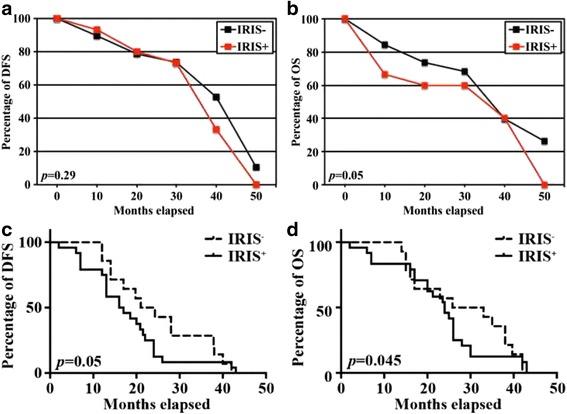
96 patients were enrolled and of these 45% were TNBC, and 55% were of other subtypes (hereafter, non-TNBC). All patients presented with invasive ductal carcinomas. No significant difference was observed for risk factors, such as age and menopausal status between the TNBC and the non-TNBC groups except after BRCA1-IRIS expression was factored in. The majority of the tumors in both groups were ≤5 cm at surgery (p = 0.013). However, in the TNBC group, ≤5 cm tumors were BRCA1-IRIS-overexpressing, whereas in the non-TNBC group they were BRCA1-IRIS-negative (p = 0.00007). Most of the TNBC patients diagnosed with grade 1 or 2 were BRCA1-IRIS-overexpressing, whereas non-TNBCs were IRIS-negative (p = 0.00035). No statistical significance was measured in patients diagnosed with grade 3 tumors. Statistically significant difference between TNBCs and non-TNBCs and tumor stage with regard to BRCA1-IRIS-overexpression was observed. Presence of axillary lymph node metastases was positively associated with BRCA1-IRIS overexpression in TNBC group, and with BRCA1-IRIS-negative status in the non-TNBC group (p = 0.00009). Relapse after chemotherapy (p < 0.00001), and local recurrence/distant metastasis after surgery (p = 0.0028) were more pronounced in TNBC patients with BRCA1-IRIS-overexpressing tumors compared to non-TNBC patients. Finally, decreased disease-free survival in TNBC/BRCA1-IRIS-overexpressing patients compared to TNBC/BRCA1-IRIS-negative patients, and decreased overall survival in TNBC as well as non-TNBC patients was driven by BRCA1-IRIS overexpression.
CONCLUSIONS
TNBC/BRCA1-IRIS-overexpressing tumors are more aggressive than TNBC/BRCA1-IRIS-negative or non-TNBC/BRCA1-IRIS-overexpressing or both negative tumors. Further studies are warranted to define whether BRCA1-IRIS drives the early TNBC lesions growth and dissemination and whether it could be used as a diagnostic biomarker and/or therapeutic target for these lesions at an early stage setting.
背景
乳腺癌是全球诊断出的最常见的女性癌症,三阴性乳腺癌(TNBC)是该疾病中最具侵袭性的亚型。在本研究中,我们旨在比较在埃及最大的综合癌症中心中,BRCA1-IRIS过表达对TNBC或非TNBC乳腺癌患者临床病理特征的影响。
方法
为实现这一目标,我们在开罗大学国家癌症研究所(埃及开罗)进行了一项观察性研究。回顾了2009年至2012年间所有确诊乳腺癌患者的数据。在这些患者的肿瘤样本中,使用实时RT/PCR测量的BRCA1-IRIS表达与肿瘤特征相关,如临床病理特征、治疗反应和生存结果。
结果
共纳入96例患者,其中45%为TNBC,55%为其他亚型(以下简称非TNBC)。所有患者均为浸润性导管癌。除考虑BRCA1-IRIS表达外,TNBC组和非TNBC组在年龄和绝经状态等危险因素方面未观察到显著差异。两组中大多数肿瘤在手术时≤5 cm(p = 0.013)。然而,在TNBC组中,≤5 cm的肿瘤为BRCA1-IRIS过表达,而在非TNBC组中它们为BRCA1-IRIS阴性(p = 0.00007)。大多数诊断为1级或2级的TNBC患者为BRCA1-IRIS过表达,而非TNBC患者为IRIS阴性(p = 0.00035)。在诊断为3级肿瘤的患者中未测得统计学意义。观察到TNBC和非TNBC在BRCA1-IRIS过表达方面与肿瘤分期存在统计学显著差异。腋窝淋巴结转移的存在与TNBC组中BRCA1-IRIS过表达呈正相关,与非TNBC组中BRCA1-IRIS阴性状态呈正相关(p = 0.00009)。与非TNBC患者相比,BRCA1-IRIS过表达肿瘤的TNBC患者化疗后复发(p < 0.00001)以及手术后局部复发/远处转移(p = 0.0028)更为明显。最后,与TNBC/BRCA1-IRIS阴性患者相比,TNBC/BRCA1-IRIS过表达患者的无病生存期降低,并且TNBC以及非TNBC患者的总生存期降低是由BRCA1-IRIS过表达驱动的。
结论
TNBC/BRCA1-IRIS过表达肿瘤比TNBC/BRCA1-IRIS阴性或非TNBC/BRCA1-IRIS过表达或两者均为阴性的肿瘤更具侵袭性。有必要进一步研究以确定BRCA1-IRIS是否驱动早期TNBC病变的生长和扩散,以及它是否可在早期阶段用作这些病变的诊断生物标志物和/或治疗靶点。
 Zotero 插件